
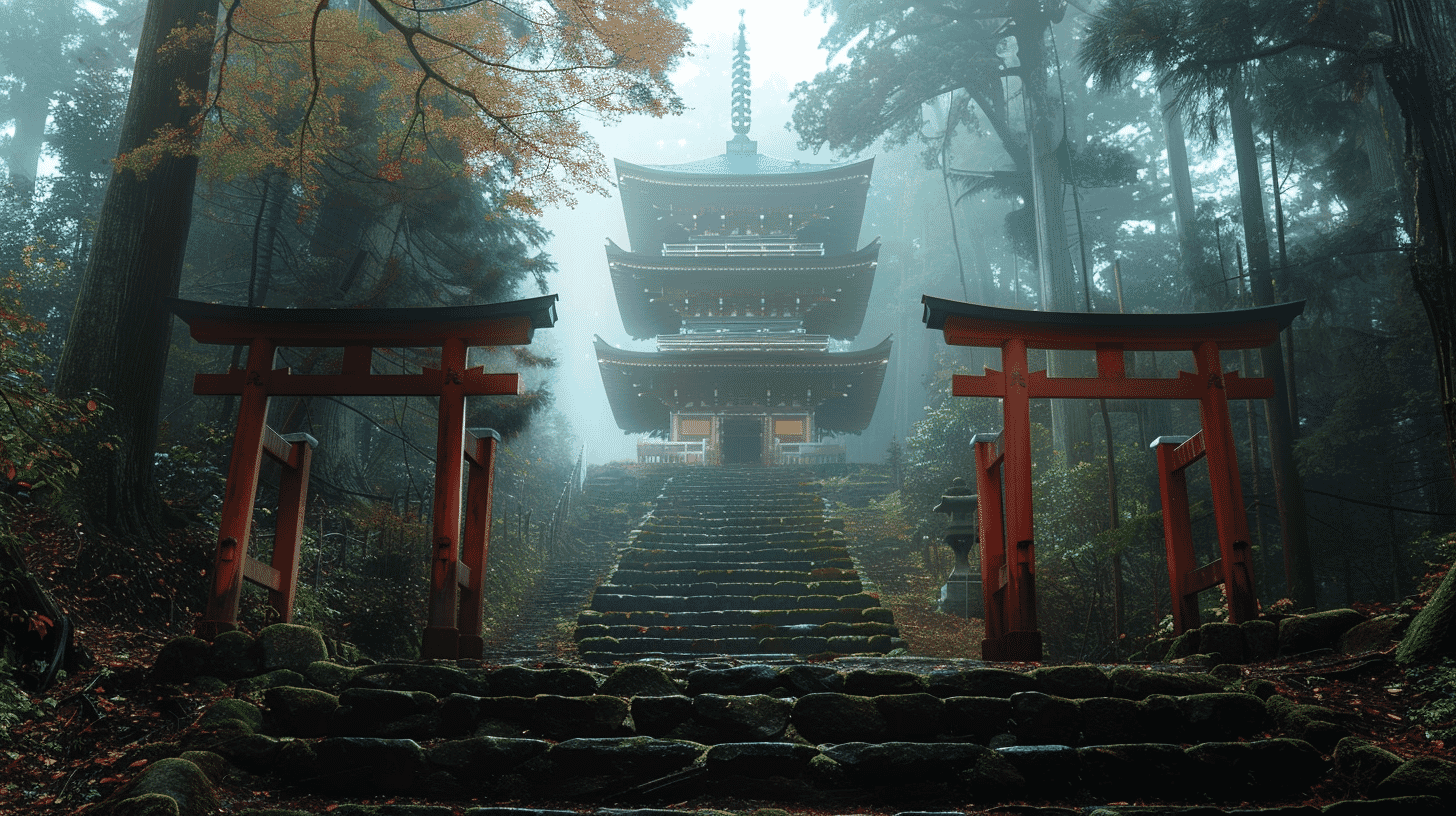
A Pagoda of about 1372, National Treasure since 1966
The Hagurosan Five-Storied Pagoda (羽黒山五重塔, Hagurosan Gojunoto) is a five-storied pagoda of the early Muromachi period at Toge, Haguro-machi, Tsuruoka City, Yamagata Prefecture, designated a National Treasure in 1966, on 11 June. It had become an Important Cultural Property on 23 April 1908. The quantity is one pagoda. It belongs to Dewa Sanzan Shrine, comprising the Gassan, Ideha and Yudonosan shrines.
The Agency for Cultural Affairs writes: it stands beside the approach to Dewa Sanzan Shrine. It was built around 1372, in the early Muromachi period. It rises over 29 metres, with greenery surrounding it. The pagoda follows orthodox method, and the treatment of detail shows the character of the early Muromachi period clearly.
It is three bays wide and five storeys high, roofed in shingle and left as plain timber. Shingle roofing lays thin wooden boards in overlapping courses, a material distinct from tile or cypress bark. Plain timber means the wood carries neither color nor lacquer. The decision not to finish the surface governs how the pagoda reads among the cedars.
Why It Was Designated: Beside the Myoo-in Pagoda
The Agency makes its judgement by comparison. Among five-storied pagodas of the period there is the Myoo-in pagoda in Fukuyama, Hiroshima Prefecture, built in the Jowa era, and the Hagurosan pagoda stands with it as representative of the five-storied pagodas of the Muromachi period.
Few five-storied pagodas of the Muromachi period survive. The Agency names only one other, and places this one beside it. That so short a list is offered is itself a measure of rarity.
The Agency's text gives the Western year for the Jowa era date of the Myoo-in pagoda as 1449, which does not match: Jowa 4 corresponds to 1348. The discrepancy lies within the official record, so this article cites the era name without the Western year.
The phrase about orthodox method also carries weight. Provincial pagodas often simplify; this one is framed by the same methods used at the centre, while its details show the early Muromachi manner.
Founding and Rebuilding: Tradition and Record
A tradition surrounds the founding. Taira no Masakado is said to have founded the pagoda in the Johei era, 931 to 938, in the middle Heian period, but nothing certain is known.
Of the present building, the Haguroyama Kyuki records that Daihoji Masauji, superintendent of Hagurosan, rebuilt it in 1372. The Agency's phrase, around 1372, rests on that account.
A copy of the ridge tablet gives different years. By it, the columns were raised in 1369 and the finial set on the roof in 1377, so eight years passed between the two.
In 1608 Mogami Yoshiaki, lord of the Yamagata domain, carried out repairs, also known from a copy of a ridge tablet. Three lines of evidence, tradition, chronicle and ridge tablet, give three different dates, which is why the Agency does not settle on a single year.
Standing Among the Cedars
The pagoda stands on the approach to Hagurosan at the foot of the first slope, past the gate of the guardian deities and across the Harai River, among the cedars.
The Agency's phrase about greenery surrounding it refers to that setting. The avenue of cedars along the approach is designated a Special Natural Monument, and the pagoda stands within it. Nearby grows the Jijisugi, a cedar said to be a thousand years old and ten metres round.
A pagoda of plain timber ringed by cedars reads differently from a painted one. The color of the wood sits close to that of the trunks, and the shingle roof is the same brown.
Shingle roofs are relaid about every twenty years. The most recent work was carried out between 2023 and 2024.
Visiting
The exterior can be seen freely at no charge, about 15 minutes on foot from the gate of the guardian deities, down the stone steps and across the Harai River. From the summit it is about 30 to 40 minutes.
The stone steps of the approach have no lighting. From autumn onward the mountain darkens early and footing becomes hard to see, so visits between morning and mid-afternoon are advised.
In winter the steps up to the pagoda are not cleared of snow and are very slippery. In rain or snow, rubber boots can be borrowed at the Ideha Cultural Museum. Beyond the pagoda the path is not cleared either, so reaching the summit means returning to the gate and going up by bus or car.
From JR Tsuruoka Station the bus takes about 35 minutes to the Haguro Zuishinmon stop. A voluntary contribution toward conserving Hagurosan and the town of Toge is collected before the gate and at the summit torii.
Q&A
- When was the Hagurosan pagoda built and designated?
- The Agency for Cultural Affairs dates it to around 1372, in the early Muromachi period. It became an Important Cultural Property on 23 April 1908 and a National Treasure in 1966, on 11 June. It is listed as one pagoda and belongs to Dewa Sanzan Shrine.
- Why was it designated?
- The Agency notes that the pagoda follows orthodox method with details showing the early Muromachi manner clearly, and that it stands with the Myoo-in pagoda in Fukuyama as representative of the five-storied pagodas of the Muromachi period. Few such pagodas of that period survive, and only one other is named.
- Why are there several dates for its building?
- Because three lines of evidence exist: a tradition that Taira no Masakado founded it, a chronicle recording that Daihoji Masauji rebuilt it in 1372, and a copy of a ridge tablet giving 1369 for the raising of the columns and 1377 for the finial. That is why the Agency says around 1372 rather than naming one year.
- What are shingle roofing and plain timber?
- Shingle roofing lays thin wooden boards in overlapping courses, distinct from tile or cypress bark. Plain timber means the wood is left without color or lacquer. That decision governs how the pagoda reads among the cedars. The roof is relaid about every twenty years, most recently between 2023 and 2024.
- How is the pagoda reached?
- By bus from JR Tsuruoka Station, about 35 minutes to the Haguro Zuishinmon stop, then about 15 minutes on foot. The stone approach has no lighting, so visits between morning and mid-afternoon are advised. In winter the steps are not cleared; rubber boots can be borrowed at the Ideha Cultural Museum.
Basic Information
| Name | Hagurosan Five-Storied Pagoda (羽黒山五重塔, Hagurosan Gojunoto) |
|---|---|
| Location | Hagurosan, Toge, Haguro-machi, Tsuruoka City, Yamagata Prefecture |
| Designation | National Treasure (structure); the cedar avenue along the approach is a Special Natural Monument |
| Year Designated | 1908 (23 April), Important Cultural Property; 1966 (11 June), National Treasure |
| Quantity | 1 pagoda |
| Dimensions | Over 29 metres high. 3 bays wide, 5 storeys, shingle roof, plain timber. Early Muromachi period, about 1372 |
| Owner | Dewa Sanzan Shrine (Gassan, Ideha and Yudonosan shrines) |
| Public Access | Exterior freely viewable, no charge, about 15 minutes on foot from the gate of the guardian deities. No lighting on the approach; steps not cleared in winter |
References
- Cultural Heritage Online: Hagurosan Five-Storied Pagoda
- https://bunka.nii.ac.jp/heritages/detail/199129
- Yamagata Prefecture tourism: the Hagurosan five-storied pagoda
- https://yamagatakanko.com/attractions/detail_704.html
- Tsuruoka tourism navi: the Hagurosan five-storied pagoda
- https://www.tsuruokakanko.com/spot/256
- Dewa Sanzan Shrine official site
- https://dewasanzan.jp/
Last verified: 2026.09.05