
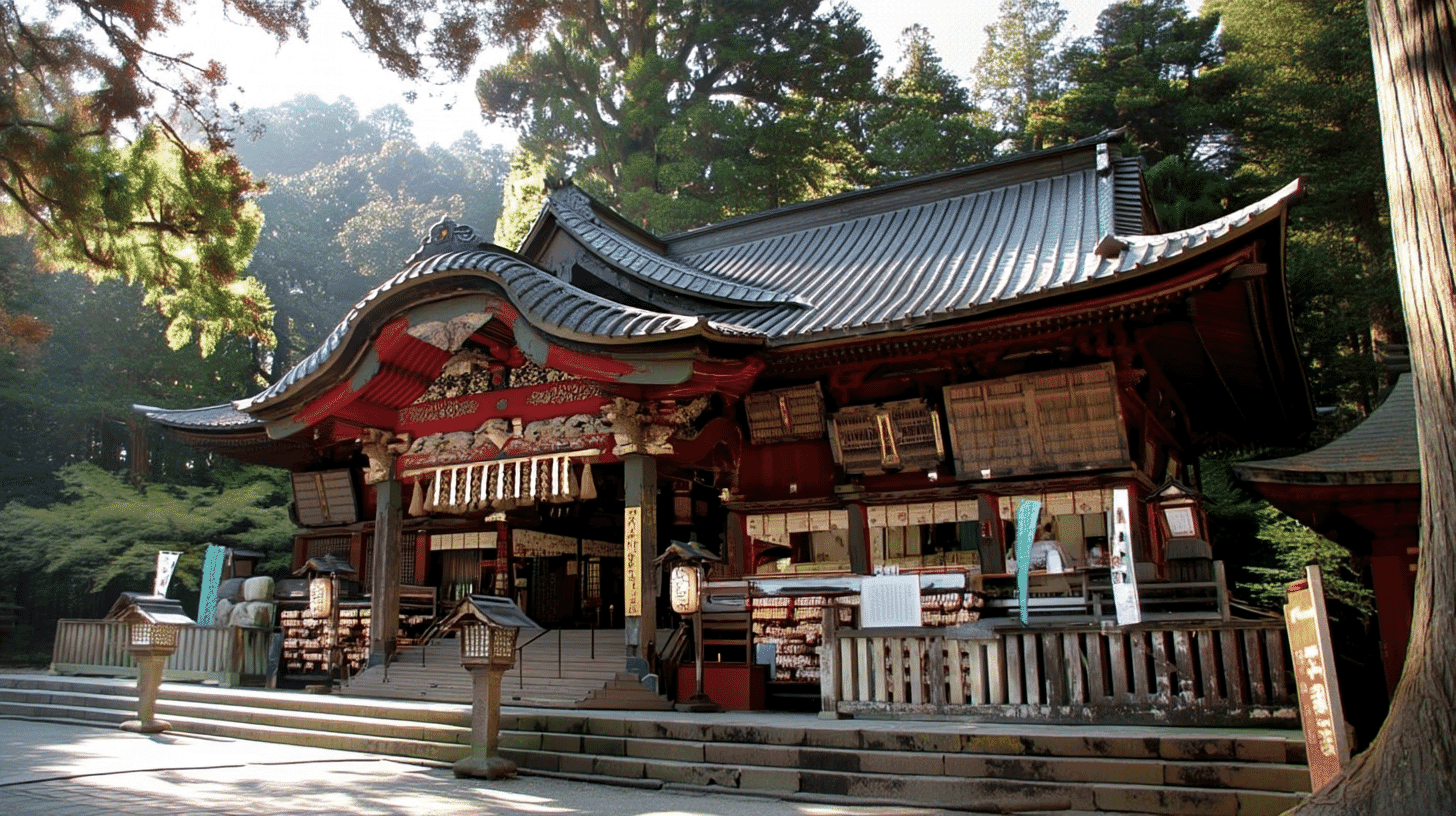
Kitaguchi Hongu Fuji Sengen Shrine Buildings: Eight Halls Raised by Fuji Pilgrims
Kitaguchi Hongu Fuji Sengen Shrine Buildings (北口本宮冨士浅間神社, Kitaguchi Hongū Fuji Sengen Jinja) are eight mid-Edo-period structures at the shrine in Kamiyoshida, Fujiyoshida City, Yamanashi Prefecture, designated together as an Important Cultural Property on November 28, 2017: the worship hall and offering hall, the Ebisu shrine with its openwork fence, the kagura hall, the water pavilion, the Zuishinmon gate, the Fukuchi Hachiman shrine, the worship hall of Suwa Shrine and the shrine office.
The designation carries the shrine's own name, with the eight buildings listed beneath it. The main hall and the Togu and Nishimiya halls were designated separately and earlier, and are not part of it. The Agency for Cultural Affairs dates the Zuishinmon to 1736, the kagura hall and the Suwa worship hall to about 1737, the worship hall and offering hall to about 1739, the Fukuchi Hachiman shrine to 1740, the shrine office to 1741, the water pavilion to 1745, and the Ebisu shrine and fence to 1753.
Attached items include a stone lantern belonging to the worship hall and ridge tablets (munafuda) for the water pavilion, the gate, the shrine office and the Fukuchi Hachiman shrine, five tablets in all, according to Fujiyoshida City. Every one of the buildings dates from the great rebuilding funded by Murakami Kosei and the Fuji pilgrim confraternities of Edo.
Why the Kitaguchi Hongu Fuji Sengen Shrine Buildings Are Designated
The Agency for Cultural Affairs explains that in the mid-18th century Murakami Kosei, sixth in the line of the Edo Fujiko, raised donations far and wide to restore the shrine buildings, which had fallen into disrepair. The worship hall's great karahafu porch at the center of the facade is dressed in carving, color and metal fittings to create a splendid space for worshippers, and the kagura hall and water pavilion are richly decorated as well. The result, the Agency says, was an ornate early-modern setting for pilgrims within a solemn cedar forest.
The builders were local carpenters from the Gunnai district (Tsuru District), and their school's characteristics show throughout. The Agency concludes that these are important shrine buildings of marked regional character, shaped by the flourishing of Mount Fuji worship. The formal designation criterion is likewise "remarkable for the characteristics of a school or region."
Yamanashi Prefecture adds that all eight relate to Murakami Kosei's donations and are valuable evidence of how strong the pilgrim confraternities had become. The money came from believers in Edo; the craftsmanship came from carpenters at the foot of the mountain. That partnership between city pilgrims and local builders is what defines the Kitaguchi Hongu Fuji Sengen Shrine Buildings.
What to See Among the Kitaguchi Hongu Fuji Sengen Shrine Buildings
The Zuishinmon gate and the kagura hall
The Zuishinmon, completed in 1736, is a three-bay gate with a single central passage and eight supporting posts, under a gabled copper roof. Yamanashi Prefecture notes an unusual arrangement typical of the mid-Edo period: the side bays facing the approach hold no guardian figures, keeping the entrance wide, while the guardians sit in the bays facing the precinct. Because guardian statues inscribed 1520 survive, Fujiyoshida City concludes that the present gate is a rebuilding by Murakami Kosei's group.
Beyond the gate, directly in front of the main hall, stands the kagura hall, a one-bay square pavilion with a hipped-and-gabled roof carried on four posts. The prefecture values it as an early kagura hall that shows early 18th-century techniques well. On festival days a local kagura association performs sacred dances here, according to the city.
The water pavilion
The water pavilion, completed in 1745, is thought by the prefecture to be the last building of the great rebuilding, made as a kind of commemorative finale. Fujiyoshida City describes a massive basin carved from Fuji lava and four posts, with a bronze dragon whose mouth still pours water drawn from Izumi, one of the Fuji Hakkai sacred springs. The city ranks its carving alongside that of the three main halls.
The worship hall and offering hall, the Ebisu shrine and fence
The worship hall is seven bays by three under a hipped-and-gabled roof, with a triangular chidori gable on the front and a one-bay karahafu porch below it. The offering hall behind, four bays by one with a gabled roof, joins it at the front, according to the Agency. Fujiyoshida City says a hall first stood here with the main hall in 1615, was repaired in 1649, and was rebuilt in its present form in 1739 by pilgrims led by Murakami Kosei. It is the largest and most visible of the eight.
Behind the main hall, beyond its fence, is the Ebisu shrine, two bays by one with a karahafu-gabled front, enshrining figures of Kotoshironushi and Okuninushi. An openwork Sukibei fence runs from each side, bending as it goes, for nine bays each to the offering hall (Agency and city). Brush inscriptions date the fence to 1753, making it the newest of the eight.
The Fukuchi Hachiman shrine, the Suwa worship hall and the shrine office
The Fukuchi Hachiman shrine is a small one-bay nagare-zukuri shrine. It was built in 1684 to the same size and plan as the Togu Main Hall and rebuilt by Murakami Kosei's group in 1740. Fujiyoshida City notes that details such as the beam-end carvings belong to the 1684 phase, so older timbers may have been reused.
The worship hall of Suwa Shrine has three bays across the front, five across the back and four in depth, under a hipped-and-gabled roof. Suwa Shrine is said to have been worshipped here before the Sengen shrine was founded; its main hall burned in 1927 and was rebuilt in 1976, the city records, which makes this worship hall the older survivor. The prefecture believes it was originally thatched, a roof type found nowhere else in the precinct.
The shrine office of 1741 measures 15.3 by 11.3 meters, partly two-storied, with a gabled roof and a karahafu-fronted formal entrance. The city calls it plain apart from that entrance and notes that its plan resembles the oshi pilgrim lodgings of Fujiyoshida; old documents call it by names such as Saijosho, Seijosho and Gokusho.
Visiting the Kitaguchi Hongu Fuji Sengen Shrine Buildings
All eight Kitaguchi Hongu Fuji Sengen Shrine Buildings stand within the grounds and can be seen from outside at any time. Walking the approach takes you through the gate past the kagura hall and water pavilion to the worship hall in order. The worship hall's interior is entered only when receiving a prayer ritual; the shrine says rituals are held there and that you may keep your shoes on, but asks visitors to phone ahead because some dates are unavailable during ceremonies.
The Ebisu shrine and fence are behind the main hall, reached by walking around the side of the worship hall. The shrine office is still in daily use, and the Fukuchi Hachiman and Suwa buildings are worshipped as subsidiary shrines. The shrine's website gives no rules on photography; avoid ceremonies and ask at the office if unsure. Directions and general visiting information are on the group page for Kitaguchi Hongu Fuji Sengen Shrine.
Q&A
- Which eight Kitaguchi Hongu Fuji Sengen Shrine Buildings are Important Cultural Properties?
- The worship hall and offering hall, the Ebisu shrine and fence, the kagura hall, the water pavilion, the Zuishinmon gate, the Fukuchi Hachiman shrine, the Suwa Shrine worship hall and the shrine office, designated on November 28, 2017. The main hall, Togu and Nishimiya are separate designations.
- When and by whom were the Kitaguchi Hongu Fuji Sengen Shrine Buildings built?
- Between 1736 and 1753, during the rebuilding funded by Murakami Kosei and the Fuji pilgrim confraternities of Edo. Local carpenters from the Gunnai district did the work.
- Why were the Kitaguchi Hongu Fuji Sengen Shrine Buildings designated?
- The Agency for Cultural Affairs calls them important shrine buildings of marked regional character, shaped by the flourishing of Mount Fuji worship. The criterion is distinction in the characteristics of a school or region.
- Can I go inside the worship hall at Kitaguchi Hongu Fuji Sengen Shrine?
- Only when receiving a prayer ritual, which is held in the worship hall. The shrine asks you to phone ahead because some dates are unavailable. The exteriors can be seen freely.
- What is special about the water pavilion at Kitaguchi Hongu Fuji Sengen Shrine?
- Built in 1745, it has a basin carved from Fuji lava, four posts and a bronze dragon whose mouth pours water drawn from Izumi, one of the Fuji Hakkai sacred springs.
Basic Information
| Name | Kitaguchi Hongu Fuji Sengen Shrine Buildings (北口本宮冨士浅間神社): worship hall and offering hall, Ebisu shrine and openwork fence, kagura hall, water pavilion, Zuishinmon gate, Fukuchi Hachiman shrine, Suwa Shrine worship hall, shrine office |
|---|---|
| Location | Kamiyoshida, Fujiyoshida City, Yamanashi Prefecture |
| Designation | Important Cultural Property (Building) |
| Year Designated | November 28, 2017 |
| Quantity | 8 buildings (with 1 lantern and 5 ridge tablets as attached items) |
| Dimensions | Worship hall 7 by 3 bays, offering hall 4 by 1 bays, shrine office 15.3 m by 11.3 m, fence 9 bays on each side, and others |
| Owner | Religious Corporation Kitaguchi Hongu Fuji Sengen Shrine |
| Public Access | Grounds open to worshippers and all eight exteriors visible; worship hall interior only when receiving a prayer ritual |
References
- Database of National Cultural Properties (Agency for Cultural Affairs): Kitaguchi Hongu Fuji Sengen Shrine, worship hall and offering hall
- https://kunishitei.bunka.go.jp/bsys/maindetails/102/00005037
- Cultural Heritage Online: Kitaguchi Hongu Fuji Sengen Shrine, kagura hall
- https://bunka.nii.ac.jp/heritages/detail/358637
- Cultural Heritage Online: Kitaguchi Hongu Fuji Sengen Shrine, water pavilion
- https://bunka.nii.ac.jp/heritages/detail/381328
- Cultural Heritage Online: Kitaguchi Hongu Fuji Sengen Shrine, Zuishinmon gate
- https://bunka.nii.ac.jp/heritages/detail/436559
- Cultural Heritage Online: Kitaguchi Hongu Fuji Sengen Shrine, Suwa Shrine worship hall
- https://bunka.nii.ac.jp/heritages/detail/382831
- Cultural Heritage Online: Kitaguchi Hongu Fuji Sengen Shrine, Fukuchi Hachiman shrine
- https://bunka.nii.ac.jp/heritages/detail/430290
- Cultural Heritage Online: Kitaguchi Hongu Fuji Sengen Shrine, shrine office
- https://bunka.nii.ac.jp/heritages/detail/410872
- Cultural Heritage Online: Kitaguchi Hongu Fuji Sengen Shrine, Ebisu shrine and openwork fence
- https://bunka.nii.ac.jp/heritages/detail/421776
- Yamanashi Prefecture: Cultural Properties Guide KB0050, eight buildings of Kitaguchi Hongu Fuji Sengen Shrine
- https://www.pref.yamanashi.jp/bunka/bunkazaihogo/bunkazai_data/yamanashinobunkazai_kb0050.html
- Fujiyoshida City: Nationally Designated Cultural Properties
- https://www.city.fujiyoshida.yamanashi.jp/page/1096.html
- Kitaguchi Hongu Fuji Sengen Shrine: Prayers and weddings (Japanese)
- https://www.sengenjinja.jp/kito_bridal/index.html
Last verified: 2026.10.03
Cultural Treasures in the Same Area
All are within walking distance in the same area, so we recommend visiting them together.
- Kitaguchi Hongu Fuji Sengen Shrine Shrine office 0.00 km
- Kitaguchi Hongu Fuji Sengen Shrine Chozuya (purification station) 0.03 km
- Kitaguchi Hongu Fuji Sengen Shrine Kagura Hall 0.05 km
- Kitaguchi Hongu Fuji Sengen Shrine Worship hall and offering hall 0.05 km
- Kitaguchi Hongu Fuji Sengen Shrine Fukuchi Hachiman Shrine 0.06 km
- Kitaguchi Hongu Fuji Sengen Shrine Sujinmon 0.06 km
- Kitaguchi Hongu Fuji Sengen Shrine Ebijusha Shrine and lattice fence 0.06 km
- Kitaguchi Hongu Fuji Sengen Shrine Suwa Shrine worship hall 0.12 km
