
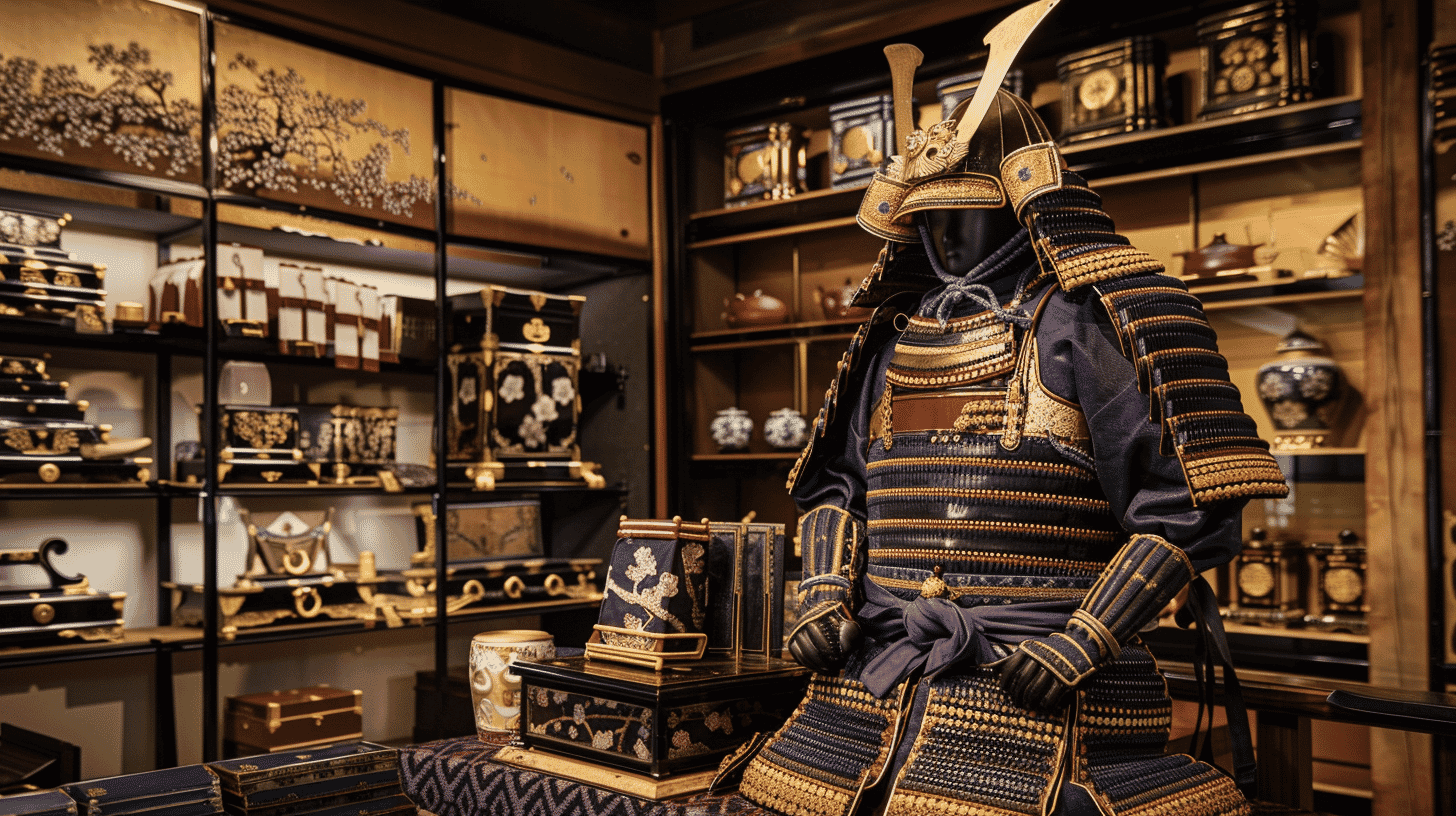
One Suit, National Treasure since 1952
Armour Laced with Small-Cherry-Patterned Leather, with Helmet and Large Sleeves (小桜韋威鎧, Kozakura-gawa Odoshi Yoroi) is a craft object owned by Kanda Tenjinja at Shiokawa Kamiozo, Koshu City, Yamanashi Prefecture, made an Important Cultural Property on 4 April 1905 and designated a National Treasure on 22 November 1952. The quantity is one suit.
22 November 1952 is the day of the Nasu stele.
Yamanashi Prefecture records that the suit passed down as a treasure of the Takeda house under a by-name meaning shieldless. The same prefecture holds the Daizenji main hall and the Seihakuji Buddha hall.
The Original of the Takeda Crest Is a Fitting on This Armour
A well-known family crest has its source in a part of the armour.
The prefecture records that the rivets and fittings on the decorative plate are gilt bases with pierced gilt lozenge-flower settings laid over them and a matching flower-headed rivet at the centre, and calls this the original of the Takeda lozenge.
An original here means the thing from which later versions were copied. The crest is traced to this fitting.
At the Sofukuji first gate, a plaque's characters gave the gate its name. With the lion-motif sword, the shape of a hilt ornament named the type.
Those are cases where a part of an object gave rise to a name. Here a part of an object gave rise to a family crest.
What marks the case is that the record places the fitting as the source rather than as an example of the crest.
The Only Other Example Is in a Picture Scroll
For one part, no other surviving example is known.
Of the large sleeves, the prefecture writes that the upper plate takes a flower-tip form ridged at the centre, of a fine antique feeling, and that apart from its appearance in the Ban Dainagon scroll there is no other example.
The upper plate is the board at the top of the sleeve. Its form ridges at the centre and ends in flower tips.
The same form appears in that picture scroll. As an object, nothing else survives.
With the painted handscroll listed by Kamakura City, a lost toilet box survives only as a painting: the object gone, the picture remaining.
Here the reverse. The object survives and there is nothing else to compare it with. A form in a painting stands beside one object.
Buried, Dug Up, Stolen, Repaired Twice
The account of its descent runs through one event after another.
At the fall of the Takeda house, the prefecture records, a retainer buried the armour beneath a great cedar at Kogakuji; Tokugawa Ieyasu had it dug up and returned to the shrine.
It continues that the suit was later stolen and badly damaged, was restored in Edo in 1791, and was repaired again in 1827 by an armourer.
Buried, dug up, stolen and broken, then mended twice.
And this, the record closes, is written in ink on the reverse of the lacing. The record of the repairs is set down on the object itself.
At the Shofukuji Jizo hall, an ink inscription on a bracket gave the date of building. Here ink records the mending. Two plates of the suit are also recorded as lost.
Seeing It
The suit is at Shiokawa Kamiozo, Koshu City, Yamanashi Prefecture, owned by Kanda Tenjinja.
The helmet rivets are counted closely: six to a row on the ground stars, one each on the brow band, and five in each of the three rows at the front.
The red-laced armour had its helmet rivets counted in twenty-four rows, the white-laced suit in thirty-eight plates. Here the count runs to rivets within each row.
Of the lacing: plates of black lacquer are mixed one in with iron plates cut at the head in a wave pattern, laced closely in indigo-dyed leather with a small cherry pattern, the edges in purple leather and the seams in red.
It is a shrine holding, not kept on permanent display. Exhibition plans can change, so check before travelling.
Q&A
- When was the suit designated?
- It became an Important Cultural Property on 4 April 1905 and a National Treasure on 22 November 1952. The quantity is one suit and the owner Kanda Tenjinja.
- Is it connected with the Takeda crest?
- Yes. The prefecture calls the fittings on the decorative plate the original of the Takeda lozenge. The crest is traced back to this fitting rather than the fitting being an example of the crest.
- Are there comparable examples?
- Of the sleeve's upper plate the prefecture writes that apart from its appearance in the Ban Dainagon scroll there is no other example. The same form survives only in a painting.
- How did it come down?
- It was buried beneath a great cedar at the fall of the Takeda house, dug up on Ieyasu's order and returned to the shrine, then stolen and badly damaged, and repaired in 1791 and again in 1827.
- Where is the record of the repairs?
- The prefecture records that it is written in ink on the reverse of the lacing. The two repairs are set down on the armour itself.
Basic Information
| Name | Armour Laced with Small-Cherry-Patterned Leather, with Helmet and Large Sleeves (小桜韋威鎧); recorded as passing under a by-name meaning shieldless |
|---|---|
| Location | Shiokawa Kamiozo, Koshu City, Yamanashi Prefecture |
| Designation | National Treasure (craft) |
| Year Designated | 1905 (4 April), Important Cultural Property; 1952 (22 November), National Treasure |
| Quantity | 1 suit |
| Dimensions | The body mixes black-lacquered plates with iron plates and is laced closely in indigo-dyed leather with a small cherry pattern. The fittings on the decorative plate are recorded as the original of the Takeda lozenge. The helmet is a riveted bowl of 10 iron plates in 8 sections. The sleeve's upper plate takes a flower-tip form with no surviving parallel. Two plates of the suit are lost |
| Owner | Kanda Tenjinja |
| Public Access | A shrine holding, not on permanent display |
References
- Yamanashi Prefecture: National Treasures of Yamanashi
- https://www.pref.yamanashi.jp/bunka/bunkazaihogo/kokuhou.html
- Koshu City: cultural properties
- https://www.city.koshu.yamanashi.jp/
- Agency for Cultural Affairs, National Cultural Properties Database
- https://kunishitei.bunka.go.jp/
- Cultural Heritage Online
- https://bunka.nii.ac.jp/
Last verified: 2026.09.06