
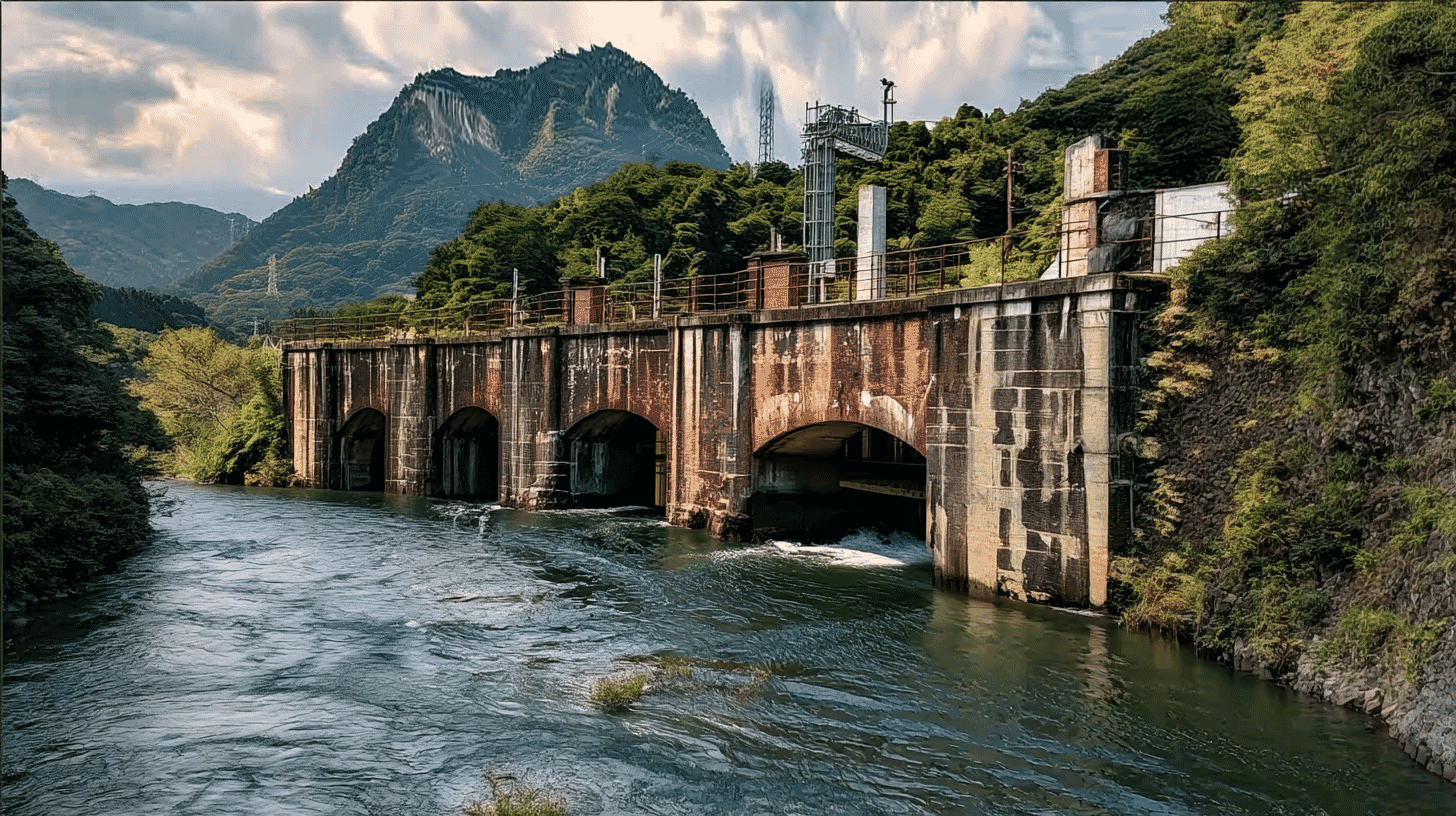
Nineteen Structures, an Important Cultural Property since 2005
Yatsusawa Hydroelectric Power Station Facilities (八ツ沢発電所施設, Yatsusawa Hatsudensho Shisetsu) span Otsuki City and Uenohara City in Yamanashi Prefecture, listed as an Important Cultural Property on 27 December 2005. The listing is as an Important Cultural Property, not a National Treasure.
The Agency describes it as a conduit-type generating installation running east and west, roughly parallel to the Katsura River.
Its structures are the intake works, tunnels numbered one to eighteen, an open channel, four aqueduct bridges, the works of the Ono regulating reservoir and an overflow channel, surviving across a range of some fourteen kilometres.
Two Different Owner Names Within One Installation
Set the records for the individual structures side by side and the owner does not read the same.
For the first aqueduct bridge, the owner field gives the renewable-power subsidiary of the electric company.
For the intake weir, it gives the parent company itself.
These are parts of one installation, and the owner is written two ways. A change of company name appears to have reached only some of the records.
With the Tsurugaoka inkstone box, a term for a silver rim was spelled two ways; with the gilt bronze implements, a word for a tray. Those concern what an object is called.
Here it is the owner. The variation falls not in a name or a part but in the field for who holds it.
The Record Says It Is the Largest of Its Kind
The assessment ends by placing the property within the system itself.
It is the largest in scale among the Important Cultural Properties of Japan, the record says.
Size relative to other listed properties is stated by the record itself.
With the Shirataki finds, the assessment closed by calling the material fit to be a National Treasure: a statement about the decision to designate.
Here the statement concerns rank among things already designated. The range of some fourteen kilometres is what supports it.
The address field runs long as well, listing nine place names across two cities.
The Measure Word Changes from Structure to Structure
There is no single way of counting.
The first aqueduct bridge is one structure: a single-arch reinforced concrete bridge with a span of 42.7 metres.
The intake weir is one site: stone and concrete, 101.7 metres long and 3.9 metres high.
The measure word for a site appears here for the first time, after those for buildings, figures, blades, scrolls, boxes, towers, pieces, suits, hangings, mirrors, flat objects, staff heads, sets and pairs.
The tunnels are gathered. Numbers six through eleven make one entry, and numbers twelve through eighteen another: six tunnels in one record and seven in the next.
At Kirishima Jingu, three buildings were gathered as one structure. Here tunnel numbers are strung together with centre dots and a conjunction, several to a single record.
Visiting
The installation lies across Otsuki City and Uenohara City in Yamanashi Prefecture, owned by the electric company.
The circumstances of building are recorded: it was built by the Tokyo Electric Light Company as part of a second hydroelectric undertaking, begun in 1910 and complete as a whole with the finishing of the Ono regulating reservoir in 1914.
The date field gives 1912, between those two years.
The purpose of the construction is noted too: the settling basin at the intake and the tunnels were built on a great scale with a view to keeping out silt and gravel.
The assessment closes that this is among the earliest full hydroelectric installations in Japan to have a large regulating reservoir, that advanced construction technique is shown across structures of differing types, and that it is of high value in the history of civil engineering. Parts of it remain in service, so access follows the owner's arrangements. Check before travelling.
Q&A
- When was the installation listed?
- On 27 December 2005, as an Important Cultural Property rather than a National Treasure. It lies across Otsuki City and Uenohara City in Yamanashi Prefecture.
- How large is it?
- The Agency gives a range of some fourteen kilometres and states that it is the largest in scale among Japan's Important Cultural Properties. The address field lists nine place names.
- Who owns it?
- The records differ by structure. The first aqueduct bridge is recorded under the renewable-power subsidiary and the intake weir under the parent company.
- What does it comprise?
- The intake works, tunnels one to eighteen, an open channel, four aqueduct bridges, the Ono regulating reservoir works and an overflow channel. Several tunnels are gathered into single entries.
- When was it built?
- The Agency records that work began in 1910 and the whole was complete with the finishing of the Ono regulating reservoir in 1914. The date field gives 1912.
Basic Information
| Name | Yatsusawa Hydroelectric Power Station Facilities (八ツ沢発電所施設); comprising 19 structures |
|---|---|
| Location | Across Otsuki City and Uenohara City, Yamanashi Prefecture; the address field lists 9 place names |
| Designation | Important Cultural Property (structure, modern); not a National Treasure |
| Year Designated | 2005 (27 December), Important Cultural Property |
| Quantity | Varies by structure: the first aqueduct bridge is 1 structure, the intake weir 1 site |
| Dimensions | Surviving across a range of some 14 kilometres. The first aqueduct bridge is a single-arch reinforced concrete bridge with a span of 42.7 metres; the intake weir is of stone and concrete, 101.7 metres long and 3.9 metres high. The date field gives 1912 and the period is Meiji |
| Owner | The electric company; the record for the intake weir names the parent company and that for the bridge its renewable-power subsidiary |
| Public Access | Parts remain in service; access follows the owner's arrangements |
References
- Cultural Heritage Online: the first aqueduct bridge
- https://bunka.nii.ac.jp/heritages/detail/147648
- Cultural Heritage Online: the intake weir
- https://bunka.nii.ac.jp/heritages/detail/177182
- Uenohara City: the Yatsusawa power station facilities
- https://www.city.uenohara.yamanashi.jp/site/kankou/1018617.html
- Agency for Cultural Affairs, National Cultural Properties Database
- https://kunishitei.bunka.go.jp/
Last verified: 2026.09.06
Cultural Treasures in the Same Area
All are within walking distance in the same area, so we recommend visiting them together.
- Yatsuzawa Power Plant Facility Tunnels No. 6, 7, 8, 9, 10 and 11 0.00 km
- Yatsuzawa Power Plant Facility No. 4 aqueduct bridge 1.08 km
- Yatsuzawa Power Plant Facility Tunnel No. 5 1.24 km
- Yatsuzawa Power Plant Facility No. 3 aqueduct bridge 1.31 km
- Yatsuzawa Power Plant Facility Tunnel No. 4 1.49 km
- Yatsuzawa Power Plant Facility No. 2 aqueduct bridge 1.75 km
- Yatsuzawa Power Plant Facility Tunnel No. 3 1.96 km
- Yatsuzawa Power Plant Facility No. 1 aqueduct bridge 1.99 km
- Yatsuzawa Power Plant Facility No. 2 tunnel 2.06 km
- Yatsuzawa Power Plant Facility First open channel 2.27 km
- Yatsuzawa Power Plant Facility First tunnel 2.80 km
- Yatsuzawa Power Plant Facility Intake grit chamber 3.42 km
- Yatsuzawa Power Plant Facility Water intake dam 3.57 km
- Yatsuzawa Power Plant Facility Intake water gate 3.59 km
- Yatsuzawa Power Plant Facility Ohno regulating pond water gate 5.07 km
- Yatsuzawa Power Plant Facility Ohno Regulating Pond Spillway 5.15 km
- Yatsuzawa Power Plant Facility Ohno Reservoir Dam 5.38 km
- Yatsuzawa Power Plant Facility Tunnels 12, 13, 14, 15, 16, 17 and 18 6.65 km
- Yatsuzawa Power Plant Facility water tank spillway 8.78 km
- Yatsuzawa Power Plant Facility aquarium 8.80 km