
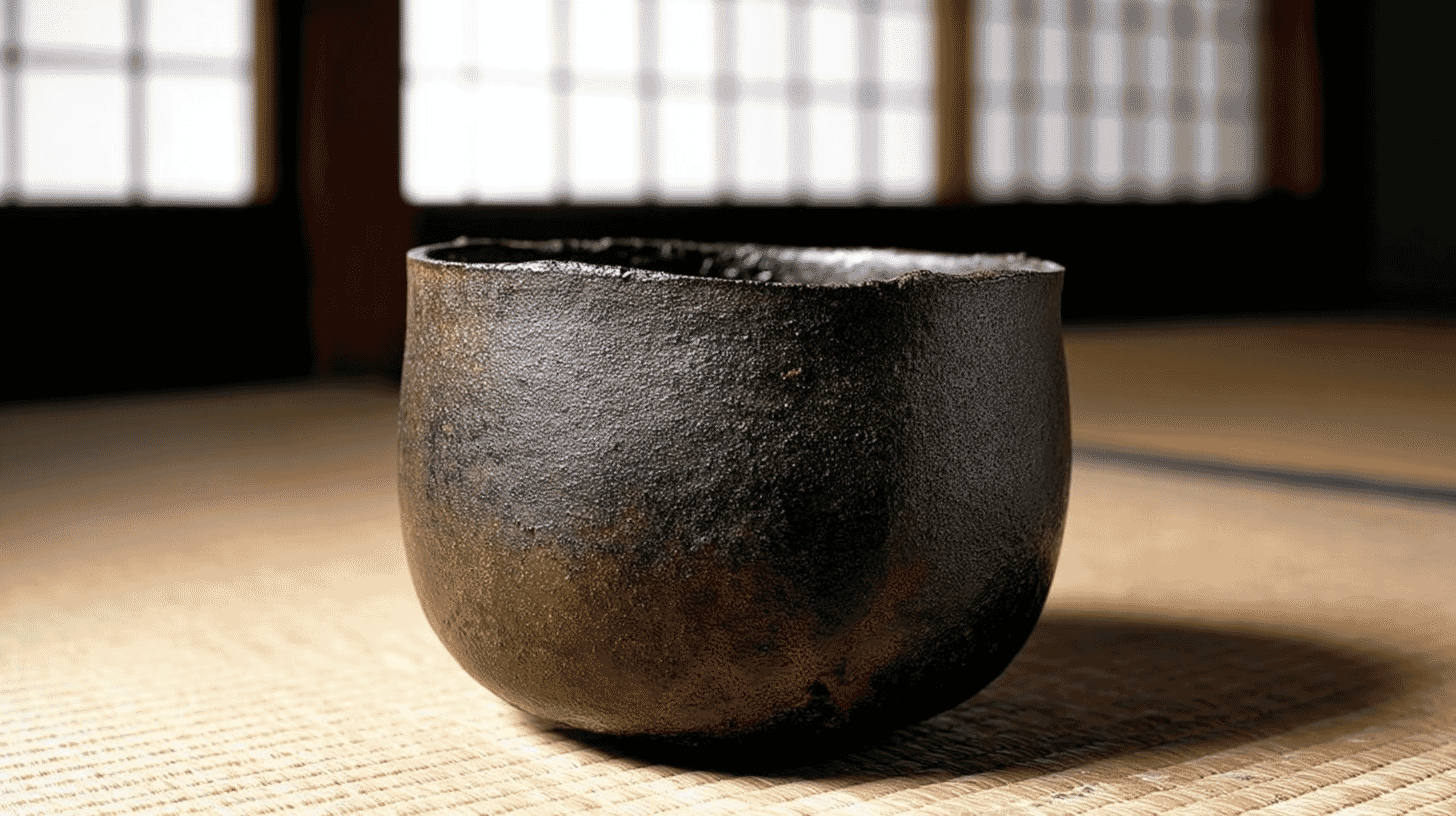
Black Raku Tea Bowl "Shigure" by Hon'ami Koetsu: Where Art Meets the Spirit of Tea
In the world of Japanese tea ceremony, few objects embody the essence of wabi-sabi as profoundly as a handcrafted raku tea bowl. Among the most celebrated examples stands "Shigure" (時雨, meaning "passing autumn rain"), a black raku tea bowl created by the Renaissance man of Edo-period Japan, Hon'ami Koetsu (1558-1637). Designated as an Important Cultural Property of Japan, this masterpiece represents the pinnacle of artistic expression in Japanese ceramics and offers visitors a rare glimpse into the soul of chanoyu, the Way of Tea.
The Master Behind the Bowl: Hon'ami Koetsu
Hon'ami Koetsu stands as one of the most versatile and influential artists in Japanese history. Born into a family of sword connoisseurs who served as appraisers and polishers for the samurai elite, Koetsu transcended his hereditary profession to become a master of multiple arts. He is celebrated as one of the "Three Brushes of the Kan'ei Era" for his exceptional calligraphy, and his contributions to lacquerware, ceramics, and garden design continue to inspire artists today.
Koetsu began his ceramic work relatively late in life, after receiving land at Takagamine in northern Kyoto from Shogun Tokugawa Ieyasu in 1615. Here, at over 60 years of age, he established an artistic community of craftspeople and devoted himself to creating tea bowls. He learned the art of raku pottery from Raku Jōkei (the second-generation head of the Raku family) and his son Dōnyū (also known as Nonkō), whose kilns he used for firing his works. Unlike professional potters, Koetsu created his tea bowls purely as expressions of his personal aesthetic vision, infusing each piece with the spontaneity and individualism that define his artistic legacy.
Understanding "Shigure": The Poetry of Rain in Clay
The tea bowl takes its evocative name from "shigure" (時雨), the intermittent autumn rains that sweep across Japan from late October through early winter. These passing showers, arriving without warning and disappearing just as suddenly, hold a special place in Japanese poetry and aesthetic consciousness as symbols of transience and seasonal melancholy.
When one examines "Shigure," the aptness of its name becomes immediately apparent. The bowl's surface presents a dramatic interplay between areas of lustrous black glaze and exposed patches where the brownish-gray clay shows through. This contrast evokes the visual rhythm of autumn rain—dark clouds releasing their moisture upon parched earth, wet surfaces glistening beside dry ones, the fleeting dance between presence and absence that characterizes these seasonal showers.
According to historical records, the name "Shigure" was inscribed on the inner storage box by Prince Ryōshō (1623-1693), the 29th abbot of Manshuin Temple in Kyoto. This connection to an imperial prince further elevates the bowl's prestige and demonstrates the high esteem in which Koetsu's works were held by Japan's cultural elite.
Why "Shigure" Became an Important Cultural Property
In 2007, the Japanese government designated "Shigure" as a National Important Cultural Property (重要文化財), recognizing its exceptional artistic and historical significance. Several factors contributed to this prestigious designation:
- Exemplary representation of Koetsu's distinctive aesthetic: The bowl showcases the characteristic features of Koetsu's black raku tea bowls, including the semi-cylindrical form (han-tsutsu-gata), the intentionally thin walls, and the masterful balance between glazed and unglazed surfaces.
- Technical excellence: Created using the hand-building technique (tedzukune) rather than a potter's wheel, the bowl demonstrates remarkable control in achieving a thin, light body while maintaining structural integrity.
- Impeccable provenance: Originally belonging to the Mitsui family, one of Japan's most prestigious merchant houses, the bowl passed through several notable collections, including those of the Hirase, Toda, and Shimomura families, before becoming the treasured possession of the renowned tea collector Morikawa Nyoshuan (1887-1980).
- Outstanding state of preservation: Despite being over 400 years old, the bowl retains its original beauty and integrity.
Physical Characteristics and Artistic Features
"Shigure" embodies the sophisticated simplicity that defines the highest achievements in Japanese tea ceramics. The bowl features a semi-cylindrical form with gently rounded hips, rising to walls that taper slightly inward before flaring subtly at the rim. The lip is flat-cut, a characteristic Koetsu technique that gives the bowl a sense of deliberate, almost architectural precision.
The clay body contains a high iron content, resulting in the distinctive grayish-brown color visible in the unglazed areas. This intentional revelation of the raw material represents a fundamental principle of wabi aesthetics—the beauty found in natural imperfection and incompleteness. The black glaze, applied unevenly, creates the "landscape" (keshiki) that gives each raku bowl its unique character.
Perhaps most remarkable is the bowl's lightness. Despite its substantial appearance, when held in the hands during a tea ceremony, "Shigure" feels surprisingly delicate—a testament to Koetsu's mastery in creating thin walls through the hand-forming process. Five firing scars (medoki) remain visible on the base, evidence of the kiln supports used during the firing process.
The Bowl's Journey Through History
The history of "Shigure" reads like a roster of Japan's most distinguished tea connoisseurs. Originally part of the Mitsui family collection, the bowl eventually came into the possession of Shimomura Seigyōan (1833-1916), a tea master of the Owari Hisada school in Nagoya. In 1903, a young tea enthusiast named Morikawa Kan'ichirō (later known by his tea name Nyoshuan) attended a tea gathering hosted by Seigyōan and encountered "Shigure" for the first time.
Though only 16 years old, Morikawa was so captivated by the bowl that he immediately asked his adoptive father to purchase it, which was accomplished by December of that same year. "Shigure" thus became the first significant art acquisition in what would become one of Japan's most important private collections. Morikawa maintained close relationships with legendary tea masters of his era, including Masuda Donō and Hara Sankei, and his collection came to include numerous Important Cultural Properties.
True to his belief that art objects should circulate among appreciators rather than remain with single owners, Morikawa parted with many treasures during his lifetime. However, "Shigure" remained his most cherished possession until the end. In 1967-1968, the Morikawa Collection, including 188 items comprising 211 pieces, was donated to Nagoya City, where it continues to enrich public cultural heritage as part of the Nagoya City Museum's holdings.
Visiting "Shigure" and Surrounding Attractions
The Nagoya City Museum, which houses "Shigure" as part of the Morikawa Collection, is currently undergoing extensive renovation and is scheduled to reopen in autumn 2026. Please note that "Shigure" is not on permanent display; as with many Important Cultural Properties, it is exhibited only during special occasions to ensure its preservation.
When planning your visit to Nagoya to experience the world of Koetsu and Japanese tea culture, consider combining your museum trip with these nearby attractions:
- Tokugawa Art Museum: Houses treasures from the Owari branch of the Tokugawa family, including the famous "Tale of Genji" scrolls (National Treasure) and an extensive collection of tea ceremony implements. Located adjacent to the beautiful Tokugawa Garden.
- Nagoya Castle: The iconic symbol of Nagoya, featuring the recently reconstructed Honmaru Palace with its stunning painted screens and golden shachihoko (mythical fish ornaments).
- Atsuta Shrine: One of Japan's most sacred Shinto shrines, housing the legendary sword Kusanagi-no-Tsurugi. The adjacent treasure house contains important historical artifacts.
- Noritake Garden: Explore the heritage of Japanese ceramics at this cultural complex operated by the famous porcelain manufacturer.
Experiencing the Spirit of Tea in Nagoya
To fully appreciate "Shigure" and Koetsu's artistic vision, consider experiencing a traditional tea ceremony during your visit. Several establishments in Nagoya offer authentic tea experiences where you can understand why the tea bowl holds such central importance in chanoyu. Holding a handmade tea bowl, feeling its weight and texture, and drinking matcha from its rim provides an embodied understanding that no amount of visual observation can match.
The black raku tea bowl represents the very essence of Sen no Rikyū's tea aesthetic—finding profound beauty in apparent simplicity, discovering the universe within a humble clay vessel. Through "Shigure," Koetsu achieved what few artists have managed: creating an object that speaks across centuries, inviting each generation to contemplate the eternal themes of impermanence, natural beauty, and the spirit of hospitality that define the Way of Tea.
- 📍 Plan Your Visit to Aichi
- Find tours, activities & transport passes near Black Raku Tea Bowl (Shigure) by Koetsu
- [ Nagoya Castle & Atsuta Shrine History Tours ]
Q&A
- What does "Shigure" mean and why was this name chosen for the tea bowl?
- "Shigure" (時雨) refers to the intermittent autumn rains that fall briefly and unpredictably in Japan from late autumn to early winter. The name was chosen because the bowl's surface—with its contrasting areas of lustrous black glaze and exposed brownish clay—evokes the appearance of wet and dry surfaces during these passing showers. The inscription is attributed to Prince Ryōshō of Manshuin Temple.
- Can I see "Shigure" on any regular visit to the Nagoya City Museum?
- No, "Shigure" is not on permanent display. As an Important Cultural Property, it is exhibited only during special exhibitions to ensure its long-term preservation. Additionally, the Nagoya City Museum is currently closed for renovation until autumn 2026. Please check the museum's official website for exhibition schedules before planning your visit.
- What makes Hon'ami Koetsu's tea bowls different from other raku ware?
- Unlike professional potters from the Raku family, Koetsu created tea bowls as artistic expressions rather than commercial products. His works are characterized by distinctive forms, intentionally thin walls achieved through hand-building technique, and a personal aesthetic that often reveals the raw clay beneath the glaze. His bowls represent the culmination of amateur artistry—works of pure creative expression unburdened by commercial considerations.
- What other Koetsu tea bowls can I see in Japan?
- Several museums house notable Koetsu tea bowls: the Mitsui Memorial Museum in Tokyo holds the black raku "Amagumo" (Rain Clouds); the Sunritz Hattori Museum in Nagano has the National Treasure white raku "Fujisan" (Mount Fuji); and the Gotō Museum and Hatakeyama Memorial Museum in Tokyo also contain important examples. Approximately 30 tea bowls are currently attributed to Koetsu.
- How do I get to the Nagoya City Museum from Nagoya Station?
- Take the Nagoya Municipal Subway Sakura-dōri Line from Nagoya Station and get off at Sakurayama Station (approximately 17 minutes). From Exit 4, it's about a 5-minute walk to the museum. Alternatively, the Nagoya Sightseeing Route Bus "Me~guru" offers convenient access to multiple cultural sites in the city.
Basic Information
| Official Name | Black Raku Tea Bowl "Shigure" by Koetsu (黒楽茶碗 銘「時雨」 光悦作) |
|---|---|
| Cultural Property Designation | Important Cultural Property of Japan (designated June 8, 2007) |
| Creator | Hon'ami Koetsu (本阿弥光悦, 1558-1637) |
| Period | Edo Period, 17th century (1601-1700) |
| Dimensions | Height: 8.8 cm, Mouth diameter: 12.4 cm, Foot diameter: 4.7 cm |
| Material/Technique | Raku ware (hand-built earthenware with iron-rich clay body, black glaze) |
| Provenance | Mitsui Family → Hirase Family → Toda Family → Shimomura Seigyōan → Morikawa Nyoshuan → Nagoya City |
| Owner | Nagoya City |
| Repository | Nagoya City Museum (currently closed for renovation until autumn 2026) |
| Museum Address | 1-27-1 Mizuho-dori, Mizuho-ku, Nagoya City, Aichi Prefecture 467-0806, Japan |
| Access | 5-minute walk from Exit 4 of Sakurayama Station (Nagoya Municipal Subway Sakura-dōri Line) |
References
- Cultural Heritage Online - Black Raku Tea Bowl (Shigure) by Koetsu
- https://bunka.nii.ac.jp/heritages/detail/158938
- Nagoya City Museum - Black Raku Tea Bowl "Shigure" and Morikawa Nyoshuan
- https://www.museum.city.nagoya.jp/collection/data/data_05/index.html
- Hon'ami Koetsu - Wikipedia (Japanese)
- https://ja.wikipedia.org/wiki/本阿弥光悦
- MIHO Museum - Red Raku Tea Bowl by Hon'ami Koetsu
- https://www.miho.jp/booth/html/artcon/00000780.htm
- Tokyo National Museum Special Exhibition Preview - The Universe of Hon'ami Koetsu
- https://artexhibition.jp/topics/news/20231219-AEJ1711435/
- Nagoya City Museum Official Website
- https://www.museum.city.nagoya.jp/
Last verified: 2026.01.02