
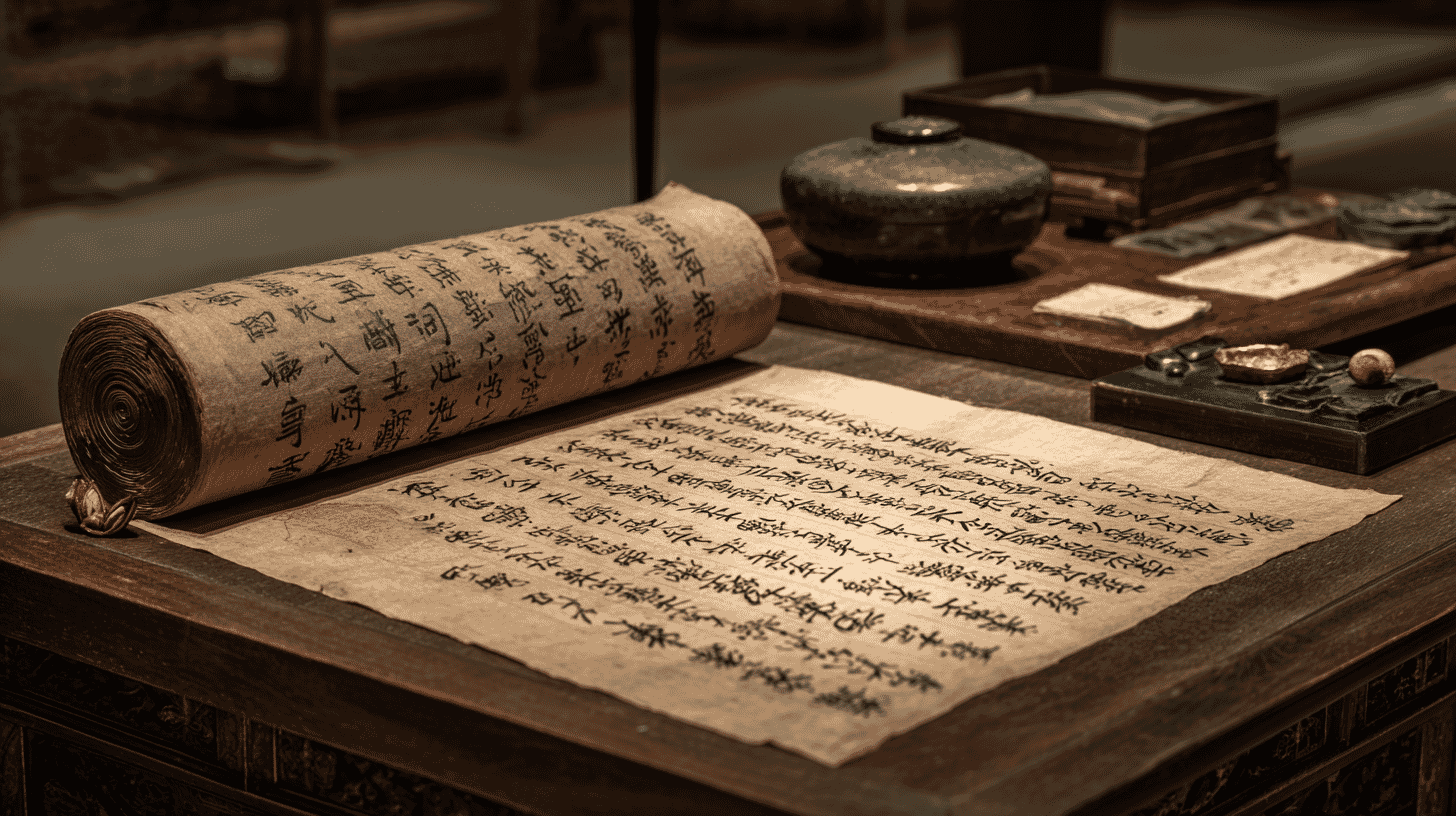
Forty Volumes, Designated in 1954
Shoku Nihongi (Kanazawa Bunko Manuscript) (続日本紀(金沢文庫本)) is a manuscript held by the Nagoya City Hosa Library at 1001 Tokugawa-cho, Higashi Ward, Nagoya City, Aichi Prefecture, designated an Important Cultural Property on 20 March 1954. The quantity is forty volumes, in the category of documents and books.
The library records the period as Kamakura together with the Keicho era, the thirteenth and fourteenth centuries together with 1596 to 1615. The volumes measure 30 centimetres in height and from 528.8 centimetres to 1768.2 centimetres in length, so the longest runs more than three times the shortest. It came from the Kanazawa Bunko and passed down as part of the Suruga bequest.
What is designated is the manuscript in forty volumes, not the Shoku Nihongi as a work. The text was completed in 797; these forty volumes were copied later.
The Volumes Were Not All Copied at Once
The point about this manuscript is that its forty volumes do not date from one time.
The library records that within it, volumes 11 to 40 are the oldest surviving copy and are taken to have been written in the later thirteenth century.
Thirty of the forty belong to the later thirteenth century and the rest to the Keicho era, 1596 to 1615. That is why the period field carries two entries. Volumes that had been lost were supplied later, and the whole has come down as one set.
The range of lengths, from 528.8 to 1768.2 centimetres, likewise reflects differences from volume to volume. These are not forty uniform books.
What the Shoku Nihongi Is
The library also describes the work itself: an official history completed in 797, following on from the Nihon Shoki. It is a chronological record of about a century centred on the Nara period, the fundamental source for that age.
An official history is one compiled at the order of the state. A chronological record sets events out in order of date, so about a century of events runs in sequence.
Fundamental source is where the assessment turns. Anyone examining the Nara period comes to this work first, and other material either supplements it or is read against it.
Within that, volumes 11 to 40 being the oldest surviving copy means they serve as the standard against which the transmission of the text is checked.
From Kanazawa Bunko to Owari
The library records two stages of provenance: formerly of the Kanazawa Bunko, and part of the Suruga bequest.
The Kanazawa Bunko was a library established in the Kamakura period at Kanazawa in Musashi province, now Kanazawa Ward in Yokohama. That volumes 11 to 40 are placed in the later thirteenth century puts them in the era of that library.
The Suruga bequest refers to the books Tokugawa Ieyasu gathered at Sunpu, divided after his death among the Owari, Kii and Mito branches of his family. The Owari share forms the foundation of the present Hosa Library.
From a library in Kamakura to Sunpu, from Sunpu to Owari, and so to Nagoya. Where the manuscript was written and where it now rests are far apart.
Consulting It
The Nagoya City Hosa Library holds the manuscript. It is not necessarily on permanent display, and whether and when it is shown depends on the library's programme.
Opening hours and admission may change, so check the library's information before travelling. All forty volumes are unlikely to be shown at once.
The text of the Shoku Nihongi has long been available in printed editions, so reading it presents no difficulty. Reading the text and seeing the manuscript are two different things.
The Hosa Library adjoins the Tokugawaen garden. From Ozone Station on the Nagoya Municipal Subway Meijo Line it is about ten minutes on foot.
Q&A
- When was the manuscript designated?
- On 20 March 1954, as an Important Cultural Property. The quantity is forty volumes, in the category of documents and books. It is held by the Nagoya City Hosa Library, with the period given as Kamakura together with the Keicho era.
- Why are two periods recorded?
- Because the forty volumes do not date from one time. The library records volumes 11 to 40 as the oldest surviving copy, written in the later thirteenth century; the rest belong to the Keicho era, 1596 to 1615. Volumes that had been lost were supplied later and the whole has come down as one set.
- What is the Shoku Nihongi?
- The library describes it as an official history completed in 797, following on from the Nihon Shoki, a chronological record of about a century centred on the Nara period and the fundamental source for that age. It was compiled at the order of the state and sets events out in order of date.
- How did it come to Nagoya?
- The library records it as formerly of the Kanazawa Bunko and part of the Suruga bequest. The Kanazawa Bunko was a Kamakura-period library in what is now Kanazawa Ward, Yokohama. The Suruga bequest was the collection Tokugawa Ieyasu gathered at Sunpu, divided after his death among the Owari, Kii and Mito branches.
- Can the manuscript be seen?
- The Hosa Library holds it, but not necessarily on permanent display; whether and when it is shown depends on the library's programme, and all forty volumes are unlikely to be shown at once. The text has long been available in printed editions, and reading it is a different matter from seeing the manuscript.
Basic Information
| Name | Shoku Nihongi (Kanazawa Bunko Manuscript) (続日本紀(金沢文庫本)) |
|---|---|
| Location | 1001 Tokugawa-cho, Higashi Ward, Nagoya City, Aichi Prefecture (Nagoya City Hosa Library) |
| Designation | Important Cultural Property (documents and books) |
| Year Designated | 1954 (20 March), Important Cultural Property |
| Quantity | 40 volumes |
| Dimensions | 30 centimetres high, from 528.8 centimetres to 1768.2 centimetres long. Volumes 11 to 40 are the oldest surviving copy, taken to date from the later 13th century. Formerly of the Kanazawa Bunko; part of the Suruga bequest. Kamakura period together with the Keicho era |
| Owner | Nagoya City Hosa Library |
| Public Access | Not necessarily on permanent display; whether and when it is shown depends on the library's programme |
References
- Cultural Heritage Online: Shoku Nihongi (Nagoya City Hosa Library)
- https://bunka.nii.ac.jp/heritages/detail/56895
- Nagoya City Hosa Library official site
- https://housa.city.nagoya.jp/
- Agency for Cultural Affairs, National Cultural Properties Database
- https://kunishitei.bunka.go.jp/
- Agency for Cultural Affairs: introduction to cultural properties
- https://www.bunka.go.jp/seisaku/bunkazai/shokai/
Last verified: 2026.09.04