
Important Cultural Landscapes of Japan
重 要 文 化 的 景 観Browse Japan’s Important Cultural Landscapes nationwide. Filter by prefecture, period, and category, with concise stories, maps, and practical travel tips.
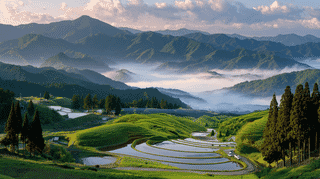
An important cultural landscape in Kumamoto Prefecture, of 65.3 hectares. No count and no owner are recorded for it here, only an area of the land itself.

A central Gifu landscape, nationally protected since 2014, where the Nagara River, Mt. Kinka, an old castle town, and 1,300 years of cormorant fishing meet.
Carved from communal grassland in the late 1920s, the Sakamoto Rice Terraces below Mt. Komatsu form rectangular paddies edged by split-stone walls two metres tall.
Japan's first urban Important Cultural Landscape, selected in 2009: a 228.5-hectare town where a Heian noble grid, centuries of tea growing, and the Uji River meet.
Itakura Town in Gunma Prefecture is home to the Water Landscape at the Confluence of the Tone and Watarase Rivers, the first Important Cultural Landscape designated in the Kanto region. Discover the mizuka refuge mounds, hanging agebune boats, raised kawada paddies, and ancient embankments that bear witness to four centuries of life lived in harmony with great rivers, alongside the Itakura Raiden Shrine and the Ramsar-listed Watarase Retarding Basin.
Aterazawa in Yamagata sits where the Mogami River bends sharply. A medieval castle, an Edo port and castle town, and a railway-era quarter layer in one townscape.
On Lake Biwa's eastern shore, the village of Iba is laced with stone-lined waterways fed by mountain springs, where houses rise straight from the channels.
On Lake Biwa's western shore, Ōmizo grew around water: a 1578 water castle using an inner lake as its moat, with Edo-era pipes and channels still in daily use.
In the snowy upper Anegawa valley of Shiga, four mountain hamlets meet three-metre winters with long-eaved houses, spring-fed channels, and pass-road crafts.
Two Noto Peninsula hamlets stand behind 4-5 meter bamboo walls, an Important Cultural Landscape preserving half-farming, half-fishing life on Japan's western coast.
In Izumisano’s hills, Ōgi keeps a medieval estate’s reservoirs, channels, and terraced paddies, selected in 2013 as Osaka’s first Important Cultural Landscape.
Himeshima, a small volcanic island off the Kunisaki Peninsula in Oita Prefecture, is home to roughly 1,800 residents living as a single self-contained village. Designated an Important Cultural Landscape of Japan in 2021, the entire island and its surrounding waters preserve a rare way of life in which fishing, salt-making, and kuruma prawn aquaculture are sustained through community-wide stewardship of natural resources. Discover the volcanic landscape, the celebrated Bon Dance, the seven legendary wonders, and the unforgettable Himeshima kuruma prawn — a quiet, deeply rooted island where sea and community live as one.
The Rural Landscape of Tashibu-no-sho Osaki in Bungotakada, Oita, selected in 2010, keeps the paddies and hamlets of a medieval estate of Usa Jingu in use.
The Cultural Landscape of Yukemuri (Steam) and Hot Springs in Beppu, located in Oita Prefecture's Kannawa and Myoban districts, was designated a national Important Cultural Landscape in 2012. Discover the rising plumes of steam over the volcanic alluvial fan, the living tradition of toji hot spring cures, yunohana mineral huts, and jigoku-mushi steam cooking that together form one of Japan's most distinctive cultural landscapes.
The Saru River Basin cultural landscape in Biratori, Hokkaido, selected in 2007, layers Ainu traditions and post-settlement farming and forestry along the river.
More across Japan
The complete kokuhō catalogue — browse by prefecture, period, and category.
Nationwide jūyō bunkazai — architecture, sculpture, painting, crafts, and documents.
UNESCO-inscribed cultural and natural sites across the archipelago.