
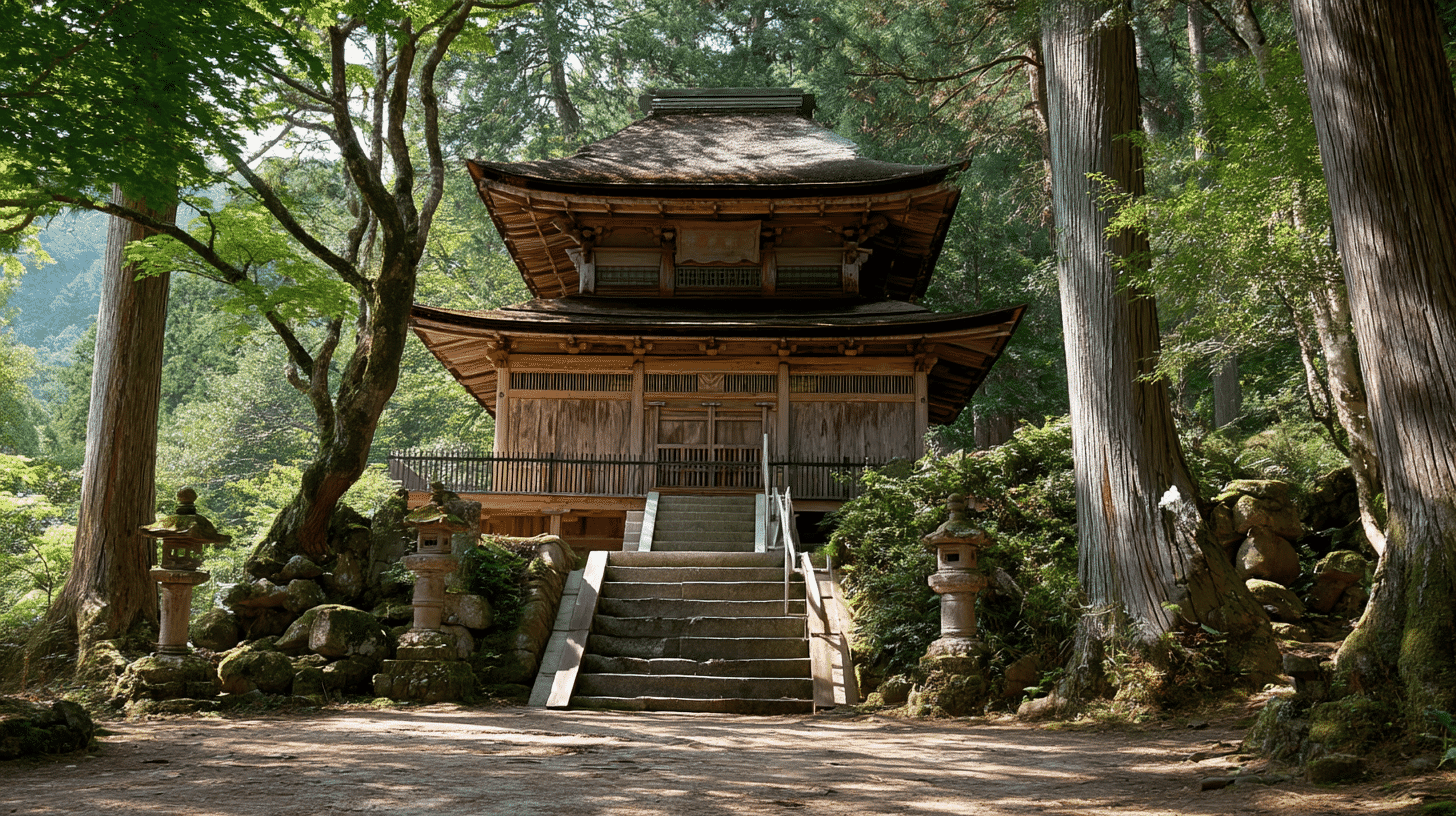
Built in 1408, National Treasure since 1963
Ankokuji Temple Sutra Repository (安国寺経蔵, Ankokuji Kyozo) stands at Nishimonzen, Kokufu-cho, Takayama City, Gifu Prefecture, designated a National Treasure on 1 July 1963. It had become an Important Cultural Property on 5 April 1909. The quantity is one building, the category pre-modern temple architecture, and the designation number 00213. The owner is Ankokuji.
The Agency for Cultural Affairs gives the period as mid-Muromachi and the year as 1408. Its commentary opens: this repository is a building raised in 1408, with a revolving sutra case inside. The date of building is fixed.
Fifty-four years passed between the earlier designation and the National Treasure listing.
A Representative Example, Not the Oldest
The Agency's assessment is a single sentence: it is a representative example of a sutra repository holding a revolving case.
Representative example, not oldest. Accounts elsewhere call it the oldest revolving sutra case in Japan, but the Agency's record contains no comparison of dates.
To call something a representative example presupposes that others of the kind exist, and picks this one out as typical among them. The Agency's related entries list many repositories: Zenkoji, Banna-ji, Honganji, Eiheiji and others.
This article follows the record and goes no further than representative example. Whether it is the oldest cannot be established from the official record.
What a Revolving Sutra Case Is
The Agency defines the object itself.
A revolving sutra case is an octagonal cabinet for scriptures, turning about a central post.
A sutra cabinet holds the scriptures. Here it is eight-sided and turns on a central post. A revolving structure stands inside the building.
The field for structure and form also states with octagonal revolving case. The case is recorded not as a fitting but as part of the building's form.
The repository was built to house that case. Building and mechanism are assessed together.
One Bay Square, with a Pent Roof Around It
The structure and form read: one bay along, one bay deep, single storey with a pent roof, hip-and-gable roof, shingled, with octagonal revolving case.
One bay along and one bay deep means a single span each way. The core of the building is no more than one bay square.
A pent roof is added round it: a lower roof and wall skirt set outside the core, so that the building reads larger from outside than its frame is. Single storey with a pent roof describes exactly that.
From outside it appears to have two levels, but structurally it has one. Pent roofs of this kind are common on pagodas and image halls; on a repository this size, it is generous treatment.
The roof is hip-and-gable, laid with shingles, thin split boards overlapped in courses.
Visiting
The repository stands within the precinct of Ankokuji. It is a temple building, so whether and how it can be viewed follows the temple's practice.
The revolving case is inside the building and cannot be seen from outside. Check in advance whether the interior can be visited.
From outside, what can be made out is the core of one bay square with its pent roof, and the shingled hip-and-gable roof above. Coming close makes clear how small the building is.
The temple is at Nishimonzen, Kokufu-cho, Takayama City, Gifu Prefecture. Hours and any charge can change, so check before travelling.
Q&A
- When was the repository built and designated?
- The Agency for Cultural Affairs gives the year as 1408. It became an Important Cultural Property on 5 April 1909 and a National Treasure on 1 July 1963, as one building under designation number 00213, owned by Ankokuji.
- Is this the oldest revolving sutra case in Japan?
- The Agency records only that it is a representative example of a sutra repository holding a revolving case, and makes no claim about age. To call something representative presupposes that others exist. Whether it is the oldest cannot be established from the official record.
- What is a revolving sutra case?
- The Agency defines it as an octagonal cabinet for scriptures, turning about a central post. The cabinet holds the scriptures, is eight-sided, and turns on a post at its centre, so a revolving structure stands inside the building.
- What form does the building take?
- The Agency gives one bay along, one bay deep, single storey with a pent roof, hip-and-gable roof, shingled, with octagonal revolving case. The core is no more than one bay square, with a pent roof added round it, so the building reads as two levels from outside while structurally having one.
- Can the revolving case be seen?
- It is inside the building and cannot be seen from outside. The repository is a temple building within the precinct of Ankokuji, so whether the interior can be visited follows the temple's practice; check in advance.
Basic Information
| Name | Ankokuji Temple Sutra Repository (安国寺経蔵, Ankokuji Kyozo) |
|---|---|
| Location | Nishimonzen, Kokufu-cho, Takayama City, Gifu Prefecture (Ankokuji) |
| Designation | National Treasure (structure, pre-modern temple architecture), designation no. 00213 |
| Year Designated | 1909 (5 April), Important Cultural Property; 1963 (1 July), National Treasure |
| Quantity | 1 building |
| Dimensions | 1 bay along, 1 bay deep, single storey with a pent roof, hip-and-gable roof, shingled, with an 8-sided revolving case. Inside stands an 8-sided sutra cabinet turning about a central post. Built 1408 |
| Owner | Ankokuji |
| Public Access | A temple building; whether and how it can be viewed follows the temple's practice |
References
- Agency for Cultural Affairs, National Cultural Properties Database: Ankokuji Sutra Repository
- https://kunishitei.bunka.go.jp/heritage/detail/102/1107
- Cultural Heritage Online: Ankokuji Sutra Repository
- https://bunka.nii.ac.jp/heritages/detail/122117
- Hida Takayama official tourism site: Ankokuji Sutra Repository
- https://www.hidatakayama.or.jp/spot/detail_1609.html
- Agency for Cultural Affairs: introduction to cultural properties
- https://www.bunka.go.jp/seisaku/bunkazai/shokai/
Last verified: 2026.09.04