
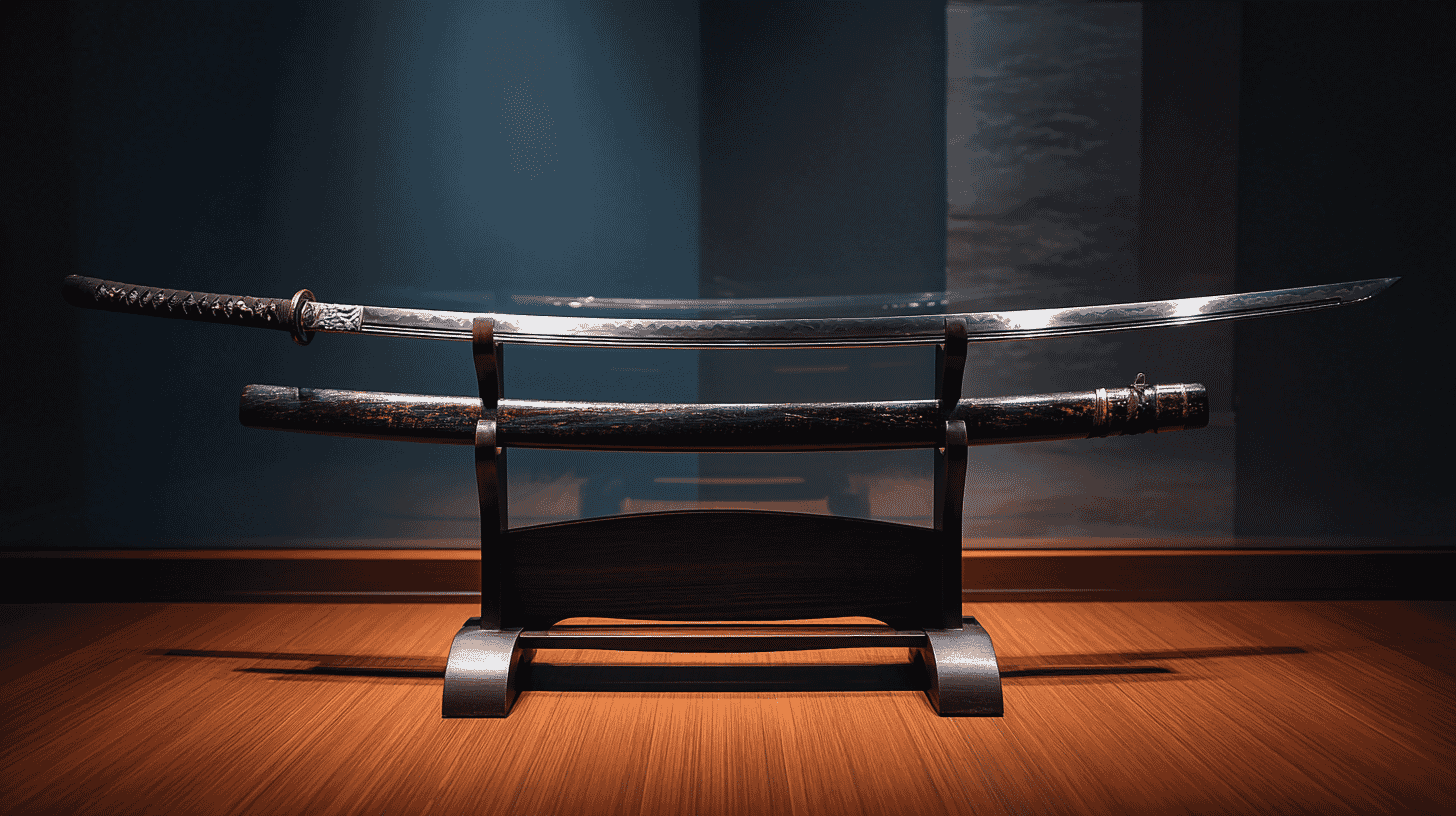
One Sword, National Treasure since 1951
Tachi Sword, Signed Hisakuni (太刀, Tachi) is a Kamakura-period craft object at the Tokyo National Museum, 13-9 Ueno Park, Taito Ward, Tokyo, made an Important Cultural Property on 14 December 1931 and designated a National Treasure on 9 June 1951. The quantity is one sword and the owner the state through the Agency for Cultural Affairs.
The maker is recorded as Hisakuni. The Agency notes that Tojiro Hisakuni, a leading smith of the Awataguchi school of Yamashiro province, is also said to have been one of the smiths who served in rotation under the retired emperor Gotoba.
This is the sixth property here owned by the state.
An Untouched Tang against a Shortened One
Of the tang, the Agency writes as follows.
On the face of the untouched tang stands the two-character signature Hisakuni, cut with a fine chisel. An untouched tang is one left as it was made, never cut back.
The katana covered immediately before, with its gold-inlaid attribution to Masamune, was the opposite. Its tang was greatly shortened, the original signature lost, and the maker's name set in gold afterwards by an appraiser.
This one was never cut. The signature the smith himself cut therefore survives.
Whether a tang is cut decides whether a signature survives. Set the two swords side by side and the dividing line is plain.
Measured in Traditional Units
The dimensions are written differently as well.
Length two shaku six sun five bu five rin, curvature one sun, nine bu wide at the base, five bu five rin at the point, point length nine bu. These are the older Japanese units.
The dimensions of the Masamune katana were given in metric: a blade of 67.0 centimetres, a curvature of 1.7 centimetres.
Both swords are at the Tokyo National Museum, both owned by the state, both listed as craft. Even so, the systems of measurement differ.
The choice of unit evidently depends on when a record was made and by whom. The Agency gives no reason.
Having a Signature Is Itself Called Rare
The assessment turns on an unusual point.
Surviving examples bearing a signature are few, and this one is precious as a complete piece preserved in almost untouched condition.
Works bearing a signature: their surviving examples are few. What is called rare is not the quality of the work but the survival of the signature itself.
Untouched condition means nothing has been done to it. A complete piece is one with nothing missing. Not cut back, not lost, still as it was: that is what is valued.
With the Taihi Tenmoku bowl, excavated pieces were set apart from those handed down. Here the division runs between signatures surviving and signatures lost. What has survived is sorted finely in these records.
Seeing It
The sword is at the Tokyo National Museum, owned by the state. It is a museum holding, not kept on permanent display.
Its shape is recorded: ridged construction with a peaked back and a small point, with a high curvature and a strong taper, a form showing the character of its period.
Of the steel the record says that the finely knotted grain with its deep reflective figure is characteristic of this smith and his line. The maker and his school are held to show in the quality of the metal itself.
Exhibition plans can change, so check the museum's information before travelling.
- 📍 Plan Your Visit to Tokyo
- Find tours, activities & transport passes near Tachi Sword, Signed Hisakuni
- [ Tokyo Skytree Asakusa & teamLab Experiences ]
Q&A
- When was the sword designated?
- It became an Important Cultural Property on 14 December 1931 and a National Treasure on 9 June 1951. The quantity is one sword, the location the Tokyo National Museum, and the owner the state.
- What does an untouched tang mean?
- A tang left as it was made, never cut back. Because of this the smith's own signature survives, and the Agency records a two-character signature reading Hisakuni, cut with a fine chisel.
- How does it differ from the Masamune katana?
- That sword's tang was greatly shortened, so its original signature was lost and an appraiser inlaid the maker's name in gold. This one was never cut, so the smith's signature remains. Cutting the tang decides whether the signature survives.
- Why are the units different?
- This record uses the older Japanese units, while the Masamune katana is given in centimetres. Both are at the same museum with the same owner and category, but the systems differ, and the Agency gives no reason.
- What is valued in it?
- The Agency writes that surviving examples bearing a signature are few and that this is precious as a complete piece in almost untouched condition. The survival of the signature is itself treated as rare.
Basic Information
| Name | Tachi Sword, signed Hisakuni (太刀, Tachi) |
|---|---|
| Location | Tokyo National Museum, 13-9 Ueno Park, Taito Ward, Tokyo |
| Designation | National Treasure (craft) |
| Year Designated | 1931 (14 December), Important Cultural Property; 1951 (9 June), National Treasure |
| Quantity | 1 sword |
| Dimensions | The Agency uses the older Japanese units: length 2 shaku 6 sun 5 bu 5 rin, curvature 1 sun, 9 bu wide at the base, 5 bu 5 rin at the point, point length 9 bu. Ridged construction with a peaked back and small point, and on the face of the untouched tang a two-character signature reading Hisakuni, cut with a fine chisel. The maker is Hisakuni and the period Kamakura |
| Owner | The state, through the Agency for Cultural Affairs |
| Public Access | A museum holding, not on permanent display |
References
- Cultural Heritage Online: tachi signed Hisakuni
- https://bunka.nii.ac.jp/heritages/detail/149881
- Tokyo National Museum official site
- https://www.tnm.jp/
- Agency for Cultural Affairs, National Cultural Properties Database
- https://kunishitei.bunka.go.jp/
- Agency for Cultural Affairs: introduction to fine arts and crafts
- https://www.bunka.go.jp/seisaku/bunkazai/shokai/bijutsu_kogei/
Last verified: 2026.09.05