Rebuilt in 1241: Six National Treasures and Six Important Cultural Properties
Itsukushima Shrine (厳島神社, Itsukushima Jinja) is a shrine at Miyajima-cho, Hatsukaichi City, Hiroshima Prefecture, whose twelve buildings were designated Important Cultural Properties on 5 April 1899, with six of them raised to National Treasure status on 29 March 1952. It belongs to the shrine.
The six National Treasures are the main sanctuary with its offering and worship halls, the main purification hall, the auxiliary Marodo shrine with its sanctuary, offering and worship halls, the Marodo purification hall, and the east and west corridors. The six Important Cultural Properties include the Asaza-ya, the arched bridge, the long bridge, the water bridge and the Noh stage. Attached property covers the jewelled fence, the left and right attendants' bridges, the high stage, the flat stage, the left and right musicians' rooms, the left and right gate-guardian sanctuaries and four ridge tablets.
The Agency for Cultural Affairs states the character of the complex briefly. Standing on Miyajima, held sacred from ancient times, it was revered as the deity guarding the sea. The present buildings rest on the rebuilding of 1241, but they follow the arrangement settled in the late Heian period under the patronage of Taira no Kiyomori. Built on an inlet facing north, with the main sanctuary to the south and the Marodo sanctuary to the east in the double-flow roof form, and worship and purification halls linked by corridors, the composition calls to mind a great residence in shinden style.
The shrine was inscribed in 1996 as the World Heritage site Itsukushima Shinto Shrine, the listed area taking in the buildings and the primeval forest of Mount Misen behind them.
Double-Flow Roofs and Corridors: A Composition from Domestic Architecture
Take the two features the Agency names in turn.
The double-flow roof extends the roof at both front and back. An ordinary nagare roof is extended only at the front; the double form carries the same extension to the rear, giving a section close to symmetrical. The main sanctuary measures eight bays across the front and nine across the back, four bays deep, single storey, with a cypress bark roof. The Marodo sanctuary is five bays by four, single storey, double-flow, cypress bark.
The corridors join the main shrine, the Marodo shrine and the land. From the shore inward the sanctuary, offering hall, worship hall and purification hall stand in a line, and seaward of them project the high stage, the flat stage and the musicians' rooms to either side. East and west corridors embrace this group, with the Marodo shrine set astride the corridor partway along.
That arrangement is why the Agency invokes a great residence in shinden style. Shinden was the form of Heian aristocratic housing: a central hall with wings to left and right, joined by covered passages and facing a pond. At Itsukushima the pond becomes the sea and the passages become corridors. A shrine borrowing the form of a house is what marks this architecture.
Two Dates: 1241 and 1571
The citation says the present buildings rest on the rebuilding of 1241, but not every building carries that date.
In the late Heian period the shrine was built by the priest Saeki Kagehiro with the support of Taira no Kiyomori, then governor of Aki. Fires struck in 1207 and 1223, and after the second the shrine was rebuilt in 1241. The offering, worship and purification halls of the main shrine, and the sanctuary, offering, worship and purification halls of the Marodo shrine, date from that rebuilding.
Only the main sanctuary is later. A ridge tablet dates it to 1571. That rebuilding did not follow a fire. In 1569 the Wachi brothers of Bingo, who had fallen out with Mori Motonari, barricaded themselves in the sanctuary and were killed there, and the building was replaced because blood had defiled it.
Of the six National Treasures, then, the main sanctuary is of 1571 and the rest rest on 1241. Though medieval rebuildings, their scale and style are held to continue those of the late Heian period. When the Agency writes that the buildings follow the late Heian arrangement, it is judging the composition rather than the age of the timber.
Why Twelve Buildings Form One Item
The main sanctuary alone is a double-flow sanctuary. The east corridor alone is a walkway over water. Only with the twelve in view does the design become legible: a group of buildings laid out across the surface of an inlet.
That the corridors are National Treasures shows it. A corridor is no more than a passage between buildings, but here the corridors make the view. As the Agency puts it, the value lies in a composition where the halls are joined in continuity.
The attached property makes the same point. The high stage, the flat stage, the musicians' rooms and the gate-guardian sanctuaries are separate buildings, yet are listed as attachments. Without the stages and rooms projecting seaward, the axis running from the sanctuary out to the water would not exist.
National Treasure status is confined to six because those six descend from the rebuilding of 1241 and form the core. The arched bridge and the Noh stage are later additions and remain Important Cultural Properties.
Visiting
The shrine opens for worship from 6:30 a.m., with closing time varying by season between 5:00 and 6:00 p.m. Admission is 300 yen for adults, 200 yen for high school students and 100 yen for primary and junior high school students, with a combined ticket for the treasure hall available.
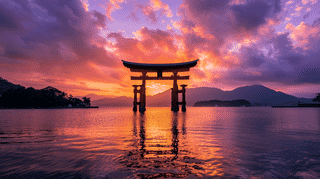
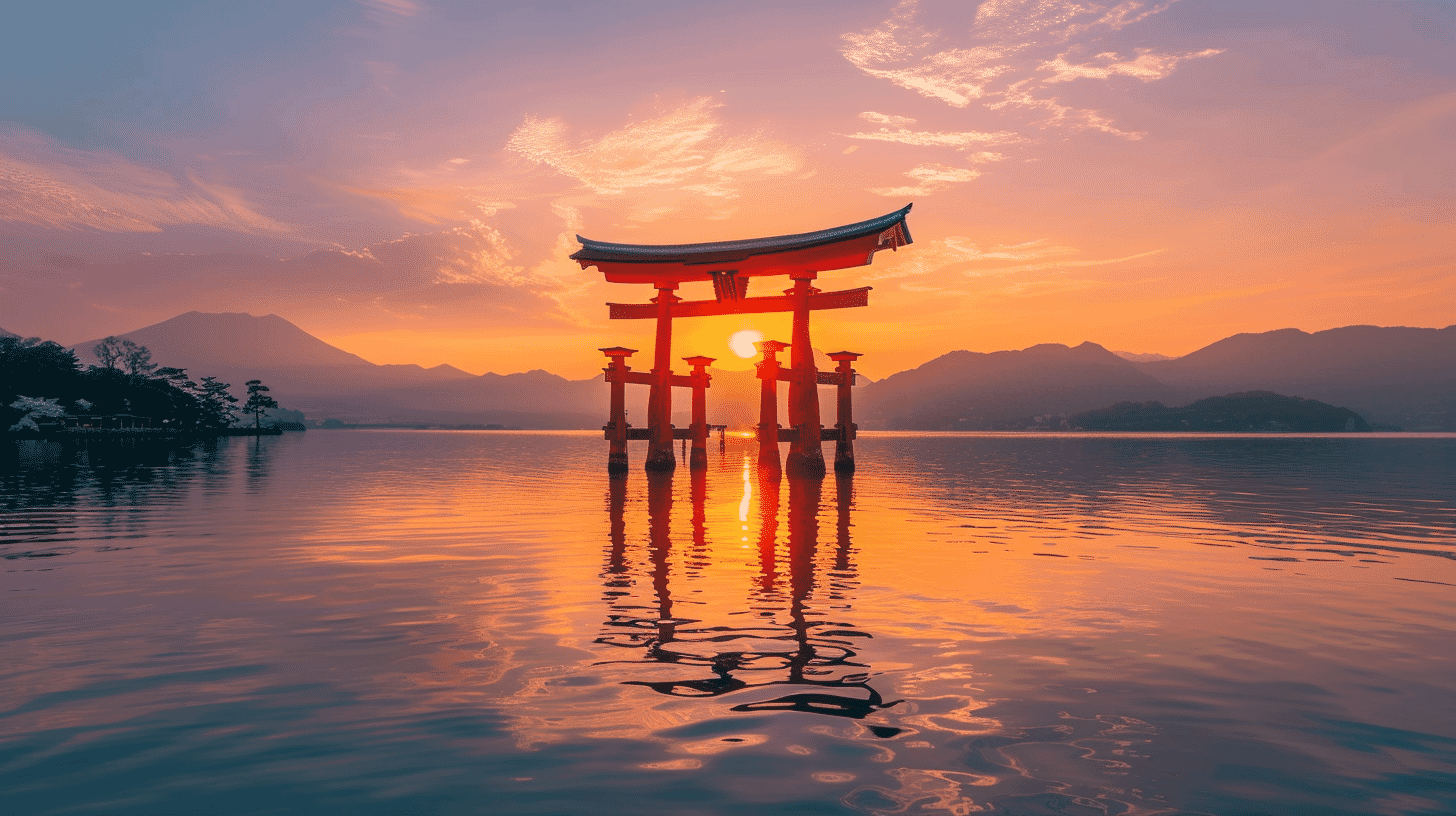
The tide changes what is seen. At high water the buildings stand above the sea; at low water it is possible to walk out to the foot of the great gate. Which of the two you want decides when to come, so check the tide table published by the Miyajima tourist association in advance. Walking to the gate is generally possible when the tide is below about 100 centimetres.
The corridors are boarded with gaps left between the planks, so that water can escape from below when the tide runs high. They are slippery in rain, so wear shoes you can walk in.
From Miyajimaguchi Station on the JR Sanyo Main Line the ferry takes about 10 minutes, and it is about 12 minutes on foot from the Miyajima pier. Two operators run the crossing, JR West Miyajima Ferry and Miyajima Matsudai Kisen. A separate Miyajima visitor tax applies.
Q&A
- How are the buildings of Itsukushima Shrine designated?
- Twelve buildings were designated Important Cultural Properties on 5 April 1899, and six were raised to National Treasure status on 29 March 1952: the main sanctuary with its offering and worship halls, the main purification hall, the Marodo shrine sanctuary with its halls, the Marodo purification hall, and the east and west corridors. The shrine became a World Heritage site in 1996.
- When were the buildings of Itsukushima Shrine built?
- Most rest on the rebuilding of 1241, which followed fires in 1207 and 1223. The main sanctuary alone dates from 1571, as a ridge tablet records. That replacement followed not a fire but the killing of the Wachi brothers inside the sanctuary in 1569, after which the building was held defiled by blood.
- What is a double-flow roof?
- A roof extended at both front and back. An ordinary nagare roof is extended only at the front; the double form carries the same extension to the rear. At Itsukushima the main sanctuary and the Marodo sanctuary both take this form, and the Agency for Cultural Affairs names them together.
- Why are the corridors National Treasures?
- Because the corridors themselves make the view. The Agency describes a composition in which worship and purification halls are joined in continuity by corridors, calling to mind a great residence in shinden style; continuity is the heart of the value. The high stage, flat stage and musicians' rooms are listed as attached property.
- What does it cost to enter, and how do I check the tide?
- Worship begins at 6:30 a.m. and closing varies by season. Admission is 300 yen for adults, 200 for high school students and 100 for younger students. At high water the buildings stand above the sea; at low water you can walk to the great gate. Check the tide table published by the Miyajima tourist association before travelling.
Basic Information
| Name | Itsukushima Shrine (厳島神社, Itsukushima Jinja) |
|---|---|
| Location | 1-1 Miyajima-cho, Hatsukaichi City, Hiroshima Prefecture |
| Designation | National Treasure (main sanctuary and others, 6 buildings); Important Cultural Property (Asaza-ya, arched bridge, long bridge, water bridge, Noh stage and others, 6 buildings). World Heritage site Itsukushima Shinto Shrine |
| Year Designated | 1899 (5 April), 12 buildings as Important Cultural Properties; 1952 (29 March), 6 buildings as National Treasures |
| Quantity | 12 buildings; attached property includes the jewelled fence, attendants' bridges, high stage, flat stage, musicians' rooms, gate-guardian sanctuaries and 4 ridge tablets |
| Dimensions | Main sanctuary: 8 bays front, 9 bays back, 4 bays deep, single storey, double-flow roof, cypress bark, 1571. Main offering, worship and purification halls and the Marodo shrine: 1241. Marodo sanctuary: 5 bays by 4, single storey, double-flow, cypress bark |
| Owner | Itsukushima Shrine |
| Public Access | Worship from 6:30 a.m., closing varies by season. Adults 300 yen, high school students 200, younger students 100. The tide changes how the buildings appear |
References
- Cultural Heritage Online: Itsukushima Shrine, main sanctuary with offering and worship halls
- https://online.bunka.go.jp/heritages/detail/148361
- Cultural Heritage Online: Itsukushima Shrine, Marodo shrine sanctuary with offering and worship halls
- https://online.bunka.go.jp/heritages/detail/191003
- Cultural Heritage Online: Itsukushima Shrine, east corridor
- https://online.bunka.go.jp/heritages/detail/157705
- Agency for Cultural Affairs, National Cultural Properties Database: Itsukushima Shrine
- https://kunishitei.bunka.go.jp/heritage/detail/102/3164
- Itsukushima Shrine official site
- https://www.itsukushimajinja.jp/
Last verified: 2026.09.28
Cultural Treasures in the Same Area
All are within walking distance in the same area, so we recommend visiting them together.
- Itsukushima Shrine Corridor (West Corridor) 0.00 km
- Itsukushima Shrine Noh stage 0.02 km
- Itsukushima Shrine Sorihashi 0.03 km
- Itsukushima Shrine Nagahashi 0.04 km
- Itsukushima Shrine Main shrine, offering hall, worship hall 0.05 km
- Itsukushima Shrine Headquarters Purification Hall 0.06 km
- Itsukushima Shrine Water pumping bridge 0.08 km
- Itsukushima Shrine Corridor (East Corridor) 0.08 km
- Itsukushima Shrine Purification Hall of the Auxiliary Shrine 0.10 km
- Itsukushima Shrine Morning sitting room 0.10 km
- Itsukushima Shrine Main hall, offering hall, worship hall of auxiliary shrines 0.13 km