
Shōwa
Ibaraki · 昭和Browse Ibaraki’s cultural heritage from the Shōwa period (1926 – 1989). Filter by type and keyword, with concise stories, maps, and travel tips.
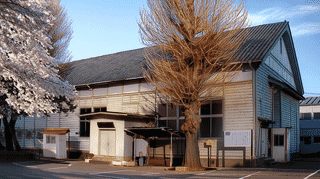
A single-storey timber hall of 1932 in Joso, Ibaraki, 541 square metres. Built as a school gymnasium and auditorium, it now serves as a martial arts hall.

The Former Yanaka Family Residence in Tsukuba, built in 1942 and 1949 by materials researcher Yanaka Ryujiro, became an Important Cultural Property in 2023.
The Arakawa Family Residence Main House, built in 1933 in Shimodate, sets an Art Deco mortar facade under a pyramidal Japanese roof. Exterior viewing only.
The Iwase Family Residence Middle Gate in Tsuchiura, Ibaraki, is a tiled timber gate 2.5 meters wide that divides the grounds north from south. Registered in 2010.
The east gate of the Iwase residence in Tsuchiura, Ibaraki, was the everyday entrance to a former Edo village headman's compound. A registered cultural property.
Built in 1936 with funds donated by merchant Umezu Fukujiro, this former town hall in Hitachiota keeps its corner tower and scratch tile and is now a free museum.
The Owada Family Rental Store in Ishioka, Ibaraki, is a timber shopfront of about 1930 built to be let out, with a central column dividing it into two shop units.
Okusho Store and Main House in Yuki, Ibaraki, is a timber merchant house of 1935 that glazed its entire frontage yet kept the deep eaves of an older shop.
Discover the Kasama City Historical Folk Museum, a nationally registered tangible cultural property in Ibaraki Prefecture. This 1937 wooden Western-style former town hall showcases early Showa civic architecture alongside archaeological and folk exhibits from the Kasama region.
Kameya Shoji (Former Iijima Family Residence) Main Building in Koga City is a Western-style timber building of 1935 with a corner watchtower, registered in 2004.
A single-storey timber wing of about 1935 behind the Kameya Shoji main building in Koga City, with stained glass and an umbrella-shaped ceiling, registered in 2004.
Kameya Shoji (Former Iijima Family Residence) Main Building Storehouse in Koga City is a 20-square-meter plastered store of about 1935, registered in 2004.
Built around 1932, Kisoba Tokyoan Store and Residence in Ishioka City turned a gabled Japanese roof to a street of Western shopfronts. Still a working soba shop.
The Kitaoka Family Residence in Makabe, Sakuragawa, is a 1931 single-storey shop house entered from its gable end, registered in 2004 and still a private home.
The Former Asakawa Elementary School Building No. 2, set deep in a quiet valley in Daigo Town, Ibaraki, is a single-story wooden schoolhouse completed in 1937. Together with the older 1913 Building No. 1, it is registered as a Tangible Cultural Property of Japan and continues in use today as a satellite campus for a correspondence high school. This guide introduces the building's history, architectural significance, surrounding sights such as Fukuroda Falls, and practical visitor information.
A 20-square-meter earthen storehouse of 1937 joined to the Japanese-style wing of the Uetake residence in Inashiki, Ibaraki, its mortar walls scored like stone.
A 1937 timber house in Inashiki, Ibaraki, faced in mortar scored to imitate stone, under a half-hipped slate roof with a semicircular pediment. Registered in 2007.
A single-story building of 1937 in Inashiki, Ibaraki, with a copper hipped gable roof, tatami reception rooms, a coved coffered ceiling and stained glass transoms.
Built in 1963 in Daigo Town, Ibaraki, Former Uwaoka Elementary School Building 3 sets clerestory windows against doubled posts and braces. Free entry at weekends.
Former Uwaoka Elementary School Building 2, built in 1937 in Daigo Town, Ibaraki, spans 31 meters on king-post trusses. Registered in 2014; free entry at weekends.