
Registered Tangible Cultural Properties of Kagawa
香 川 県 の 登 録 有 形 文 化 財Kagawa · Registered Tangible Cultural Properties
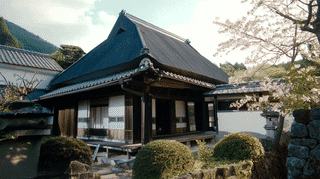
A Meiji-period main house in Manno, Kagawa Prefecture, Japan. Eaves run round all four sides, and one formal room also serves as the altar room there.

A c.1931 townhouse facing the old Konpira road in Takamatsu, Kagawa: black plaster over white tile, stepped copper eaves and a gabled porch. Registered 2005.
A c.1931 two-storey clay-walled storehouse in Takamatsu, Kagawa, once used for bottling sake: five bays long and 48 square metres, finished to match its neighbour.
A c.1931 four-and-a-half-mat sukiya pavilion in the courtyard of a Takamatsu townhouse, with a half-gabled, half-hipped roof, giboshi railings and a drum bridge.
A c.1931 two-storey clay-walled sake storehouse in Takamatsu, Kagawa, part of a townhouse's street front: high namako tiling, white plaster and a thick eaves band.
The Middle Sake Storehouse at Ayagiku Sake Brewery in Ayagawa, Kagawa, is an early Showa earthen storehouse 34 m long, with a plaster brand name on its gable.
The Detached Tatami Room at Ayagiku Sake Brewery in Ayagawa, Kagawa, is an early Showa nine-mat guest room whose hipped roof drops a step on the south side.
The East Sake Storehouse at Ayagiku Sake Brewery in Ayagawa, Kagawa, is a late Meiji earthen storehouse whose roof sweeps down on the east to span 14.2 meters.
The West Sake Storehouse at Ayagiku Sake Brewery in Ayagawa, Kagawa, is a 1950 timber hall with a red-tiled south section and a board-clad west face on the highway.
A 1920 classroom block of the former Awashima Seamen's School in Kagawa, the largest of five registered structures, with its own variant gable and canopy.
A 1920 single-storey classroom block of the former Awashima Seamen's School in Kagawa, later a maritime gallery, its seaward front matching the Main Building.
The 1920 judo hall of the former Awashima Seamen's School in Kagawa, a plain timber building whose trussed roof leaves the mat floor entirely free of posts.
The 1920 timber main building of the former Awashima Seamen's School in Kagawa, with an upstairs auditorium, clapboard walls and a half-timbered central gable.
A pair of 1920 granite gateposts, 109 cm high, at the former Awashima Seamen's School in Kagawa, with chamfered corners and rounded tops typical of the Taisho era.
Late Edo gatehouse range and U-shaped barn of the Awaya Okada merchant house in Sakate, Shodoshima, Kagawa, with tiled gabled roofs, fronting the 1830 main house.
Timber house of 1930 in Zentsuji, Kagawa, with a small mortar-finished Western wing beside the entrance of a Japanese home; a fine example of the type.
Early Showa roofed board fences framing a Sakaide salt family's entrance: 2.6 metres high, 41 metres long, with battened boards and a paired diagonal lattice on top.
Late Meiji granite borders lining the 16-metre approach to a Sakaide salt family's gate: 0.7-metre stone walls capped with cut blocks holding planting beds.
The late Meiji yakuimon gate of a Sakaide salt family's estate: 2.1 metres wide under a gently swelling tiled roof, with four beams on its lintel and a wicket door.
Built around 1890 for a Sakaide salt family and enlarged about 1932, this 283 m² hip-and-gable house mixes Japanese and Western rooms. Registered 2019; private.
More from Kagawa
Kagawa’s registered properties across designations, with featured heritage and travel notes.
The complete kokuhō catalogue — browse by prefecture, period, and category.
Nationwide jūyō bunkazai — architecture, sculpture, painting, crafts, and documents.