
Meiji
Kagawa · 明治Browse Kagawa’s cultural heritage from the Meiji period (1868 – 1912). Filter by type and keyword, with concise stories, maps, and travel tips.
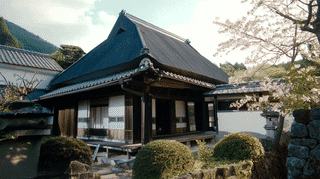
A Meiji-period main house in Manno, Kagawa Prefecture, Japan. Eaves run round all four sides, and one formal room also serves as the altar room there.

Twelve buildings atop Kotohira Shrine's 785 steps, rebuilt in plain cypress after the Shinto-Buddhist separation of the 1870s and designated in 2024: dates, details.
Timber officers' club of the army's 11th Division, completed in 1903 in Zentsuji, Kagawa; restored to its original Renaissance-style form and open free to visitors.
Early-Meiji stone lighthouse on Nabeshima, Sakaide, Kagawa, among the first built under Richard Henry Brunton; its grounds are open, with views of the Seto Ohashi.
The East Sake Storehouse at Ayagiku Sake Brewery in Ayagawa, Kagawa, is a late Meiji earthen storehouse whose roof sweeps down on the east to span 14.2 meters.
Late Meiji granite borders lining the 16-metre approach to a Sakaide salt family's gate: 0.7-metre stone walls capped with cut blocks holding planting beds.
The late Meiji yakuimon gate of a Sakaide salt family's estate: 2.1 metres wide under a gently swelling tiled roof, with four beams on its lintel and a wicket door.
Built around 1890 for a Sakaide salt family and enlarged about 1932, this 283 m² hip-and-gable house mixes Japanese and Western rooms. Registered 2019; private.
A late Meiji two-storey wing of formal rooms behind a Sakaide salt family's house, with polished log posts, ebony trim and mist-pattern transoms on both floors.
A two-storey clay-walled storehouse of about 1911 in a Sakaide salt family's courtyard: white plaster, namako tiles at base and corners, and a Western roof truss.
Late Meiji plastered earthen walls flanking a Sakaide salt family's gate: 2.4 metres high and 47 metres long, on stone bases, with hachiso motifs at the corners.
Built in mid-Meiji Japan at Ubushina Shrine in Utazu, Kagawa, this 27 sq m two-storey earthen storehouse hides a Western roof truss behind tiled gables and plaster.
Raised in 1874 at Ubushina Shrine in Utazu, Kagawa, this 37 sq m tiled hall omits bracketing across its body and gathers all carving, a wave motif, at the canopy.
An early Meiji firewood barn at the corner of a goshi estate in Takamatsu: 16.4 m long, a windowless storehouse-built wall to the road, open within. Seen outside.
A mid Meiji gate and wall dividing the entry court from the garden of a goshi estate in Takamatsu: a yakuimon gate, white plaster one side, black the other.
An early Meiji two-storey storehouse on a goshi estate in Takamatsu: rice store east, utensil store west, and an upper floor with mesh windows and gapped boards.
An early Meiji barn in Takamatsu where a goshi family matured liquid fertilizer in three big jars: blind plastered wall to the road, open to the yard. Seen outside.
A c.1902 guest bath and lavatory at a goshi estate in Takamatsu: log framing, an iron-tube tub, a celadon toilet and round lattice windows. Not open to the public.
Timber shop of 1901 of a sake brewer in Zentsuji, Kagawa, its black-plastered upper floor painted with the name of Gogaku sake, with a bowed roof and plaster relief.
Twin timber brewing storehouses of the early Meiji period at a soy sauce brewery at Obe on Shodoshima, Kagawa, the core of the works, with slatted upper windows.