
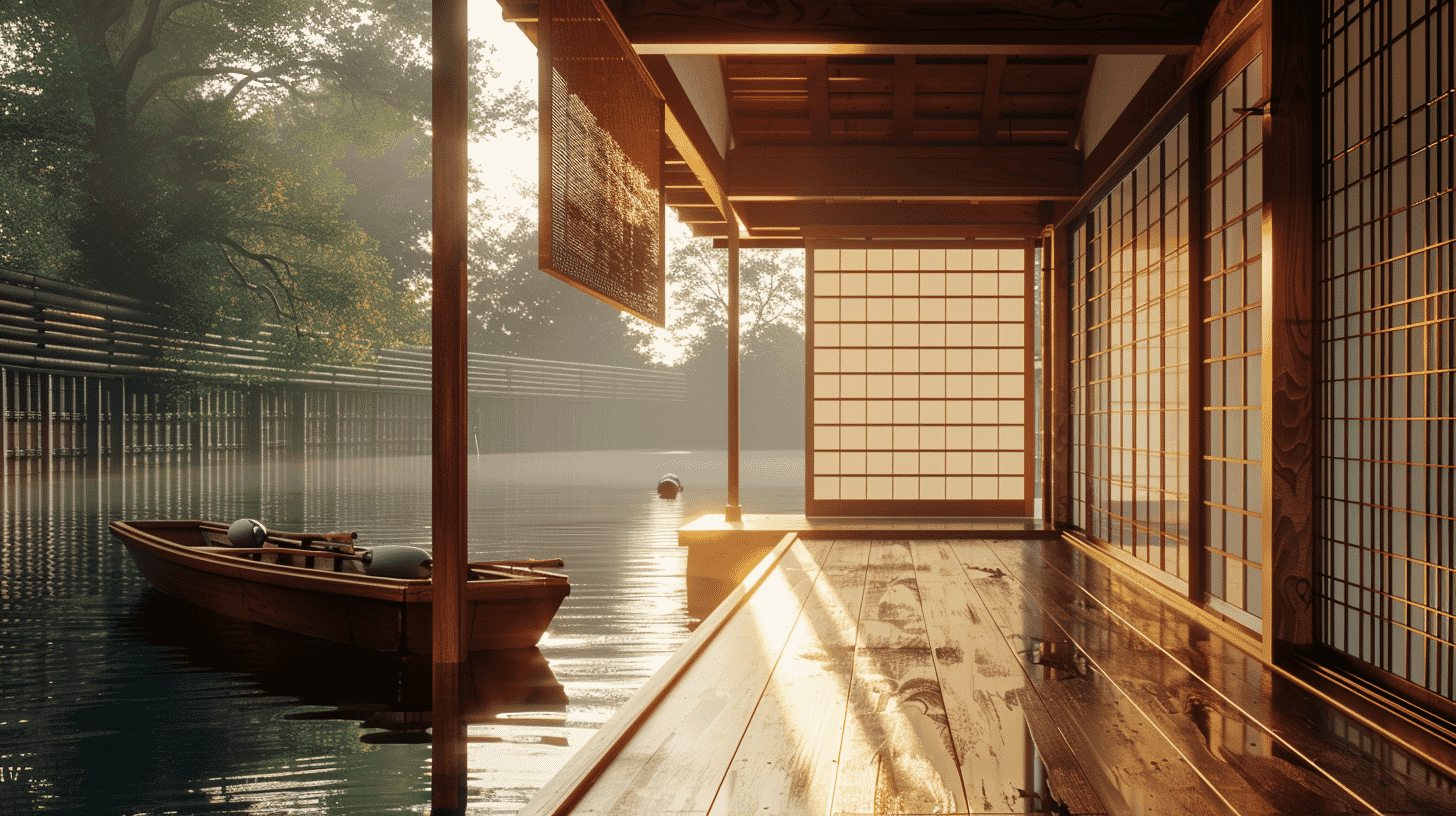
A Three-Storey Pavilion, National Treasure since 1951
Honganji Temple Hiunkaku (本願寺飛雲閣, Honganji Hiunkaku) stands at Honganji Monzen-cho, Horikawa-dori Hanayacho-sagaru, Shimogyo Ward, Kyoto City, Kyoto Prefecture, designated a National Treasure on 9 June 1951. It had become an Important Cultural Property on 28 December 1897. The quantity is one building, the designation number 00005, and the owner Honganji. Nothing is designated as an appendage.
The Agency for Cultural Affairs places it under pre-modern residential architecture. Though it stands within a temple precinct, it is classed as a dwelling rather than a temple building. The period is Momoyama, given as 1573 to 1614.
Its dimensions are 25.8 metres on the south and north faces, 11.8 metres on the east and 12.5 metres on the west, three storeys, roofed in split boards.
East and West Differ by 0.7 Metres
The dimensions repay attention.
South and north are both 25.8 metres. East, however, is 11.8 metres and west 12.5, a difference of 0.7 metres.
North and south agree; east and west do not. The building has long been described as asymmetrical, and that asymmetry appears as a figure in the Agency's own record.
Seven-tenths of a metre is about the margin at which a difference becomes noticeable. The plan is not a true rectangle.
The Agency gives no reason. Whether the site imposed it or the design intended it cannot be told from the record.
Each Storey Has Its Named Rooms
The field for structure and form lists the rooms floor by floor.
The ground floor comprises the Shokenden, the eight-views room, the boat-entry room, an aisle, a veranda and a tea room. The first floor comprises the poets' room, the stair, a wrapping veranda and a mezzanine stair hall. The second floor comprises the Tekiseiro and a stair hall.
The divisions thin out as the building rises: six below, four above that, two at the top. At the top there is only the Tekiseiro and its stair hall.
The boat-entry room names its own use. A room a boat enters tells you the building stands at the water.
Tekiseiro means the tower for plucking stars, so the name of the top floor states its height. The Shokenden, the eight-views room and the poets' room each have their own derivation, but the Agency does no more than name them.
As at Nanzenji and Zuiganji, the rooms are listed in the field for structure and form. Here, though, they are set out storey by storey.
What the Record Does Not Say
Much has been said about the origins of this building as well.
The Agency's commentary field is empty. Beyond the structure and form, the dimensions and the dates of designation, no words of assessment are recorded.
Accounts elsewhere say the pavilion was moved from the Jurakudai palace. The Agency's record contains no such statement, and the date field goes no further than Momoyama, 1573 to 1614, a span of forty-one years.
The same accounts call it one of the three great pavilions of Kyoto alongside the Golden and Silver Pavilions. The Agency's record contains no comparison with other buildings.
This article follows the record and keeps to the structure, the dimensions and the arrangement of rooms.
Visiting
Honganji is at Horikawa-dori Hanayacho-sagaru, Shimogyo Ward, Kyoto City. The pavilion is not normally open, and access follows the temple's practice.
Special openings are arranged from time to time, so check the temple's information before travelling.
What repays attention is how the three storeys are made up: six divisions below, four above, two at the top, and a plan measuring 25.8 metres north to south against 11.8 and 12.5 metres east and west.
The roof runs to three tiers, laid in split boards, thin shingles in overlapping courses, neither tile nor cypress bark.
Q&A
- When was the pavilion designated?
- On 9 June 1951, having become an Important Cultural Property on 28 December 1897. It counts as one building under designation number 00005, belongs to Honganji, and has nothing designated as an appendage.
- Is it really asymmetrical?
- The Agency's dimensions give 25.8 metres on the south and north faces, 11.8 metres on the east and 12.5 on the west. North and south agree while east and west differ by 0.7 metres, so the plan is not a true rectangle. No reason is recorded.
- What rooms are there?
- The ground floor comprises the Shokenden, the eight-views room, the boat-entry room, an aisle, a veranda and a tea room; the first floor the poets' room, the stair, a wrapping veranda and a mezzanine stair hall; the second floor the Tekiseiro and a stair hall. The divisions thin out as the building rises.
- Why is it classed as a dwelling?
- The Agency places it under pre-modern residential architecture. Though it stands within a temple precinct, it is classed as a dwelling rather than a temple building. The boat-entry room among its names also shows it stands at the water.
- Was it moved from the Jurakudai palace?
- The Agency's commentary field is empty and contains no statement about a removal. The date field goes no further than Momoyama, 1573 to 1614. This article keeps to the structure, the dimensions and the arrangement of rooms.
Basic Information
| Name | Honganji Temple Hiunkaku (本願寺飛雲閣, Honganji Hiunkaku) |
|---|---|
| Location | Honganji Monzen-cho, Horikawa-dori Hanayacho-sagaru, Shimogyo Ward, Kyoto City, Kyoto Prefecture (Honganji) |
| Designation | National Treasure (structure, pre-modern residential architecture), designation no. 00005; nothing designated as an appendage |
| Year Designated | 1897 (28 December), Important Cultural Property; 1951 (9 June), National Treasure |
| Quantity | 1 building |
| Dimensions | 25.8 metres on the south and north faces, 11.8 metres on the east and 12.5 metres on the west, 3 storeys, roofed in split boards. The ground floor comprises the Shokenden, the eight-views room, the boat-entry room, an aisle, a veranda and a tea room; the 1st floor the poets' room, the stair, a wrapping veranda and a mezzanine stair hall; the 2nd floor the Tekiseiro and a stair hall. Momoyama period |
| Owner | Honganji |
| Public Access | Not normally open; special openings are arranged from time to time |
References
- Agency for Cultural Affairs, National Cultural Properties Database: Honganji Hiunkaku
- https://kunishitei.bunka.go.jp/bsys/maindetails/102/1815
- Honganji: the Hiunkaku
- https://www.hongwanji.kyoto/see/hiunkaku.html
- Honganji official site
- https://www.hongwanji.kyoto/
- Agency for Cultural Affairs: introduction to cultural properties
- https://www.bunka.go.jp/seisaku/bunkazai/shokai/
Last verified: 2026.09.05
