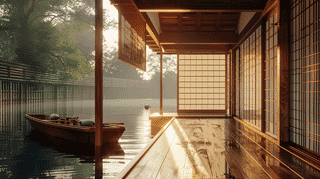
A Momoyama Bathhouse Linked to the Hiunkaku
The Honganji Temple Bathhouse (Okakudai) and Attached Corridor (本願寺浴室(黄鶴台)附廻廊, Honganji Yokushitsu, Ōkakudai) is a Momoyama-period bathhouse of 1573 to 1614 in the southeast corner of Honganji (Nishi Honganji) in Shimogyo Ward, Kyoto City, designated an Important Cultural Property on August 1, 1908.
The name 黄鶴台, "Yellow Crane Terrace", is read Ōkakudai, written Okakudai without the macron. The designation covers the bathhouse (Okakudai) as one building, with a corridor added as an attached item (Tsuketari). The Agency for Cultural Affairs classes it as residential rather than temple architecture.
The Agency records the building as 11 bays long by 4 deep, single-storey, with a hipped Yosemune-zukuri roof of thin wooden shingles (Kokerabuki). The length is close to three times the depth, giving a long, narrow plan.
The Corridor from the Hiunkaku and the Raised Okakudai
The Honganji Temple Bathhouse (Okakudai) stands inside the Tekisuien garden in the southeast corner of the precinct, the same garden as the three-storey Hiunkaku pavilion.
Honganji describes the Okakudai as a raised-floor building with a hipped, shingled roof, joined to the Hiunkaku by a corridor that runs west from the pavilion. Stepping down from the Okakudai leads to the bathhouse, where a steam bath with a cusped karahafu gable and an iron cauldron stand in the southwest corner.
This was a steam bath rather than a tub: water heated in the cauldron filled the room with vapour. According to the temple, the bather controlled the heat by opening and closing the upper windows and the wooden doors.
How Many Buildings? The Name and the Count
The designated name of the Honganji Temple Bathhouse (Okakudai) and Attached Corridor brackets the bathhouse and the Okakudai together. The Agency's database treats them as a single building and gives one set of dimensions, 11 by 4 bays.
Honganji's guide, however, describes the bathhouse as a separate building below the Okakudai. In the temple's account the raised Okakudai and the steam-bath section are written up as distinct structures. Published sources do not show how this matches the Agency's single-building record, so this article gives both descriptions.
The attached corridor appears to correspond to the passage the temple describes running from the Hiunkaku. The temple lists this part as the "Okakudai and attached corridor" among the buildings it has restored.
Restoration from 2017 to 2020
According to Honganji, the Hiunkaku and the Honganji Temple Bathhouse (Okakudai) and Attached Corridor were restored together as a state-subsidised project from July 2017 to April 2020, a period of 2 years and 10 months. The temple's restoration log follows the re-shingling of the Hiunkaku's roofs.
Visiting the Honganji Temple Bathhouse (Okakudai)
Honganji keeps the Hiunkaku closed to the public as a rule, and the Honganji Temple Bathhouse (Okakudai) lies within the same Tekisuien garden. The temple calendar notes that matcha is served at the Hiunkaku during the Gōtan-e on May 20 and 21, which celebrates the birth of Shinran. The temple does not say if visitors on those days can approach the Okakudai or the bathhouse, so check with Honganji in advance.
The temple's guide gives no information on photography or interior access for this building. Directions to Honganji and opening hours are on the Honganji page.
Q&A
- When was the Honganji Temple Bathhouse (Okakudai) and Attached Corridor designated?
- It was designated an Important Cultural Property on August 1, 1908. The building dates from the Momoyama period, between 1573 and 1614.
- How is Honganji's 黄鶴台 pronounced?
- It is read Ōkakudai (Okakudai), meaning "Yellow Crane Terrace". The Agency for Cultural Affairs database gives the same reading.
- What is the steam bath in the Honganji Temple Bathhouse (Okakudai) like?
- In the southwest corner of the bathhouse are a steam bath with a karahafu gable and an iron cauldron. The heat was adjusted by opening and closing the upper windows and wooden doors.
- How is the Honganji Temple Bathhouse (Okakudai) related to the Hiunkaku?
- Both stand in the Tekisuien garden, and the Okakudai is joined to the Hiunkaku by a corridor running west. They were restored together from July 2017 to April 2020.
- Can visitors see the Honganji Temple Bathhouse (Okakudai) and Attached Corridor?
- The Tekisuien garden with the Hiunkaku is normally closed. Matcha is served at the Hiunkaku during the May Gōtan-e, but it is not published if visitors can approach the Okakudai, so ask Honganji.
Basic Information
| Name | Honganji Temple Bathhouse (Okakudai) and Attached Corridor (本願寺浴室(黄鶴台)附廻廊) |
|---|---|
| Location | Horikawa-dori Hanayacho-sagaru, Honganji Monzen-cho, Shimogyo Ward, Kyoto City, Kyoto Prefecture |
| Designation | Important Cultural Property (building) |
| Year Designated | August 1, 1908 (Meiji 41) |
| Quantity | 1 building (with 1 attached corridor) |
| Dimensions | 11 by 4 bays, single storey, hipped roof, wooden shingles |
| Owner | Honganji |
| Public Access | Not open to the public (in the Tekisuien garden with the Hiunkaku; access during events to be confirmed) |
References
- Agency for Cultural Affairs Database: Honganji Bathhouse (Okakudai) with Attached Corridor (Japanese)
- https://kunishitei.bunka.go.jp/bsys/maindetails/102/1819
- Honganji: Hiunkaku (Japanese)
- https://www.hongwanji.kyoto/see/hiunkaku.html
- Honganji: Precinct and Buildings (Japanese)
- https://www.hongwanji.kyoto/see/keidai.html
- Honganji: Restoration of Designated Buildings (Japanese)
- https://www.hongwanji.kyoto/see/repair.html
- Honganji: The Year at Honganji (Japanese)
- https://www.hongwanji.kyoto/know/annual.html
Last verified: 2026.10.04