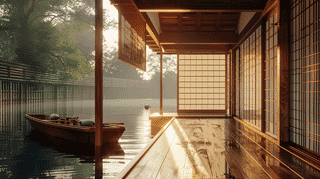
A Private Reception Hall Behind the Shiroshoin, Built in 1657
The Honganji Temple Kuroshoin and Corridor (本願寺黒書院及び伝廊, Honganji Kuroshoin oyobi Denrō) is a two-building group at Honganji (Nishi Honganji) in Shimogyo Ward, Kyoto City, consisting of a reception hall built in 1657 and the corridor that links it to the main shoin, and it was designated a National Treasure on June 28, 1956.
The Agency for Cultural Affairs database also records an earlier designation date of April 14, 1913, in its Important Cultural Property column. The designation covers both buildings as a single entry, and the Agency classes them as residential architecture rather than temple architecture.
The Kuroshoin (Black Shoin) stands northeast of the main shoin, the Taimensho and Shiroshoin, and is reached from it by the Denrō corridor. The Agency's record gives the Kuroshoin a frontage of 6 bays at the front but 7 at the back, and side walls of 4 bays on the left and 6 on the right, so no two opposite sides match. It has two roof tiers, a hipped Yosemune-zukuri form and a roof of thin wooden shingles (Kokerabuki). The corridor is 4 bays by 2, single-storey, with a simple two-sided roof, also shingled.
Formal Shiroshoin, Informal Kuroshoin
The Agency explains the Honganji Temple Kuroshoin and Corridor by contrast with its neighbour. The Shiroshoin (White Shoin) served as the formal audience hall and shows the strict vocabulary of Shoin-zukuri. The Kuroshoin appears to have been built for the inner, private side of temple life: it keeps the dignity of a shoin but borrows the lighter, more refined touches of Sukiya-zukuri, the style associated with tea houses.
Honganji itself describes the division in practical terms. The Shiroshoin was where official audiences took place, while the Kuroshoin was used for private meetings, for receiving guests and as the place where the head priest attended to temple business.
Cultural Heritage Online, in its World Heritage description of Honganji, goes a step further, suggesting that the Kuroshoin was the residence of the head priest and calling it a leading example of a sukiya-style shoin that includes rooms for tea.
Inside the Kuroshoin: Two Main Rooms and a Six-Mat Tea Room
According to the Agency, the principal rooms are the Ichi-no-ma (11 tatami mats) and the Ni-no-ma (20 mats). Their posts are Menkawa-bashira, squared timbers that keep strips of the original round log surface on the corners, which give the rooms a relaxed feel. Against that rustic note, the open-work carving of the Chigaidana staggered shelves and the Ranma transoms is fine and ornate. Cultural Heritage Online adds that both rooms have the standard shoin fittings: a raised tatami alcove, a Tsukeshoin built-in desk, the carved shelves and the transoms.
Behind the Ichi-no-ma is a six-mat Chashitsu, or tea room. It can also be entered from an earth-floored area at the northeast of the building, and the Agency reads this arrangement as an early idea of a tea room planned as part of a shoin.
Honganji lists the other parts of the Kuroshoin: the tea room, a Kusari-no-ma and a Hiroshiki grouped around the two main rooms, an Irigawa passage running around them, and a Tsuchibisashi earth-floored eave at the northeast corner. The temple states that the Ichi-no-ma, Ni-no-ma and tea room carry ink paintings by Kano Tan'yū.
That is the sharpest difference from the Taimensho and Shiroshoin, whose rooms are known for gold-ground and brightly coloured paintings. In the Honganji Temple Kuroshoin and Corridor the main rooms are painted in ink, and bark-edged posts share the space with delicate carving.
The Denrō Corridor and Later Repairs
The Denrō is the connecting passage to the Shiroshoin. The Agency singles out its doors, which are richly designed. Honganji describes the link as a double corridor, one side boarded and one side matted, leading from the northeast corner of the Shiroshoin's Ichi-no-ma.
Cultural Heritage Online's World Heritage text instead describes the corridor as joining the Kuroshoin to the Taimensho. Because the Agency's detailed explanation and the temple both describe the connection as being to the Shiroshoin, this article follows them.
The same World Heritage text records that the Honganji Temple Kuroshoin and Corridor underwent dismantling or partial dismantling repairs in 1953.
Seeing the Honganji Temple Kuroshoin and Corridor
Honganji treats its shoin buildings as non-public cultural properties. On the 16th of every month except January, which the temple calls Shinran's Day, worshippers who attend the morning service and sermon may join a guided tour of the shoin led by a monk. Registration is at the Ryūkoden hall from 9:00 a.m. to 10:00 a.m. on the day, the tour runs from 11:00 a.m. until about noon, places are limited to 40 and cannot be booked in advance, and photography is not allowed.
The temple does not say if the tour route includes the Kuroshoin and its corridor, so visitors hoping to see the Kuroshoin should ask when they register. Directions to Honganji and opening hours are on the Honganji page.
Q&A
- When was the Honganji Temple Kuroshoin and Corridor built, and when did it become a National Treasure?
- It was built in 1657 and designated a National Treasure on June 28, 1956. The Agency for Cultural Affairs database also records an Important Cultural Property designation date of April 14, 1913.
- How does the Honganji Kuroshoin differ from the Shiroshoin?
- The Shiroshoin was the formal audience hall and follows strict shoin-zukuri. The Kuroshoin served private meetings, guests and the head priest's temple business, and adds sukiya-style touches to the shoin form.
- What are the main rooms of the Honganji Kuroshoin like?
- The Ichi-no-ma (11 mats) and Ni-no-ma (20 mats) use bark-edged posts alongside finely carved shelves and transoms. A six-mat tea room lies behind the Ichi-no-ma and can also be entered from an earth-floored area.
- What is the corridor in the Honganji Temple Kuroshoin and Corridor?
- The Denrō is the passage linking the Kuroshoin with the Shiroshoin, 4 bays by 2 with a shingled roof. Honganji describes it as a double corridor, half boarded and half matted, and the Agency notes its decorative doors.
- Can visitors see the Honganji Temple Kuroshoin and Corridor, and is photography allowed?
- The shoin buildings are not open to the public, but monks guide visitors through them on the 16th of each month except January. Whether the Kuroshoin is on the route is not published, so ask at registration. Photography is not allowed.
Basic Information
| Name | Honganji Temple Kuroshoin and Corridor (本願寺黒書院及び伝廊) |
|---|---|
| Location | Horikawa-dori Hanayacho-sagaru, Honganji Monzen-cho, Shimogyo Ward, Kyoto City, Kyoto Prefecture |
| Designation | National Treasure (building) |
| Year Designated | Important Cultural Property April 14, 1913 (Taisho 2); National Treasure June 28, 1956 (Showa 31) |
| Quantity | 2 buildings (Kuroshoin, Denrō corridor) |
| Dimensions | Kuroshoin: 6 bays at the front and 7 at the back, 4 bays on the left side and 6 on the right, two roof tiers, hipped roof, wooden shingles; Corridor: 4 by 2 bays, single storey, two-sided roof, wooden shingles |
| Owner | Honganji |
| Public Access | Not open to the public (monk-guided shoin tour on the 16th of each month; check if the Kuroshoin is included) |
References
- Agency for Cultural Affairs Database: Honganji Kuroshoin and Corridor, Kuroshoin (Japanese)
- https://kunishitei.bunka.go.jp/bsys/maindetails/102/1825
- Agency for Cultural Affairs Database: Honganji Kuroshoin and Corridor, Denro (Japanese)
- https://kunishitei.bunka.go.jp/bsys/maindetails/102/1826
- Cultural Heritage Online: World Heritage, Honganji (Japanese)
- https://online.bunka.go.jp/special_content/component/39
- Honganji: Shoin and Noh Stages (Japanese)
- https://www.hongwanji.kyoto/see/shoin.html
- Honganji: Shinran's Day (Japanese)
- https://www.hongwanji.kyoto/see/shinransday.html
Last verified: 2026.10.04
Cultural Treasures in the Same Area
All are within walking distance in the same area, so we recommend visiting them together.
- Honganji Temple Kuroshoin and Corridor Kuroshoin 0.00 km
- Honganji Temple Kuroshoin and Corridor Denro 0.01 km