
National Treasure in 2024, 111 Years On
Manpukuji Temple (萬福寺) at Gokasho Sanbanwari, Uji City, Kyoto Prefecture, head temple of the Obaku school of Zen, was designated a National Treasure on 9 December 2024. The temple had become an Important Cultural Property in 1913, on 14 April. The owner is the Manpukuji religious corporation.
One hundred and eleven years separate the two. Among the properties covered here, gaps of fifty-four years at Ankokuji and sixty-two at Kitano Tenmangu have appeared; this interval far exceeds them.
The Agency for Cultural Affairs describes Manpukuji as the head temple of the Obaku school, founded by the Chinese monk Ingen. Building of the precinct began in 1661 and reached a first completion by 1679, with some new work and rebuilding since.
Preserving the Precinct as a Whole
The Agency's account states the purpose of the designation outright.
Seventeen buildings including the great hall are currently Important Cultural Properties; to these are added the memorial hall for mortuary tablets, the gabled great kitchen, and the hall enshrining the tablets of the successive Tokugawa shoguns, so as to preserve this distinctive precinct as a whole.
Preserve the precinct as a whole is written into the record as the reason. Rather than listing the merits of individual buildings, keeping the group together is what the designation is for.
The three added buildings differ from one another: one holds mortuary tablets, one is a gabled kitchen, one enshrines the tablets of the shoguns. Buildings of different use and form were added to complete the precinct.
Three added to seventeen makes twenty. What was missing was supplied so that the whole would be entire.
Late Ming and Early Qing Influence
The axis of the assessment is where the style came from.
The layout of the precinct and the architectural manner of its halls were shaped by Chinese Buddhist building of the late Ming and early Qing, which gives them high value in the architectural history of the early modern period.
Both layout and manner are named. Not the design of the individual buildings alone but how the buildings are arranged is held to be under that influence.
Ingen, who founded the temple, was a Chinese monk. The origin of the founder shows directly in the lineage of the buildings.
The Kannon hall at Eihoji was assessed as showing a Japanese turn through simplifying the Zen manner. Here, by contrast, the arrival of a Chinese manner is itself what is valued. Assimilation in one case, importation in the other.
The Form of the Great Hall
Of the great hall at the centre of the precinct, the Agency records the following.
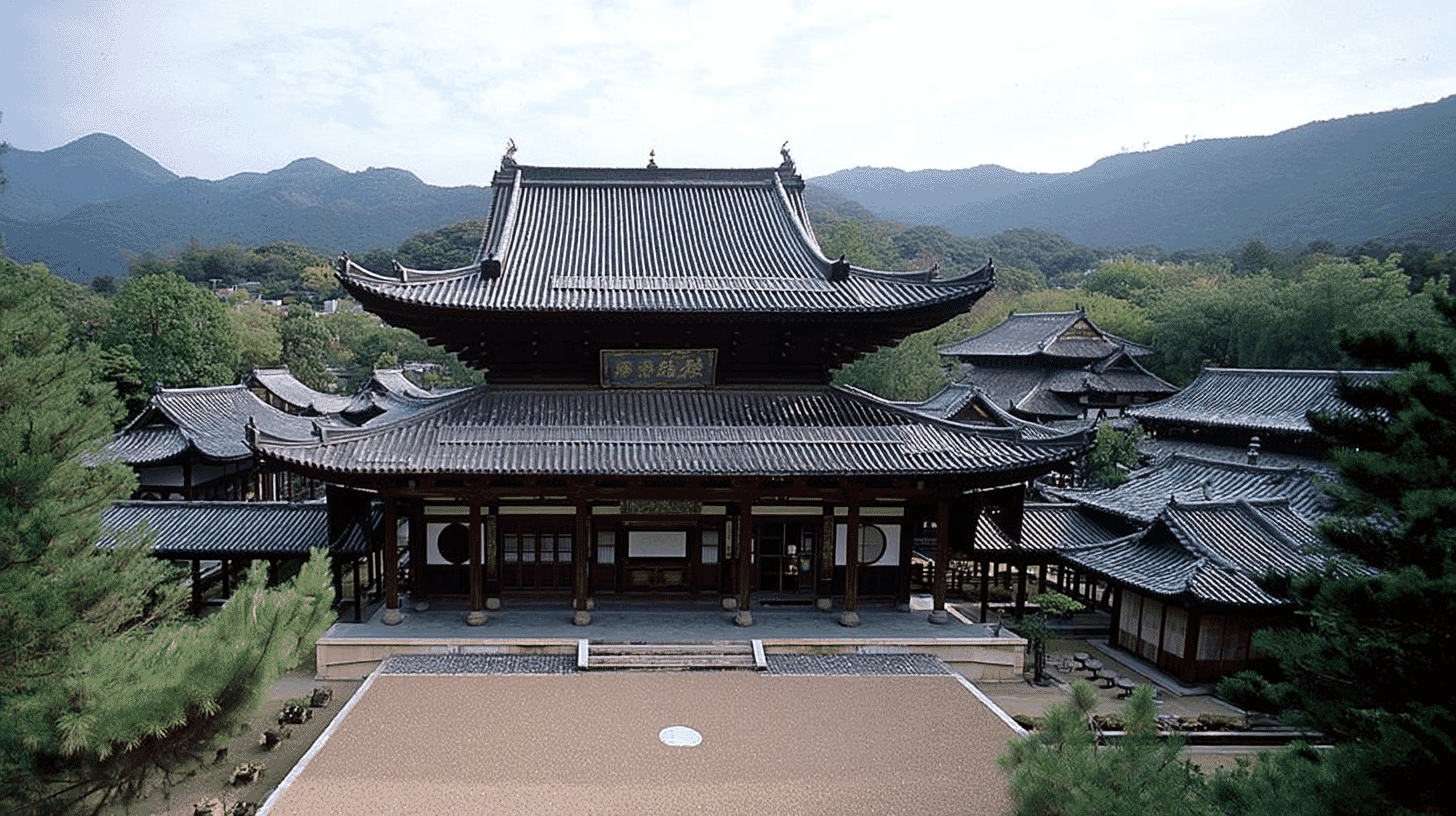
Three bays by three bays, single storey with a pent roof, hip-and-gable roof, heavy tile, with a raised terrace attached at the front. The date is given as mid-Edo, 1668.
A core three bays square with a pent roof around it. The same arrangement appears at Ankokuji, one bay square, and at Hokaiji, five bays square, here at another scale again.
A raised terrace adjoins the front. Such a platform serves for ceremony and is not a usual element in Japanese Buddhist halls.
Building of the precinct ran from 1661 to a first completion in 1679, so the great hall of 1668 falls within that span.
Visiting
Manpukuji is at Gokasho Sanbanwari, Uji City, Kyoto Prefecture. The designated buildings make up the precinct, so they are seen in the course of visiting it.
Hours and admission may change, so check the temple's information before travelling. Conditions for entering interiors can differ from building to building.
What repays attention is the layout. Given that the Agency values arrangement as well as manner, the point is to look at how the buildings stand in relation to one another, not only at each in turn.
At the great hall, the raised terrace at the front and the pent roof around a core three bays square can both be made out.
Q&A
- When did Manpukuji receive its designation?
- On 9 December 2024 as a National Treasure, having become an Important Cultural Property on 14 April 1913. One hundred and eleven years separate the two. The owner is the Manpukuji religious corporation.
- How many buildings are covered?
- The Agency records seventeen buildings including the great hall as currently Important Cultural Properties, to which are added the memorial hall, the gabled great kitchen and the hall of the shoguns' tablets. Three added to seventeen makes twenty.
- Why were the three added?
- The Agency states the purpose as preserving this distinctive precinct as a whole. Rather than listing the merits of individual buildings, keeping the group together is the reason. The three differ from one another in use and form.
- What marks the architecture?
- The Agency records that the layout of the precinct and the manner of its halls were shaped by Chinese Buddhist building of the late Ming and early Qing, giving them high value in early modern architectural history. Ingen, who founded the temple, was a Chinese monk.
- What form does the great hall take?
- Three bays by three, single storey with a pent roof, hip-and-gable roof, heavy tile, with a raised terrace attached at the front, dated to 1668. Such a terrace serves for ceremony and is not a usual element in Japanese Buddhist halls.
Basic Information
| Name | Manpukuji Temple (萬福寺) |
|---|---|
| Location | Gokasho Sanbanwari, Uji City, Kyoto Prefecture |
| Designation | National Treasure and Important Cultural Property (structures) |
| Year Designated | 1913 (14 April), Important Cultural Property; 2024 (9 December), National Treasure |
| Quantity | 17 buildings including the great hall, with 3 more added: the memorial hall, the great kitchen and the hall of the shoguns' tablets |
| Dimensions | The great hall is 3 bays by 3 bays, single storey with a pent roof, hip-and-gable roof, heavy tile, with a raised terrace attached at the front. Building of the precinct began in 1661 and reached a first completion by 1679. Mid-Edo period |
| Owner | Manpukuji religious corporation |
| Public Access | The buildings are seen in the course of visiting the precinct; hours and admission may change |
References
- Cultural Heritage Online: Manpukuji great hall
- https://bunka.nii.ac.jp/db/heritages/detail/147151
- Manpukuji, head temple of the Obaku school: official site
- https://www.obakusan.or.jp/
- Manpukuji: on the National Treasure designation
- https://www.obakusan.or.jp/information/2600
- Agency for Cultural Affairs, National Cultural Properties Database
- https://kunishitei.bunka.go.jp/
Last verified: 2026.09.05
Cultural Treasures in the Same Area
All are within walking distance in the same area, so we recommend visiting them together.
- Manpukuji Temple Tennoden 0.00 km
- Manpukuji Temple Bell Tower 0.04 km
- Manpukuji Temple drum tower 0.05 km
- Manpukuji Temple Soshido 0.05 km
- Manpukuji Temple Garando 0.05 km
- Manpukuji Temple Daeonghoden 0.06 km
- Manpukuji Temple Saido 0.07 km
- Manpukuji Temple Zendo 0.07 km
- Manpukuji Temple Daikuri 0.08 km
- Manpukuji Temple Sanmon 0.09 km
- Manpukuji Temple Shrine 0.09 km
- Manpukuji Temple Dharma hall 0.11 km
- Manpukuji Temple Eastern Hall 0.11 km
- Manpukuji Temple Nishihojo 0.11 km
- Manpukuji Temple Itokuden 0.15 km
- Manpukuji Temple Main Gate 0.16 km