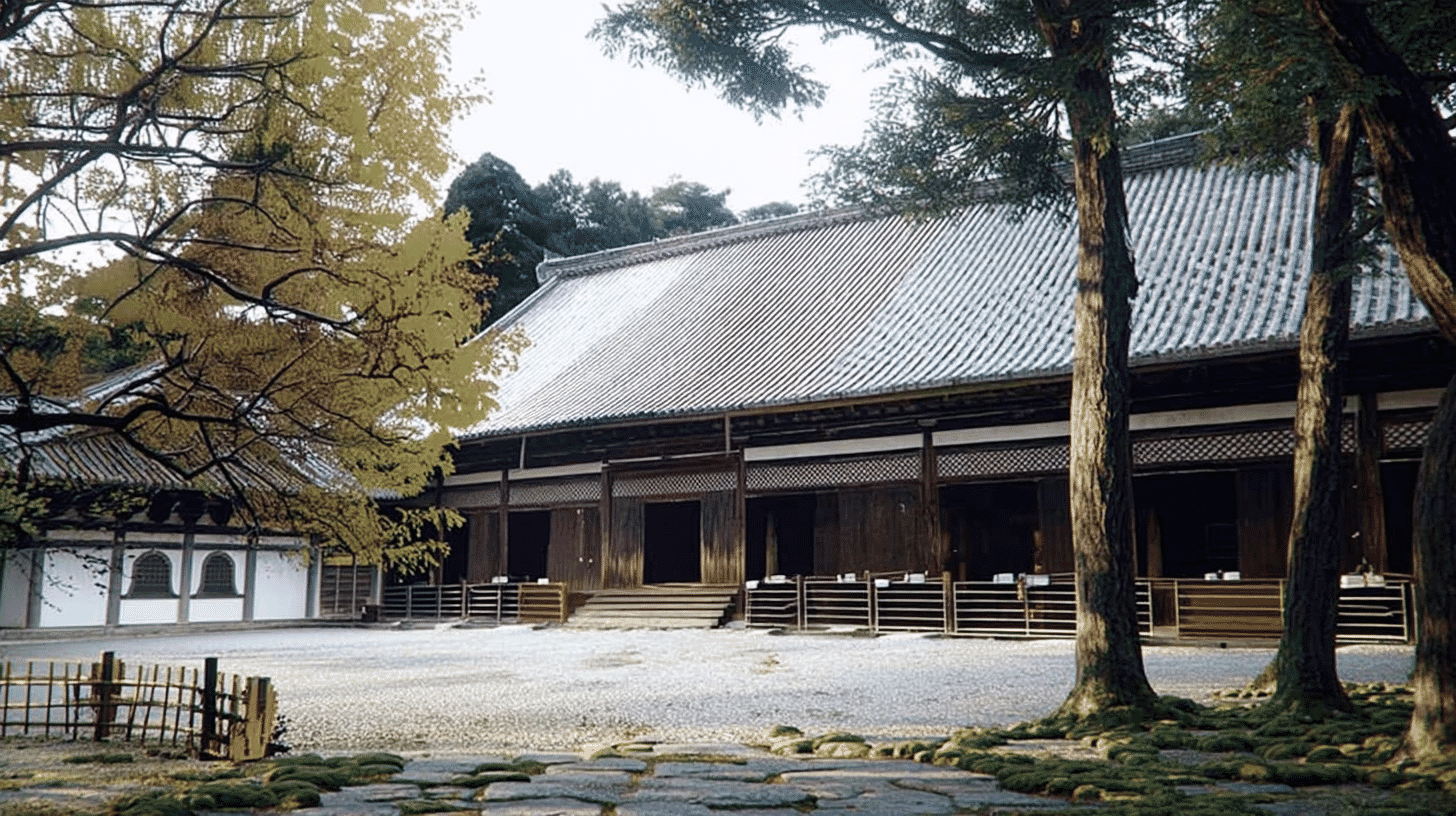
Zuiganji Temple Main Hall: A National Treasure of Momoyama Splendor in Matsushima

Discover Zuiganji Temple's National Treasure Main Hall in Matsushima, Miyagi. Built by Date Masamune in 1609, explore its golden fusuma paintings, Godaido Hall, and the finest Momoyama-era architecture in Japan's Tohoku region.

Zuiganji Temple Main Hall: A National Treasure of Momoyama Splendor in Matsushima

Standing amid the serene cedar groves of Matsushima — one of Japan's celebrated Three Great Views — Zuiganji Temple is home to some of the most remarkable architectural treasures in northern Japan. Its Main Hall (Hondo), originally known as the Hojo, has been designated a National Treasure for its extraordinary display of Momoyama-period craftsmanship: lavish gold-leaf fusuma paintings, intricate transom carvings, and a grand scale that befits the ambition of its patron, the legendary feudal lord Date Masamune. Together with the temple's Kitchen (Kuri), connecting Corridor, Onarimon Gate, Middle Gate, and the iconic Godaido Hall perched on a seaside islet, Zuiganji offers international visitors an unforgettable journey through Japan's cultural heritage.

A Thousand Years of Sacred History

The origins of Zuiganji Temple reach back to 828, when the revered monk Jikaku Daishi Ennin — who also founded temples at Yamadera and Hiraizumi — established a Tendai-sect temple called Enpukuji on this site. During the mid-thirteenth century, under the influence of Kamakura Shogunate regent Hojo Tokiyori, the temple was converted to a Rinzai Zen institution and renamed Enpukuji (円福寺).

By the Sengoku (Warring States) period, decades of conflict had left the temple in decline. Its fortunes changed dramatically in 1604 when Date Masamune, the newly established lord of Sendai domain and one of Japan's most charismatic samurai leaders, undertook a grand project to restore the temple as the family's ancestral mausoleum. Masamune personally oversaw the planning, summoned over 130 master craftsmen from the Kinki region (Kyoto and surrounds), and imported the finest cypress, cedar, and zelkova timber from the sacred forests of Kumano in Kii Province. After five years of painstaking construction, the rebuilt temple was completed in 1609 and received its present name: Matsushima Seiryuzan Zuigan Enpuku Zenji — commonly known as Zuiganji.

The Main Hall (Hondo) — National Treasure

The Main Hall is the crown jewel of Zuiganji and stands as one of the finest surviving examples of Momoyama-period temple architecture in Japan. Completed in the third month of Keicho 14 (1609), it was designated a National Treasure on March 31, 1953. The building spans an impressive thirteen bays in width and eight bays in depth, with a grand irimoya-style (hip-and-gable) roof covered in hon-kawara (formal) tiles. An entrance vestibule (genkan) is attached for ceremonial arrivals.

Inside, the hall is divided into multiple chambers, each adorned with distinctive fusuma (sliding door) paintings and ceiling designs that reflect the hierarchy of the Date clan's social order. The most spectacular of these is the Shitsuchu, known as the Peacock Room (Kujaku no Ma), where the principal Buddhist image — a statue of Sho Kannon Bosatsu (Holy Avalokitesvara), said to have been Date Masamune's personal devotional figure — is enshrined. Resplendent cherry blossoms on gold leaf cover the fusuma across three walls, evoking a vision of the Pure Land paradise. The folding-screen-style ceiling (oriagari kogumi goten-jo) further elevates the room's majesty.

The Bun'o no Ma (King Wen Room) served as the reception chamber for Date clan relatives and features paintings by Hasegawa Touin, a distinguished disciple of the great Hasegawa Tohaku. These depict scenes from the founding of China's Zhou dynasty — an allegory for wise governance that would have resonated with Masamune's political ambitions.

Perhaps the most celebrated decorative elements are the ranma (transom) carvings above the corridors. These were executed by Tsuru Gyobu Zaemon Kunitsugu, a master woodcarver from Kishu Negoro who was lauded as "an artisan without equal under heaven." His carvings of phoenixes, peacocks, cranes, chrysanthemums, and peonies brim with auspicious symbolism, their detail so fine that each feather and petal seems to quiver with life.

Why the Main Hall Was Designated a National Treasure

The designation recognizes the Main Hall as a large-scale hojo (abbot's quarters) of exceptional cultural significance. Several factors contributed to this honor. The building is a superb embodiment of Momoyama-era architectural aesthetics, combining the grandeur of castle architecture with the refined spatial sensibility of Zen Buddhism. The elaborate decorative programs — gilded fusuma paintings, carved transoms, and sculpted doors — represent the pinnacle of early seventeenth-century craftsmanship. Together with the National Treasure Osaki Hachimangu Shrine in Sendai, Zuiganji's Main Hall stands as a vital testament to the Date clan's cultural patronage and the distinctive "Date culture" that flourished in the Tohoku region. Its art-historical and cultural significance has been recognized as profoundly important for understanding the broader development of Japanese civilization.

The Kitchen (Kuri) and Corridor — National Treasures

Adjacent to the Main Hall stand two more National Treasures: the Kitchen (Kuri) and the Corridor (Roka) that connects them. The Kuri, completed around the same time as the Main Hall in 1609, was designated a National Treasure on June 27, 1959.

Measuring 13.8 meters across the front and 23.6 meters deep, the Kuri is built in the kirizuma-zukuri (gable) style with formal tile roofing and a distinctive irimoya-style smoke vent atop the ridge. In Zen monasteries, the kuri traditionally served as the communal kitchen, and this building is regarded as one of Japan's three greatest temple kitchens. What sets Zuiganji's Kuri apart is its extraordinary decorative treatment: the front gable is adorned with bold arabesque carvings in the Momoyama style, and the interior beam framework is both massive and elegantly composed — far exceeding the utilitarian simplicity typical of such structures.

The Corridor connecting the Kuri to the Main Hall features refined exposed rafters (kesho-daruki) and graceful architectural detailing. Remarkably, it is the only corridor in Japan to have received National Treasure designation — a reflection of both its structural beauty and its role in completing the harmonious ensemble of Zuiganji's sacred architecture.

The Onarimon Gate and Middle Gate — Important Cultural Properties

The temple precinct is accessed through two gates that together illustrate the strict social hierarchy of the Edo period. Both were designated Important Cultural Properties in 1956.

The Onarimon (Lord's Gate) is a substantial yakuimon-style gate with a hip-and-gable roof of formal tiles. Its deep eaves and heavy proportions convey authority and prestige; this was the gate reserved for the domain lords, members of the imperial family, and other dignitaries of the highest rank.

The Chumon (Middle Gate), positioned directly in front of the Main Hall, is a shikyakumon (four-legged gate) with a gable roof of kokera-buki (wooden shingles) — the only shingle-roofed structure within the complex. Its exposed structural framework has a spare, austere beauty that contrasts strikingly with the grandeur of the Onarimon. Samurai attendants entered through this gate while their lords proceeded through the Onarimon. The plaque reading "Zuigan Enpuku Zenji" was inscribed by Tosui Tosho, the 100th abbot of Zuiganji.

Flanking both gates are taikohei (drum walls) — hollow-centered walls filled loosely with stone that produce a low, drum-like resonance when struck. These walls are finished in white plaster and lend a dignified character to the approach.

Godaido Hall — The Icon of Matsushima

Standing on a tiny islet just off the coast of Matsushima Bay, Godaido Hall is perhaps the most photographed structure in the entire region and has been designated an Important Cultural Property. It was rebuilt by Date Masamune in 1604, prior to the main temple reconstruction, making it the oldest surviving Momoyama-period building in the Tohoku region.

The hall enshrines five statues of the Godai Myo'o (Five Wisdom Kings), with Fudo Myo'o at the center flanked by Gozanze, Daiitoku, Gundari, and Kongoyasha. These sacred images are hikbutsu (secret Buddhas) that are revealed to the public only once every 33 years; the next unveiling is scheduled for 2039. The hall is built in the hogyo-zukuri (pyramidal) style with formal tile roofing, and its most notable exterior feature is the set of twelve zodiac animal carvings adorning the kaerumata (frog-leg struts) beneath the eaves, each animal positioned according to its corresponding compass direction.

To reach Godaido, visitors cross the sukashi-bashi (transparency bridge), a red wooden walkway with intentional gaps between the planks through which the sea is visible below. This design is said to encourage mindfulness — compelling visitors to watch their steps and compose their thoughts before entering the sacred space.

Highlights and Seasonal Attractions

A visit to Zuiganji offers a wealth of experiences beyond its National Treasure buildings. The approach to the Main Hall proceeds along a long, straight path shaded by towering cedar trees, creating a contemplative atmosphere from the moment of arrival. To one side, visitors can explore a series of meditation caves carved into the rock face — remnants of centuries of Buddhist practice at this site, some containing carved stone statues and memorial stupas.

In the temple grounds, visitors will find the Garyu-bai (Crouching Dragon Plum Trees), red and white plum trees said to have been planted by Date Masamune himself. These blossom in late March through early April. The contemporary dry landscape gardens, designed to express the culture of Matsushima and the spirit of Zen, provide tranquil spaces for reflection.

The Seiryuden Museum, located within the compound, houses a rotating collection of the temple's treasures, including original fusuma paintings from the Main Hall (displayed on a limited-time basis), calligraphy, Buddhist sculptures, and artifacts related to the Date clan. A wooden portrait of Date Masamune and his wife Megohime can also be viewed here.

Each autumn, Zuiganji hosts special nighttime illumination events in collaboration with creative teams, offering visitors a rare opportunity to experience the National Treasure buildings bathed in light and projection art — a magical fusion of heritage and contemporary culture.

Surrounding Attractions

Zuiganji sits at the heart of Matsushima, one of Japan's Three Great Views, famed for the more than 260 pine-covered islets that dot the bay. A sightseeing cruise around the bay is highly recommended for appreciating the scenic beauty that has inspired poets and painters for centuries — including the haiku master Matsuo Basho, who visited in 1689.

Adjacent to Zuiganji is Entsuin Temple, the mausoleum of Date Mitsumune (Masamune's grandson), known for its moss gardens, Zen rock landscapes, and a remarkable mausoleum featuring hidden Christian motifs from the early Edo period. A short walk away, the Kanrantei Pavilion offers panoramic views of the bay and houses Important Cultural Property screen paintings.

The nearby Shiogama Shrine and the Shiogama Fish Market — one of the largest tuna markets in Japan — provide further cultural and culinary experiences. A day combining Zuiganji, Matsushima Bay, and Shiogama makes for an unforgettable excursion from Sendai, which is only 30 to 40 minutes away by train.

📍 Plan Your Visit to Miyagi
Find tours, activities & transport passes near Zuiganji Temple Main Hall (former Abbot's Chamber)
[ Matsushima Bay Cruise & Sendai Food Tours ]

Q&A

QIs photography allowed inside the Main Hall?
APhotography is not permitted inside the Main Hall or the Kuri, as these contain National Treasure-designated structures and fragile cultural properties. However, you are welcome to photograph the exterior of the buildings, the temple grounds, gardens, and Godaido Hall. Tripods, selfie sticks, and drones are also prohibited on the premises.
QIs English-language information available at Zuiganji?
AYes. Zuiganji provides brochures in English, Simplified Chinese, Traditional Chinese, Korean, and Thai. Signage within the temple grounds includes some English explanations. The Multilingual Support Project by the Japan Tourism Agency has also created detailed English texts for many of the temple's features.
QWhen is the next public viewing of the Five Wisdom Kings in Godaido Hall?
AThe five statues of the Godai Myo'o are secret Buddhist images (hikbutsu) that are shown to the public only once every 33 years. The next scheduled unveiling is in 2039. Godaido Hall itself is open to visitors year-round at no charge, and the zodiac carvings on the exterior are always visible.
QHow do I get to Zuiganji Temple from Sendai?
AFrom JR Sendai Station, take the JR Senseki Line to Matsushima-Kaigan Station (approximately 41 minutes). From there, the temple is about a 5 to 10-minute walk. Alternatively, take the JR Tohoku Main Line to Matsushima Station (about 24 minutes), then walk approximately 20 minutes. By car, the temple is accessible from the Sanriku Expressway Matsushima-Kaigan Interchange in about 10 minutes.
QHow much time should I plan for a visit?
AAllow at least 60 to 90 minutes to visit the Main Hall, Kuri, temple grounds, and the Seiryuden Museum. If you also wish to visit Godaido Hall and the surrounding Matsushima area (including a bay cruise), half a day or more is recommended.

Basic Information

Official Name Matsushima Seiryuzan Zuigan Enpuku Zenji (松島青龍山瑞巌円福禅寺)
Cultural Property Designation National Treasure: Main Hall (Hondo, 1953), Kitchen (Kuri) & Corridor (1959); Important Cultural Property: Onarimon Gate & Middle Gate (1956), Godaido Hall (1952)
Religious Affiliation Rinzai Zen Buddhism, Myoshinji School
Founding 828 (Tencho 5) by Jikaku Daishi Ennin; rebuilt by Date Masamune, completed 1609 (Keicho 14)
Main Hall Structure 13 bays wide, 8 bays deep, single-story, irimoya-zukuri (hip-and-gable), hon-kawara-buki (formal tile), with attached entrance vestibule
Address 91 Chonai, Matsushima, Matsushima-machi, Miyagi-gun, Miyagi 981-0213, Japan
Admission Adults: ¥700 / Children (under 15): ¥400; Godaido Hall: Free
Hours April–September: 8:30–17:00 / March & October: 8:30–16:30 / February & November: 8:30–16:00 / January & December: 8:30–15:30 (last admission 30 min before closing)
Access JR Senseki Line, Matsushima-Kaigan Station: approx. 5–10 min walk; JR Tohoku Main Line, Matsushima Station: approx. 20 min walk
Website https://www.zuiganji.or.jp/

References

瑞巖寺本堂(元方丈) — Cultural Heritage Online (文化遺産オンライン)
https://bunka.nii.ac.jp/heritages/detail/173372
指定文化財〈国宝〉瑞巴寺本堂 — Miyagi Prefectural Government
https://www.pref.miyagi.jp/soshiki/bunkazai/04zuiganji.html
指定文化財〈国宝〉瑞巌寺庫裏及び廊下 — Miyagi Prefectural Government
https://www.pref.miyagi.jp/soshiki/bunkazai/05zuiganji.html
指定文化財〈重要文化財〉瑞巌寺御成門及び中門 — Miyagi Prefectural Government
https://www.pref.miyagi.jp/soshiki/bunkazai/0607zuiganji.html
境内のご案内 — National Treasure Zuiganji (Official Website)
https://zuiganji.or.jp/guide/keidai_01.php
拝観案内 — National Treasure Zuiganji (Official Website)
https://www.zuiganji.or.jp/guide/
瑞巌寺 — Matsushima Tourism (日本三景松島WEBサイト)
https://www.matsushima-kanko.com/miru/detail.php?id=140
五大堂 — Wikipedia
https://ja.wikipedia.org/wiki/五大堂
Zuiganji Temple — VISIT MIYAGI
https://visitmiyagi.com/articles/zuiganji-temple/
国宝-建築|瑞巖寺 本堂(元方丈) — WANDER 国宝
https://wanderkokuho.com/102-00132/
瑞巌寺 御成門・中門・太鼓塀 — Multilingual Commentary Database (MLIT)
https://www.mlit.go.jp/tagengo-db/H30-00209.html

Last verified: 2026.02.08

Nearby heritages
