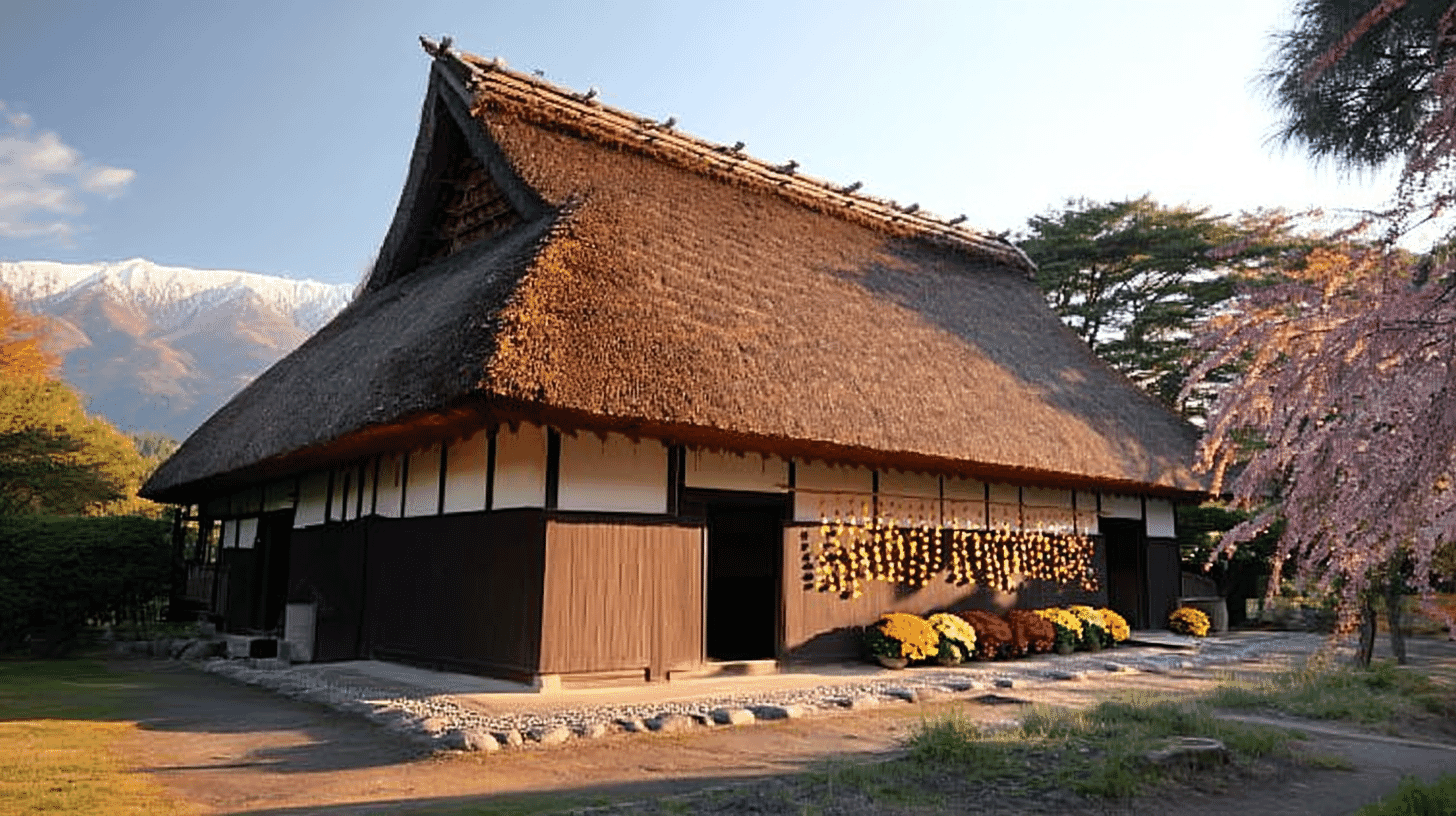
Former Takahashi Family Residence: A Hidden Cultural Treasure in Azumino
Nestled at the foot of the magnificent North Alps in Nagano Prefecture, Azumino is a region celebrated for its crystal-clear spring waters, sweeping rice paddies, and a profound sense of timeless tranquility. Within this idyllic landscape lies a remarkable cultural heritage site that offers visitors an authentic window into traditional Japanese rural life: the Former Takahashi Family Residence (Kyū Takahashi-ke Jūtaku).
This extraordinary complex of historic buildings, registered as a National Tangible Cultural Property, comprises a main house dating back to the Edo period and three earthen-wall storehouses from the Meiji era. But the site holds an even deeper significance—it is the birthplace of Takahashi Setsuro (1914–2007), one of Japan's most celebrated lacquer artists who received the prestigious Order of Culture in 1997.
Historical Background: A Prosperous Farming Family's Legacy
The Takahashi family were prominent landowners who prospered in the Hotaka region of what is now Azumino City. Their wealth and social standing are evident in the substantial construction of their residence. During the modern era, family members served in distinguished positions, including the role of village mayor of Kita-Hotaka.
The main house is believed to have been constructed during the mid-Edo period, sometime between 1751 and 1829. Over the centuries, the building underwent various additions and modifications, but a recent comprehensive restoration project has returned the main structure to its appearance at the time of completion, allowing visitors to experience authentic Edo-period architecture.
The three storehouses—North, West, and South—were added during the Meiji period, creating a harmonious ensemble that represents the evolution of rural architecture from the Edo period into the modern era. Together, these buildings stand as valuable examples of farmhouse architecture from the Hotaka region, preserving the rural landscape that characterized this area from the late Edo through early modern periods.
Why Was It Designated as a Registered Tangible Cultural Property?
On July 1, 2003, the Former Takahashi Family Residence received official registration as a Tangible Cultural Property of Japan. This designation recognizes buildings and structures that possess historical, artistic, or academic value worthy of preservation for future generations.
Several factors contributed to this prestigious designation. First, the main house represents one of the few surviving examples of traditional farmhouse architecture from the Hotaka region, providing invaluable insights into rural construction techniques and living conditions during the Edo and Meiji periods. Second, the careful restoration work has preserved the authentic character of the original construction while making the buildings accessible to the public. Third, the complete ensemble—main house and three storehouses—creates a cohesive historical landscape that demonstrates how a prosperous farming family lived and worked. Finally, the site's connection to Takahashi Setsuro, a cultural figure of national importance, adds an additional layer of significance to these already historically valuable buildings.
The Main House (Omoya): Authentic Edo-Period Architecture
The heart of the Former Takahashi Family Residence is its magnificent main house, a wooden single-story structure originally topped with a traditional thatched roof. With a floor area of 143 square meters, this substantial building reflects the prosperity and status of the Takahashi family.
Upon entering, visitors are greeted by the spacious doma (earthen-floor entrance hall), a characteristic feature of traditional Japanese farmhouses. This versatile space served multiple functions: a work area, a place to receive visitors, and a transition zone between the outside world and the private living quarters. The exposed wooden beams overhead reveal the sophisticated carpentry techniques employed by Edo-period craftsmen.
Beyond the doma lies the raised living area with its tatami rooms, where family life unfolded according to the rhythms of the seasons. The zashiki (formal reception room) showcases the refined aesthetic sensibility of the period, with its carefully proportioned spaces and subtle decorative elements.
Today, the main house interior has been thoughtfully adapted to serve as a venue for exhibitions, lectures, and cultural events, while maintaining its historic atmosphere. This allows visitors to not only observe but also experience the space in meaningful ways.
The Three Storehouses (Kura): Guardians of the Past
Surrounding the main house are three distinctive earthen-wall storehouses, each with its own character and history.
South Storehouse (Minami-gura)
Built in 1903 (Meiji 36), as confirmed by ink inscriptions found during restoration, the South Storehouse is the most recent of the three. This two-story earthen-wall structure covers 83 square meters and features a distinctive gabled roof with Japanese tiles. The lower portion of its walls displays the elegant namako-kabe pattern—a traditional technique using raised diagonal tiles that creates a striking geometric design resembling sea cucumber skin.
The first floor contains a 10-tatami room and a wooden-floored area, while the second floor forms a single open space. Today, this storehouse has been converted into a venue suitable for small exhibitions and workshops accommodating 7-8 participants, allowing visitors to experience traditional architecture in an intimate setting.
West Storehouse (Nishi-gura)
Dating from the Meiji period (1868–1911), the West Storehouse stands adjacent to the main house with its entrance facing the residence. This two-story structure measures 60 square meters and features a hipped roof design. A distinctive full-width eave extending approximately 1.5 meters from the front facade provides protection from the elements. Currently used as a storage facility, this building exemplifies the practical architecture that supported daily life on a prosperous farm.
North Storehouse (Kita-gura)
The North Storehouse, also constructed during the Meiji period, stands connected to the northern side of the West Storehouse. This compact structure spans 65 square meters and features an "okiyane" style roof—a distinctive construction where the roof sits atop the earthen walls rather than being directly attached. Positioned at the northwestern corner of the property, this storehouse helps define the boundaries of the historic compound.
The Garden: A Living Canvas of Seasonal Beauty
The Former Takahashi Family Residence is surrounded by a traditional Japanese garden that has been carefully maintained for generations. The centerpiece is a magnificent Tagyomatsu pine tree, over 100 years old, whose graceful branches have been trained by decades of patient cultivation.
Throughout the year, the garden transforms with the seasons. Spring brings delicate cherry blossoms and fresh green shoots, while summer fills the space with the vibrant colors of traditional flowering plants. Autumn sets the maples ablaze with crimson and gold, and winter dusts the scene with snow, creating a serene monochrome landscape backed by the snow-capped peaks of the North Alps.
The garden is freely accessible to visitors during museum hours, offering a peaceful retreat where one can contemplate the harmonious relationship between traditional architecture and nature that defines Japanese aesthetic sensibility.
Takahashi Setsuro: The Artist Who Transformed Japanese Lacquer Art
The Former Takahashi Family Residence gains additional cultural significance as the birthplace of Takahashi Setsuro (1914–2007), one of the most innovative lacquer artists of modern Japan. Born and raised in this very house, Takahashi developed a unique artistic vision that drew deeply from his childhood memories of Azumino's natural beauty.
Takahashi revolutionized the ancient art of lacquerwork, transforming it from a craft tradition into a recognized form of fine art. His signature technique involved chinkin (sunken gold)—a method where gold is inlaid into carved lines on a lacquered surface. Using a palette predominantly of black lacquer and gold, he created dreamlike compositions depicting the starry skies, ancient burial mounds, and mountainous landscapes that surrounded his childhood home.
His contributions to Japanese art were recognized with the Order of Culture in 1997, one of the nation's highest honors. Today, the Azumino Takahashi Setsuro Memorial Art Museum, built on the grounds of his birthplace, houses approximately 3,000 of his works along with 10,000 related materials.
Visiting the Site: Practical Information
The Former Takahashi Family Residence is part of the Azumino Takahashi Setsuro Memorial Art Museum complex. The historic buildings and garden can be accessed freely during museum hours, while the main museum galleries require a separate admission fee.
The museum offers hands-on chinkin (lacquer engraving) workshops where visitors can try their hand at the same technique that Takahashi Setsuro mastered. These experiences provide a deeper understanding of the patience and skill required in traditional lacquer arts.
The main house and South Storehouse are available for rental as event spaces, offering a unique opportunity to host lectures, exhibitions, or cultural gatherings in an authentic historic setting.
Nearby Attractions
The Former Takahashi Family Residence is ideally situated for exploring the cultural and natural treasures of the Azumino region. Daio Wasabi Farm, Japan's largest wasabi farm, offers beautiful walking paths through extensive wasabi fields fed by crystal-clear spring water from the North Alps—the same pure water that flows through Azumino. The Rokuzan Art Museum, housed in a charming ivy-covered brick building, displays works by Ogiwara Morie (1879–1910), a pioneering sculptor who also hailed from Azumino. The Chihiro Art Museum Azumino celebrates the gentle watercolor illustrations of picture book artist Iwasaki Chihiro, set amid peaceful parkland with mountain views. Hotaka Shrine is one of Japan's most important Shinto shrines, dedicated to the guardian deity of the mountains and the ancestral god of the Azumi people who settled this region in ancient times.
For those seeking natural experiences, the region offers cycling routes through rice paddies with mountain views, hot spring resorts in the Hotaka Onsen area, and seasonal attractions such as winter swan watching at the Gohouda Pond.
- 📍 Plan Your Visit to Nagano
- Find tours, activities & transport passes near Former Takahashi Family Residence, Main Building
- [ Matsumoto Castle & Kamikochi Hiking Tours ]
Q&A
- Can I visit the Former Takahashi Family Residence for free?
- Yes, the historic buildings (main house, storehouses) and garden can be accessed freely during museum opening hours. Only the main museum galleries displaying Takahashi Setsuro's artwork require admission (400 yen for adults).
- Is English guidance available at the site?
- While the site primarily provides information in Japanese, the visual experience of the historic architecture and garden is universally accessible. Basic English signage may be available. Consider downloading a translation app or arranging a private guide for a more in-depth experience.
- What is the best season to visit?
- Each season offers unique appeal. Spring (April-May) brings cherry blossoms and fresh greenery. Summer offers lush gardens against mountain backdrops. Autumn (October-November) showcases spectacular fall foliage. Winter provides a serene, snow-dusted landscape. The garden features seasonal plantings throughout the year.
- How long should I plan for a visit?
- Allow 1-2 hours to explore the historic buildings, garden, and museum galleries at a leisurely pace. If participating in a chinkin workshop, add an additional 30-60 minutes. Combined with nearby attractions like Daio Wasabi Farm or Rokuzan Art Museum, the area makes an excellent full-day excursion.
- Is the site accessible for visitors with mobility challenges?
- The historic buildings, being traditional Japanese architecture, include raised thresholds and tatami rooms that may present challenges for wheelchair users. The garden paths and museum galleries are more accessible. Please contact the museum in advance to discuss specific accessibility needs.
Basic Information
| Name | Former Takahashi Family Residence (Kyū Takahashi-ke Jūtaku) / 旧高橋家住宅 |
|---|---|
| Cultural Property Designation | Registered Tangible Cultural Property of Japan (Registered July 1, 2003) |
| Main House Construction Period | Mid-Edo Period (1751-1829) |
| Storehouses Construction Period | Meiji Period (1868-1911); South Storehouse specifically dated to 1903 |
| Main House Structure | Wooden single-story building, thatched roof (now restored), 143 m² |
| Address | 626-12 Kita-Hotaka, Hotaka, Azumino City, Nagano Prefecture 399-8302, Japan |
| Associated Facility | Azumino Takahashi Setsuro Memorial Art Museum |
| Museum Hours | 9:00 AM - 5:00 PM |
| Closed | Mondays (following day if Monday is a national holiday), December 28 - January 4 |
| Museum Admission | Adults: 400 yen / High school & university students: 300 yen / Junior high school and younger: Free |
| Access by Car | Approximately 20 minutes from Azumino IC on the Nagano Expressway |
| Access by Train | JR Oito Line to Hotaka Station, then 10 minutes by taxi; or to Ariake Station, then 25 minutes on foot |
| Parking | Free parking available (50 regular vehicles, 3 large buses) |
| Contact | Tel: 0263-81-3030 |
References
- Former Takahashi Family Residence Main House - Cultural Heritage Online (Agency for Cultural Affairs)
- https://bunka.nii.ac.jp/heritages/detail/116304
- Former Takahashi Family Residence North Storehouse - Cultural Heritage Online
- https://bunka.nii.ac.jp/heritages/detail/116507
- Former Takahashi Family Residence West Storehouse - Cultural Heritage Online
- https://bunka.nii.ac.jp/heritages/detail/179646
- Former Takahashi Family Residence South Storehouse - Cultural Heritage Online
- https://bunka.nii.ac.jp/heritages/detail/150035
- About the Main House and South Storehouse - Azumino Cultural Foundation
- http://azumino-bunka.com/news/setsuro/news881/
- Azumino Takahashi Setsuro Memorial Art Museum - Facility Introduction
- http://azumino-bunka.com/facility/setsuro-museum/
- Azumino Takahashi Setsuro Memorial Art Museum - Nagano Museum Association
- https://www.nagano-museum.com/info/detail.php?fno=111
- Azumino Takahashi Setsuro Memorial Art Museum - Wikipedia
- https://ja.wikipedia.org/wiki/安曇野高橋節郎記念美術館
Last verified: 2026.01.28
Nearby heritages
- Statue of Hojo Torakichi (by Ogiwara Morie/plaster
- 5095-1 Oaza Hotaka, Hotaka-cho, Minamiazumi-gun, Nagano Prefecture
- Rokuzan Museum Rokuzankan
- 5095-1 Hotaka, Azumino City, Nagano Prefecture, and other locations
- Sonehara Family Residence (Hodaka Town, Minamiagumo
- 1632 Hotaka Ariake, Minamiazumino City, Nagano Prefecture
- Araya Community Center
- 1402-1, Hodaka Ariake, Azumino City, Nagano Prefecture, and other locations
- Matsuo-Ji Temple Main Hall
- Hodaka Ariake, Azumino City, Nagano Prefecture
- Hozoji Temple Bell Tower Gate
- 5716 Toyoshina, Azumino City, Nagano Prefecture
- Hozoji Temple Priests' Quarters
- 5716 Toyoshina, Azumino City, Nagano Prefecture
- Hozoji Shoin
- 5716 Toyoshina, Azumino City, Nagano Prefecture
- Hozoji Temple Storehouse
- 5716 Toyoshina, Azumino City, Nagano Prefecture
- Hozoji Temple Back Gate
- 5716 Toyoshina, Azumino City, Nagano Prefecture
