
National Treasures of Nagano
長 野 県 の 国 宝Nagano’s national treasures — properties designated kokuhō for their exceptional value to the nation.
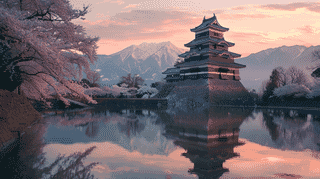
The keep of Matsumoto Castle in Nagano, built between 1594 and 1599, rises five tiers on gently sloped walling. Five buildings of differing dates make it up.

Rebuilt in 1707 and made a National Treasure in 1953, Zenkoji Hondo runs fourteen bays deep against five wide. A pitch-dark passage circles beneath its altar.
The Daihoji Temple Three-Storey Pagoda in Aoki, Nagano, of 1333 and a National Treasure since 1953, is a pure Japanese-style pagoda called the look-back pagoda.
Nishina Shinmei Shrine in Omachi, Nagano, has a main hall and gate, a National Treasure since 1953, in the purest shinmei style, rebuilt every 20 years.
Found nearly whole in 1986, this mica-flecked Jomon figure was Japan's first prehistoric National Treasure. The original stands at a museum in Chino, Nagano.
A large Late Jomon clay figure from the Nakappara site in Chino, Nagano, named for its inverted-triangle, mask-like face. A National Treasure since 2014.
Hon'ami Kōetsu's Raku bowl Fujisan, white above and dark below like snow-capped Mount Fuji, is a National Treasure rarely shown at Sunritz Hattori Museum, Lake Suwa.
Kao's Kanzan, a 14th-century National Treasure of early Japanese ink painting at the Sunritz Hattori Museum on Lake Suwa, shown only in select exhibitions.
More from Nagano
Nagano’s registered properties across designations, with featured heritage and travel notes.
The complete kokuhō catalogue — browse by prefecture, period, and category.
Nationwide jūyō bunkazai — architecture, sculpture, painting, crafts, and documents.