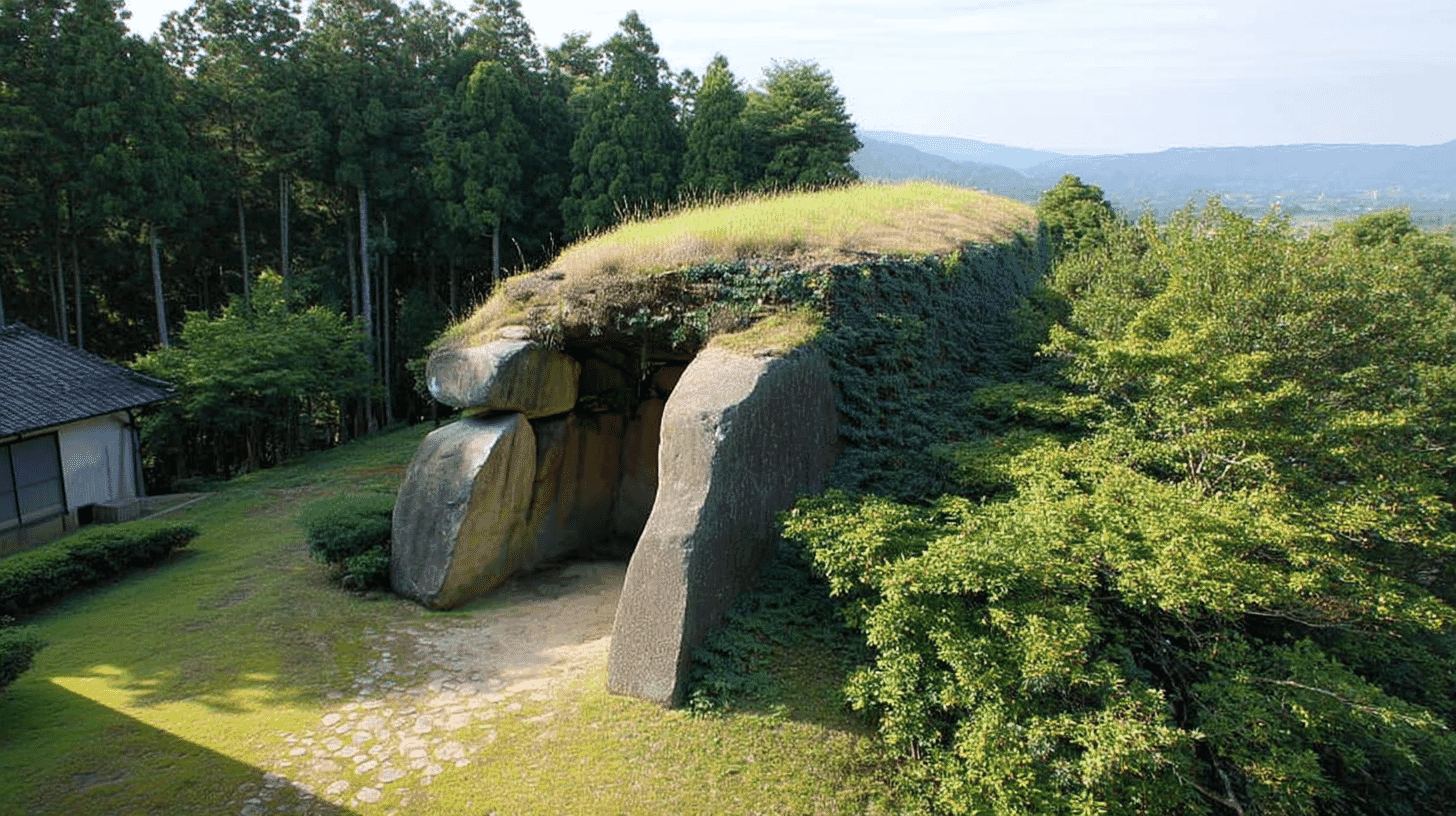
Futatsuzuka Kofun: A Hidden Gem of Ancient Japanese Burial Architecture
Nestled on the eastern foothills of Mount Katsuragi in Nara Prefecture, Futatsuzuka Kofun stands as one of Japan's most archaeologically significant yet lesser-known ancient burial mounds. This National Historic Site, designated in 1978, offers visitors a rare glimpse into Japan's Kofun period (6th century) and presents a unique architectural marvel: three distinct stone burial chambers within a single tomb—an extraordinary rarity in Japanese archaeology.
Unlike the more famous burial mounds in Osaka or Nara City, Futatsuzuka Kofun provides an intimate, accessible experience for history enthusiasts seeking authentic encounters with Japan's ancient past, away from crowded tourist circuits.
Understanding Futatsuzuka Kofun: Historical Significance and Structure
Futatsuzuka Kofun, also known historically as "Zentorizuka" (Money-taking Mound), is a keyhole-shaped burial mound (zenpō-kōen-fun) constructed during the mid-6th century, approximately 1,450 years ago. The tomb measures 60 meters in total length, with the circular rear portion (kōen-bu) spanning 36 meters in diameter and the square front section (zenpō-bu) extending 41 meters in width. Both sections rise to an impressive height of 10 meters.
What makes this kofun truly exceptional is its construction method and internal structure. Built by cutting into the ridge of a hillside at approximately 200 meters elevation, the tomb features a two-tiered mound construction with stone facing (fukiishi) strategically placed at key points, though notably without the clay haniwa figurines commonly found at other period tombs.
The Extraordinary Three-Chamber System
The most remarkable feature of Futatsuzuka Kofun is undoubtedly its triple stone chamber configuration—a phenomenon extremely rare in Japanese kofun architecture. Each chamber exhibits distinct structural characteristics, suggesting different cultural influences and burial practices:
Rear Circular Chamber (Kōen-bu): The largest and primary burial chamber opens to the south and measures an impressive 16.7 meters in total length. This two-sided entrance chamber (ryōsode-shiki) features a burial room measuring 6.73 meters long, 2.98 meters wide, and 4.1 meters high. The chamber once housed a tuff stone coffin, though only fragments remain. Archaeological excavations revealed golden bronze floral seat fittings, crystal ornaments, horse equipment, iron agricultural tools, and various weapons.
Front Square Chamber (Zenpō-bu): This one-sided entrance chamber (katasode-shiki) extends 9 meters in total length with a burial room of 3.9 meters long, 1.7 meters wide, and 1.9 meters high. It contained the base section of a combined tuff stone coffin, along with horse equipment, agricultural implements, and hollow gold and silver beads.
Projecting Section Chamber (Tsukuridashi-bu): Perhaps the most intriguing of the three, this chamber exhibits architectural features observed in certain Korean Peninsula tomb styles. The no-sided entrance chamber (musode-shiki) measures 7.82 meters in total length, with the burial room floor positioned approximately 0.9 meters lower than the corridor—a highly unusual architectural choice. This chamber yielded an extraordinary collection of 118 burial items including amber beads, straight swords, horse equipment, iron farming tools, and massive quantities of Sue pottery.
Why Futatsuzuka Kofun Received National Historic Site Designation
The designation of Futatsuzuka Kofun as a National Historic Site in December 1978 reflects several factors of exceptional historical and archaeological value:
Architectural Uniqueness: The presence of three stone chambers with distinctly different architectural styles within a single burial mound is extraordinarily rare. This suggests complex burial customs and possibly the interment of multiple individuals of high social status, potentially representing a family or clan burial complex.
Cultural Exchange Evidence: The projecting section chamber's Korean Peninsula-influenced architecture provides tangible evidence of cultural and technological exchange between ancient Japan and the Korean kingdoms during the 6th century, a pivotal period in Japanese state formation.
Exceptional Preservation: Despite its 1,450-year history, the site remained relatively undisturbed until systematic excavation in 1958 by the Kashihara Archaeological Research Institute. This preservation allowed archaeologists to recover burial goods in their original placement, providing invaluable insights into 6th-century burial practices.
Regional Significance: As the central and largest kofun among the 30-plus burial mounds comprising the Teraguchi Kofun Group, Futatsuzuka represents the political and social pinnacle of local power structures in the late Kofun period.
Late Period Representative: Among Nara Prefecture's relatively few late-period keyhole-shaped kofun, Futatsuzuka stands as a particularly prominent example, marking the twilight era of this distinctive burial mound tradition before Buddhism's introduction changed Japanese funerary practices.
Discovering the Treasures: Archaeological Findings
The 1958 excavation of Futatsuzuka Kofun yielded an impressive collection of 118 burial items, now housed at the Nara National Museum. These artifacts paint a vivid picture of 6th-century elite life and death customs:
Personal Adornments: Golden bronze floral seat fittings, crystal triple-ring beads, amber date-shaped beads, hollow gold beads, hollow silver beads, and various glass beads demonstrate the sophisticated metalworking and luxury goods available to the elite class.
Military Equipment: Iron straight swords, sword ornaments, arrowheads, and armor pieces indicate the martial status of those interred, reflecting the warrior culture of late Kofun period leaders.
Horse Equipment: The abundance of horse-related items across all three chambers—bits, saddle fittings, and decorative elements—underscores the importance of mounted warfare and transportation for the elite class during this period.
Agricultural Tools: Iron shovels, axes, sickles, and other farming implements suggest the buried individuals' administrative responsibility over agricultural production and land management.
Ceramic Vessels: Large quantities of Sue pottery (a Korean-influenced gray stoneware) and Haji pottery (native reddish earthenware) were used in burial rituals and demonstrate sophisticated ceramic technology.
The remarkable quantity and quality of these items, particularly their undisturbed arrangement within the chambers, have made Futatsuzuka Kofun invaluable for understanding 6th-century social hierarchies, trade networks, and belief systems.
Visiting Experience: What Makes Futatsuzuka Kofun Special
Unlike many major kofun that remain sealed or viewable only from a distance, Futatsuzuka Kofun offers visitors several unique experiences that make the journey worthwhile:
Panoramic Vista: The kofun's elevated position at 200 meters provides breathtaking views eastward across the entire Nara Basin. On clear days, visitors can identify the Yamato Three Mountains and trace the ancient landscape that gave rise to Japanese civilization. This perspective helps visitors understand why this strategic location was chosen for such an important burial site.
Accessible Stone Chambers: While preservation concerns limit deep interior access, visitors can approach close enough to the chamber entrances to appreciate the engineering sophistication of 6th-century tomb construction. The scale and stone-working precision become immediately apparent when standing before these 1,450-year-old structures.
Natural Setting: The walk to Futatsuzuka Kofun takes you through the scenic Teraguchi area, where ancient history blends seamlessly with rural Japanese landscapes. The approach along the ridge offers a sense of pilgrimage, connecting visitors to the ancient processional routes used during burial ceremonies.
Seasonal Beauty: Each season offers distinct charms—spring brings cherry blossoms and fresh greenery, summer offers lush forest canopy, autumn showcases brilliant foliage, and winter provides the clearest views across the Nara Basin with less vegetation obscuring the tomb's earthwork structure.
Quiet Contemplation: As a lesser-known site, Futatsuzuka Kofun rarely experiences the crowds that can diminish the experience at more famous locations. This tranquility allows for genuine historical contemplation and photographic opportunities without distraction.
Exploring the Surrounding Area: Teraguchi and Mount Katsuragi
The Futatsuzuka Kofun visit can be enriched by exploring the historically rich Teraguchi area and surrounding attractions:
Hakusai Shrine: Located approximately 830 meters from the kofun, this shrine features a main hall designated as an Important Cultural Property. The shrine enshrines Shitateruhime-no-Mikoto and Sugawara no Michizane, reflecting the area's connection to the powerful Fuse clan who dominated this region during the Kofun and subsequent periods.
Okion-ji Temple (Fuse-ji): About 210 meters from the kofun, this temple served as the Fuse clan's family temple. Its 1,300-year history connects to the Buddhist monk Gyoki's activities in the region, providing context for the religious transformation that eventually ended kofun burial practices.
Fuse Castle Ruins: On the hillside west of Futatsuzuka Kofun, the remains of the Fuse clan's castle demonstrate the continuous strategic importance of this elevated position from ancient times through the medieval period.
Katsuragi City Historical Museum: For those wishing to see the actual artifacts excavated from Futatsuzuka Kofun, this museum displays selected items along with a detailed diorama model of the tomb complex. The museum provides essential context for understanding the broader archaeological landscape of the Katsuragi region.
Mount Katsuragi and Mount Nijō: Outdoor enthusiasts can extend their visit with hiking on these mountains, which offer spectacular panoramic views. Mount Katsuragi is particularly famous for its azalea blooms (mid-May) when "one million" flowers create a crimson hillside.
Taima-dera Temple: This nationally significant temple complex, located within reasonable distance, features National Treasure buildings and the famous Taima Mandala. The temple can be combined with a Futatsuzuka visit for a full day of historical exploration.
Takenouchi Kaido: Japan's oldest official road connecting Nara Basin with Osaka Plain passes through the region. Walking portions of this ancient highway helps visitors understand the trade routes and cultural exchange that influenced Futatsuzuka's construction.
Practical Visitor Information
Best Time to Visit: Spring (April-May) and autumn (October-November) offer the most comfortable temperatures and clearest views. Winter provides excellent visibility but can be cold. Summer visits are possible but expect heat, humidity, and dense vegetation that may obscure views.
What to Bring: Comfortable walking shoes are essential as the approach involves uphill walking on sometimes uneven paths. Bring water, sun protection, and insect repellent during warmer months. Photography equipment users should bring wide-angle lenses to capture the expansive views and tomb structure.
Time Required: Allow 1-2 hours for the site itself, plus travel time. Combining with nearby attractions like Hakusai Shrine and local temples makes for a rewarding half-day itinerary. Adding the Katsuragi City Historical Museum extends this to a full day.
Language Considerations: Signage at the site is primarily in Japanese. English information may be limited, making advance research (or guided tours) particularly valuable for international visitors. The Katsuragi City Historical Museum offers some English materials.
Photography: Photography is permitted throughout the site. The panoramic views from the kofun position are particularly photogenic during golden hour (early morning or late afternoon). Respect any barriers protecting the stone chamber entrances.
- 📍 Plan Your Visit to Nara
- Find tours, activities & transport passes near Futatsuzuka Kofun
- [ Todaiji Great Buddha & Nara Park Deer Experience ]
Q&A
- What makes Futatsuzuka Kofun unique compared to other ancient burial mounds in Japan?
- Futatsuzuka Kofun is extraordinarily rare because it contains three separate stone burial chambers within a single tomb structure, each with different architectural styles. This triple-chamber configuration is virtually unprecedented in Japanese kofun archaeology. Additionally, one chamber exhibits Korean Peninsula-influenced architecture, providing tangible evidence of international cultural exchange during the 6th century. The tomb's elevated position also offers panoramic views of the Nara Basin, combining historical significance with natural beauty.
- Can visitors enter the stone burial chambers at Futatsuzuka Kofun?
- As of recent reports, visitors can approach close to the chamber entrances, though full interior access may be restricted for preservation purposes. The degree of access can vary depending on conservation work and weather conditions. Even from the entrances, visitors can appreciate the impressive stone construction and chamber scale. For those interested in seeing the burial goods and detailed chamber reconstructions, the Katsuragi City Historical Museum displays artifacts and models from the excavation.
- How long does it take to reach Futatsuzuka Kofun from the nearest station, and is the walk difficult?
- From Kintetsu Shinjo Station, the walk takes approximately 35 minutes. The route involves uphill walking on sometimes uneven paths, with an elevation gain to about 200 meters. The walk is moderately challenging but manageable for anyone with basic fitness. Comfortable walking shoes are essential. Directional signs are posted along the way, making navigation straightforward. The effort is rewarded with increasingly better views as you ascend, and the quiet, scenic approach adds to the pilgrimage-like experience of visiting this ancient site.
- What were the 118 burial items found at Futatsuzuka Kofun, and where can I see them?
- The excavation uncovered a remarkable collection including golden bronze ornaments, crystal and amber beads, hollow gold and silver beads, horse equipment, iron weapons (swords and arrowheads), agricultural tools (shovels, sickles, axes), and massive quantities of Sue and Haji pottery. These items demonstrate the wealth, status, and diverse responsibilities of those buried here. The artifacts are primarily housed at the Nara National Museum, while selected items and detailed replicas can be viewed at the Katsuragi City Historical Museum, which also features a scale model of the entire tomb complex.
- Why did the practice of building kofun burial mounds eventually end in Japan?
- Kofun construction declined and eventually ceased in the late 6th to early 7th century due to several interconnected factors. The introduction and adoption of Buddhism fundamentally changed Japanese funeral practices, with cremation gradually replacing burial in elaborate earthen mounds. Simultaneously, the centralization of the Yamato court and reforms in governance reduced the regional power of local clan leaders who had built kofun to display their authority. The enormous resources required for kofun construction became increasingly difficult to justify in this changing political and religious landscape. Futatsuzuka Kofun, constructed in the mid-6th century, represents one of the last generations of this thousand-year burial tradition.
Basic Information
| Official Name | Futatsuzuka Kofun (二塚古墳) |
|---|---|
| Alternative Names | Zentorizuka (銭取塚), Shinjo Futatsuzuka Kofun |
| Location | Teraguchi, Katsuragi City, Nara Prefecture |
| Designation | National Historic Site (December 27, 1978) |
| Type | Keyhole-shaped burial mound (Zenpō-kōen-fun) |
| Construction Period | Mid-6th century (approximately 550 CE) |
| Total Length | 60 meters |
| Height | 10 meters (both front and rear sections) |
| Rear Circular Diameter | 36 meters |
| Front Square Width | 41 meters |
| Elevation | Approximately 200 meters above sea level |
| Number of Stone Chambers | Three (rear, front, and projecting section) |
| Excavation | 1958 by Kashihara Archaeological Research Institute |
| Burial Goods | 118 items (horse equipment, weapons, tools, jewelry, pottery) |
| Artifact Repository | Nara National Museum; Katsuragi City Historical Museum (selected items) |
| Access | 35-minute walk west from Kintetsu Shinjo Station |
| Admission | Free (outdoor historic site) |
| Facilities | Limited; bring necessary supplies |
| Best Season | Spring (April-May) and Autumn (October-November) |
| Nearby Museum | Katsuragi City Historical Museum |
References
- 二塚古墳 (葛城市) - Wikipedia
- https://ja.wikipedia.org/wiki/二塚古墳_(葛城市)
- 二塚古墳 - 葛城市公式サイト
- https://www.city.katsuragi.nara.jp/soshiki/rekishihakubutsukan/1/1/1835.html
- 二塚古墳 - 文化遺産オンライン
- https://bunka.nii.ac.jp/db/heritages/detail/172735
- 葛城市の二塚古墳!大和盆地一望 - 奈良の宿大正楼
- https://narayado.info/nara/futatsuka-tumulus.html
- Kofun Burial Mounds and Imperial Tombs - Nara Prefecture
- https://www.pref.nara.jp/miryoku/ikasu-nara/en/fukabori/detail02/