
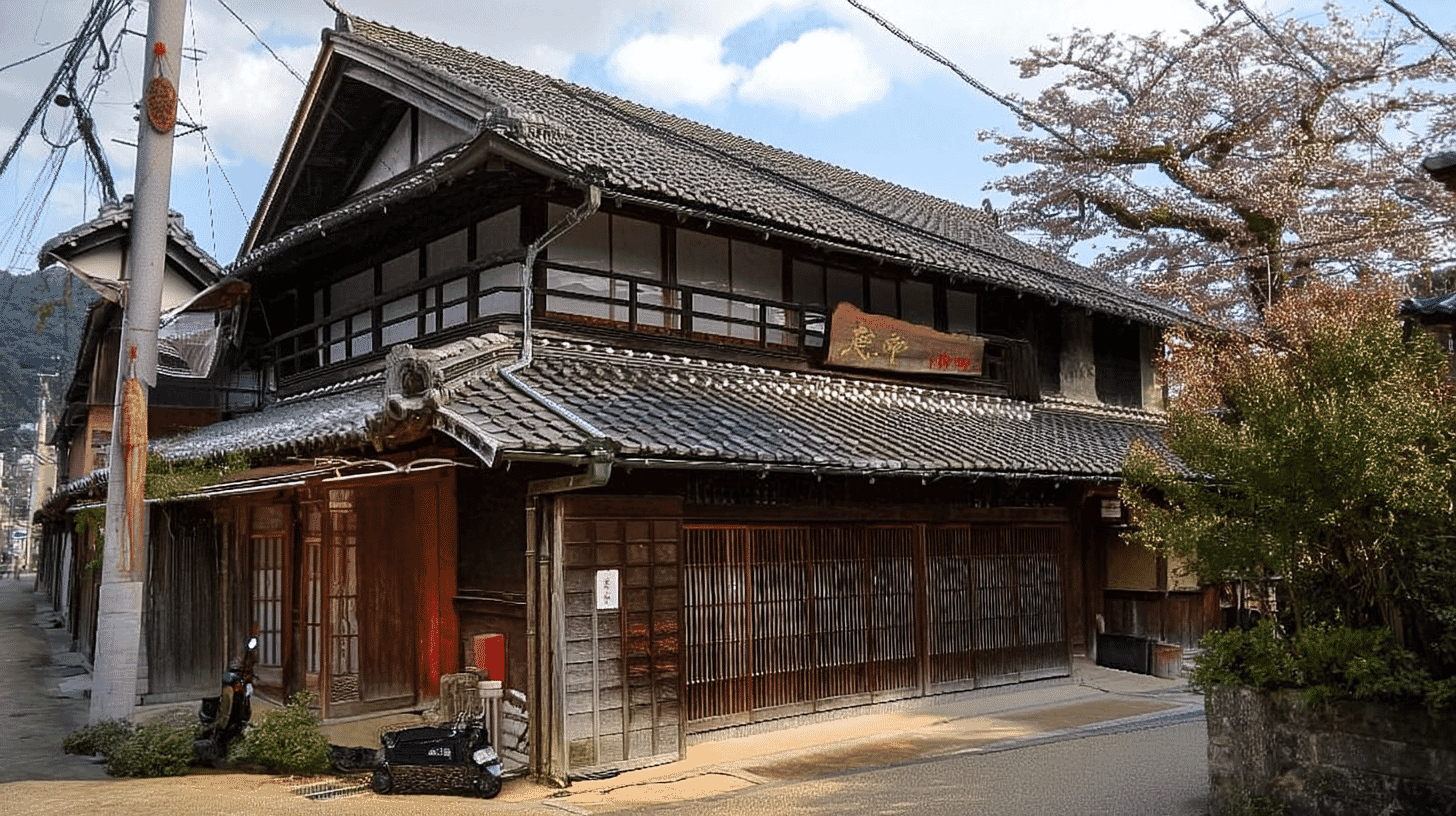
One Main House, a Registered Tangible Cultural Property since 2016
Tamaya Main House (玉や主屋, Tamaya Shuoku) stands at 1242 Moto-Taimagata, Taima, Katsuragi City, Nara Prefecture, an Edo-period building entered on the register of tangible cultural properties on 25 February 2016. It is a registered property rather than a designated one.
The quantity is one building.
The structure is timber, two-storeyed, tiled, with a floor area of 142 square metres. The date field reads Edo and the year field 1830 to 1868.
A Plaster Relief on the Wall, Jewels Carved on the Brackets
Pictures and carving are added to the outside of the building.
The Agency records lattices set around the outside, a plaster relief of a crane and pine on the wall, and jewel shapes carved on the brackets beneath the eaves, giving it a lively air and contributing to the prospect before an ancient temple.
A plaster relief is built up with a plasterer's trowel. A crane with a pine is a pairing long favoured as a sign of good fortune.
A bracket carries the eaves from below; a jewel shape is a round ornament drawn to a point. Carving is given even to a member whose work is to support.
At the Nakanobo Inari shrine, colour over the whole frame makes it, in the record's words, a small work rich in ornament.
Here picture and carving make a lively air. Abundance of ornament becomes the assessment itself.
One Roof, Different at West and East
At the two ends of one building, the roof takes different forms.
The Agency records it as hip-and-gabled on the west face and gabled on the east, with a slightly convex pantiled roof, a lean-to and a railing running round.
A hip-and-gable roof is gabled above and slopes on all four sides below; a gabled roof falls to two sides. A convex roof swells gently outward in its surface.
The Kusumori Kahoku main house is hip-and-gabled at the east and gabled at the west; the Akagi main house gabled at the south and hip-and-gabled at the north.
Here the west is hip-and-gabled and the east gabled. The detached room on the same property is likewise hip-and-gabled on the south and gabled on the north.
A lean-to is a lower roof projecting below the main one, and the railing runs round the veranda. On the upper floor a railing encircles the building.
Once a House for Travellers, on a Corner by the Temple Gate
The former use, which the present name does not reveal, is set down in the record.
The Agency records a two-storeyed building on a corner before the gate of the temple Taimadera that once took in travellers. Houses of this kind received travellers on the highways of the Edo period.
Tamaya is a trading name, and nothing in it shows that travellers once stayed here. The word former marks the earlier use.
Uno Pharmacy faces west on a corner of a main street in Osaka, and the Obaraya shop storehouse once faced the main street.
Here the building stands on a corner before a temple gate. A corner is seen from two streets, so the lattices and the plaster relief meet the eye.
The Agency closes that it contributes to the prospect before an ancient temple.
Visiting
The house stands at 1242 Moto-Taimagata, Taima, Katsuragi City, Nara Prefecture.
At 142 square metres, it was registered on the same day as the detached room of 42 square metres on the same property.
The detached room stands north-west of the main house, joined to it by a corridor.
No owner is recorded, and opening and terms follow the owner's arrangements. Check before travelling.
In the same district stands the Nakanobo Inari shrine, a separate cultural property.
Q&A
- When was the house registered?
- On 25 February 2016, as a registered tangible cultural property. It is registered rather than designated, and the quantity is one building.
- What is a plaster relief?
- A picture built up in plaster with a trowel. Here a crane and pine are shown on the wall.
- What is the roof like?
- Hip-and-gabled on the west face and gabled on the east, slightly convex and pantiled, with a lean-to and a railing running round.
- What was it before?
- A house on a corner before the temple gate that once took in travellers in the Edo period.
- What is valued in it?
- That it has a lively air and contributes to the prospect before an ancient temple.
Basic Information
| Name | Tamaya Main House (玉や主屋, Tamaya Shuoku); Tamaya is a trading name |
|---|---|
| Location | 1242 Moto-Taimagata, Taima, Katsuragi City, Nara Prefecture |
| Designation | Registered tangible cultural property (structure, domestic architecture); registered rather than designated; 2 buildings on the same property were registered on the same day |
| Year Designated | 2016 (25 February), registered |
| Quantity | 1 building |
| Dimensions | Timber, 2-storeyed, tiled, with a floor area of 142 square metres. Hip-and-gabled on the west face and gabled on the east, slightly convex and pantiled, with a lean-to and a railing running round. Lattices outside, a plaster relief of a crane and pine on the wall, and jewel shapes carved on the eave brackets. The date field reads Edo and the year field 1830 to 1868 |
| Owner | Not stated in the record |
| Public Access | Opening and terms follow the owner's arrangements |
References
- Cultural Heritage Online: the main house
- https://bunka.nii.ac.jp/heritages/detail/298969
- Cultural Heritage Online: the detached room
- https://bunka.nii.ac.jp/heritages/detail/292700
- Agency for Cultural Affairs, National Cultural Properties Database
- https://kunishitei.bunka.go.jp/
- Katsuragi City
- https://www.city.katsuragi.nara.jp/
Last verified: 2026.09.22
