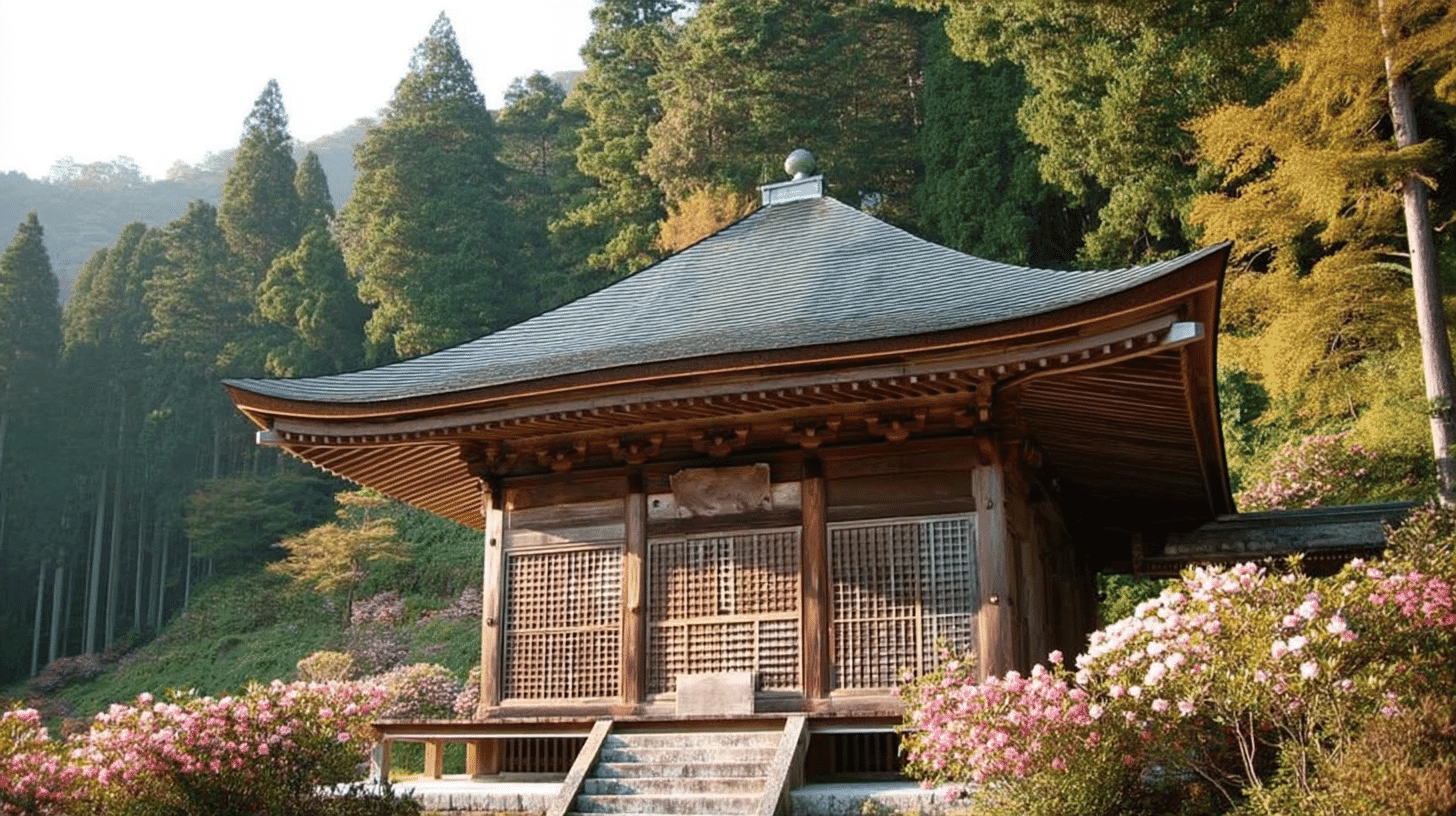
A Sacred Mountain Retreat: Discovering Jinkakuji Hondo
Perched near the summit of Mount Jinkakuji at an elevation of 730 meters, Jinkakuji Temple stands as a testament to the enduring spiritual heritage of Japan's Bungo region. While countless visitors flock to well-known temples in Kyoto and Nara, this ancient sanctuary in Oita Prefecture offers something increasingly rare in modern Japan: an authentic encounter with sacred architecture in its original, contemplative setting.
The main hall, known as Jinkakuji Hondo, represents one of Kyushu's finest examples of early Muromachi period religious architecture. Designated as an Important Cultural Property in 1907, this remarkable structure has witnessed over 650 years of continuous worship, natural disasters, and careful restoration—emerging today as a pristine embodiment of medieval Japanese Buddhist architecture.
Historical Legacy: From Korean Origins to Bungo's Great Temple
The origins of Jinkakuji Temple are shrouded in ancient legend. According to temple tradition, it was founded in 570 CE by a Buddhist monk from the Korean kingdom of Silla during the reign of Emperor Kinmei. This would place its establishment among the earliest wave of Buddhist temples in Japan, predating even the famous Horyuji Temple.
During the Heian period under Emperor Kanmu, the temple flourished as a center of Tendai Buddhism, with historical records suggesting that nearly 300 monks' quarters dotted the mountainside. After a period of decline, the temple was revived during the reign of Emperor Daigo (897-930) by the eminent monk Shobo, who transformed it into a Shingon Buddhist institution—an affiliation it maintains to this day as part of the Koyasan Shingon sect.
The present main hall was constructed in 1369 (Oan 2) under the patronage of the Otomo clan, the powerful feudal lords who controlled the Bungo region. Originally called "Tobo" (Eastern Hall), it was one of six monastic buildings erected during this major reconstruction effort. Together with Reizenji Temple of Mount Reizan and Entsuji Temple of Mount Kurokui, Jinkakuji earned recognition as one of the "Three Great Temples of Bungo."
Architectural Significance: Why Jinkakuji Hondo Became a Cultural Property
The designation of Jinkakuji Hondo as an Important Cultural Property reflects its exceptional value as an example of early Muromachi period religious architecture. The building exhibits a harmonious blend of traditional Japanese (wayo) elements with subtle influences from the Zen architectural style (zenshuyo) that was gaining prominence during this era.
The structure measures three bays (ken) in both width (keta-yuki) and depth (hari-ma), creating a compact yet perfectly proportioned sacred space. Rising above is the distinctive hogyo-zukuri roof—a pyramidal form that converges to a single point at the apex. This elegant roof is clad in hinoki-buki (cypress bark shingles), a traditional roofing technique that creates beautiful natural textures while providing excellent protection against the mountain elements.
Architectural historians particularly value the building for preserving elements of older Zen-style construction techniques while adapting them to the local Kyushu context. The gentle upward curve of the eaves, known for its graceful appearance, demonstrates the sophisticated craftsmanship of Muromachi-era builders.
Highlights and Must-See Features
Beyond the main hall's architectural beauty, Jinkakuji Temple offers visitors a rich array of cultural treasures and natural wonders that make it a compelling destination throughout the year.
The temple's mountain gate (sanmon) houses a pair of imposing Kongo Rikishi statues—fierce guardian deities that protect the sacred precinct from evil. These wooden sculptures, designated as Important Cultural Properties in 1982, stand approximately 2.5 meters tall and date from the early Kamakura period. Created using the yosegi-zukuri (joined woodblock) technique and featuring polychrome painting, they represent some of the finest examples of Kei school Buddhist sculpture in Kyushu. During restoration work conducted between 1983 and 1986, a wooden tablet bearing 47 names was discovered inside the statues, suggesting they were commissioned during the Mongol invasion period as prayers for national security.
Within the main hall, the principal object of worship is a secret Buddha image of Juichimen Senju Sengen Kannon (Thousand-Armed Kannon with Eleven Faces). This revered statue is only partially revealed every 17 years and fully unveiled every 33 years, making special viewing occasions particularly significant events.
Perhaps the temple's most beloved feature is its extraordinary collection of rhododendrons. Approximately 500 plants, many over a century old, transform the grounds into a sea of pink and white blossoms during late April and early May. This spectacular display has earned Jinkakuji the affectionate nickname "Shakunage-dera" (Rhododendron Temple), drawing flower enthusiasts from across Japan.
Geological Wonders: Where Sacred Architecture Meets Natural Heritage
Jinkakuji Temple's setting offers more than spiritual significance—it provides a fascinating window into the geological history of the region. The temple is located within the Jinkakuji-Serikawa Prefectural Natural Park and sits atop volcanic formations created approximately 15 million years ago.
The temple grounds rest on welded tuff deposits from the Miyakeyama pyroclastic flow, characterized by distinctive columnar jointing. The original approach path to the temple was carved directly into these volcanic columns, creating a stairway that appears to have been hewn from the living rock. This remarkable feature, along with stone Rakan (disciple) statues placed along the path, creates an atmosphere of profound spiritual solemnity.
The temple's mountaintop location also offers spectacular panoramic views over the Bungo Ono plains below. On clear days, visitors can see why this strategic vantage point made the temple site valuable not only for meditation but also as a military stronghold during periods of civil conflict.
Exploring the Surrounding Region
Bungo Ono City, where Jinkakuji Temple is located, has been designated as part of the Bungo Ono UNESCO Global Geopark, offering numerous additional attractions for visitors seeking to extend their cultural and natural explorations.
Just 30 minutes by car, Harajiri Falls presents one of Japan's most dramatic waterfalls. Known as the "Niagara of the Orient," this impressive cascade spans 120 meters in width and drops 20 meters into a pool below. Formed by pyroclastic flows from Mount Aso approximately 90,000 years ago, the falls offer a stunning complement to the ancient temple on the mountain.
For those interested in subterranean wonders, Inazumi Underwater Cave provides a unique opportunity to explore a 300-million-year-old limestone formation that was flooded by volcanic activity. The region also boasts numerous stone bridges, including the adjacent Deai and Todoroki bridges, which rank first and second in Japan for arch span diameter.
Five roadside stations (michi no eki) are scattered throughout Bungo Ono City, each offering local specialties, fresh produce, and information about area attractions. The Michi no Eki Asaji, nearest to Jinkakuji, provides an excellent starting point for temple visits.
Practical Information for Visitors
Visiting Jinkakuji Temple requires some planning, as the mountain location means public transportation options are limited. However, the journey itself becomes part of the pilgrimage experience, passing through scenic countryside and offering glimpses of rural Japan rarely seen by international visitors.
The temple grounds are open throughout the year, with free admission to the main areas. The approach roads, while narrow in places, are well-maintained and navigable by standard vehicles. Parking is available for approximately 40 cars near the main gate.
The best times to visit are late April through early May for the rhododendron season, and autumn for pleasant temperatures and changing foliage. Summer visitors will appreciate the cool mountain temperatures—often 5-10 degrees Celsius lower than the lowlands—making it an ideal escape from the humid Kyushu heat.
- 📍 Plan Your Visit to Oita
- Find tours, activities & transport passes near Jinkakuji Temple Main Hall
- [ Beppu Hell Tour & Yufuin Onsen Hot Springs ]
Q&A
- Is English signage or guide information available at Jinkakuji Temple?
- Currently, most signage is in Japanese only. Visitors are encouraged to research the temple beforehand or bring translation apps. The temple staff are welcoming though language barriers may exist.
- Can I receive a Goshuin (temple seal stamp) at Jinkakuji?
- Yes, Goshuin are available at Jinkakuji Temple. Visit the temple office (normally near the main hall) during regular hours to receive this calligraphic commemoration of your pilgrimage.
- What is the best season to visit Jinkakuji Temple?
- Late April to early May offers the spectacular rhododendron blooms. Autumn provides comfortable weather and fall colors. Summer is cooler than lowland areas due to the 730m elevation. Winter can bring occasional snow.
- How long should I plan for a visit to Jinkakuji Temple?
- Allow 1-2 hours for a thorough visit including the main hall, Kongo Rikishi statues, and grounds. During rhododendron season, you may wish to spend longer enjoying the flowers and views.
- Is the temple wheelchair accessible?
- Due to the mountain location and traditional construction, full wheelchair access is limited. The parking area provides some views, but the main temple grounds include steps and uneven paths. Please contact the temple in advance if you have mobility concerns.
Basic Information
| Name | Jinkakuji Hondo (神角寺本堂) |
|---|---|
| Temple Name | Nyoizan Jinkakuji (如意山 神角寺) |
| Buddhist Sect | Koyasan Shingon-shu (高野山真言宗) |
| Principal Image | Juichimen Senju Sengen Kannon (Eleven-Faced Thousand-Armed Kannon) |
| Cultural Property Designation | Important Cultural Property (Building) |
| Designation Date | May 27, 1907 |
| Construction Date | 1369 (Oan 2, Muromachi Period) |
| Architectural Style | Hogyo-zukuri (pyramidal roof), Hiwada-buki (cypress bark roofing) |
| Structure | 3 bays × 3 bays, single story |
| Address | 1354 Torita, Asaji-machi, Bungo Ono City, Oita Prefecture 879-6331 |
| Telephone | 0974-74-2418 |
| Access | 30 minutes by car from JR Bungo-Asaji Station; 20 minutes from Ono IC on Nakakyushu Expressway |
| Parking | Approximately 40 spaces available |
| Admission | Free |
References
- Cultural Heritage Online - Jinkakuji Hondo (Agency for Cultural Affairs)
- https://bunka.nii.ac.jp/heritages/detail/191453
- National Designated Cultural Properties Database (Agency for Cultural Affairs)
- https://kunishitei.bunka.go.jp/bsys/maindetails/102/3616
- Jinkakuji - Wikipedia (Japanese)
- https://ja.wikipedia.org/wiki/神角寺
- Oita Prefecture Official Tourism Site - Jinkakuji
- https://www.visit-oita.jp/spots/detail/4550
- Bungo Ono City Tourism Association
- https://sato-no-tabi.jp/
Last verified: 2026.01.28
Nearby heritages
- Goto Family Residence (Nozuhara Town, Oita County, Oita
- 1161 Oaza Nioki, Oita City, Oita Prefecture
- Wakamiya Iji Sasamuta Stone Arch Bridge
- 1504-1 Sasamuta, Hasada, Taketa City, Oita Prefecture
- Bat Falls
- Bungo-Ono City
- Meiji Okamoto Iro (Ishigaki Iro)
- Oita Prefecture, Taketa City, Ueki, Onida 2084-1581
- Former Ogata Village Office
- 574 Baba Kashiwagi, Ogata-cho, Bungo-Ono City, Oita Prefecture
- Chinda Falls
- Bungo-Ono City
- Aso Pyroclastic Flow Deposits in Taketa
- Taketa City, Oita Prefecture
- Ogata River and Rural Landscape of the Ogata Basin
- Bungo-Ono City, Oita Prefecture
- Ogata Miyasako East Stone Buddha
- Bungo-Ono City
- Ogata Miyasako West Stone Buddha
- Ogatacho, Bungo-Ono City