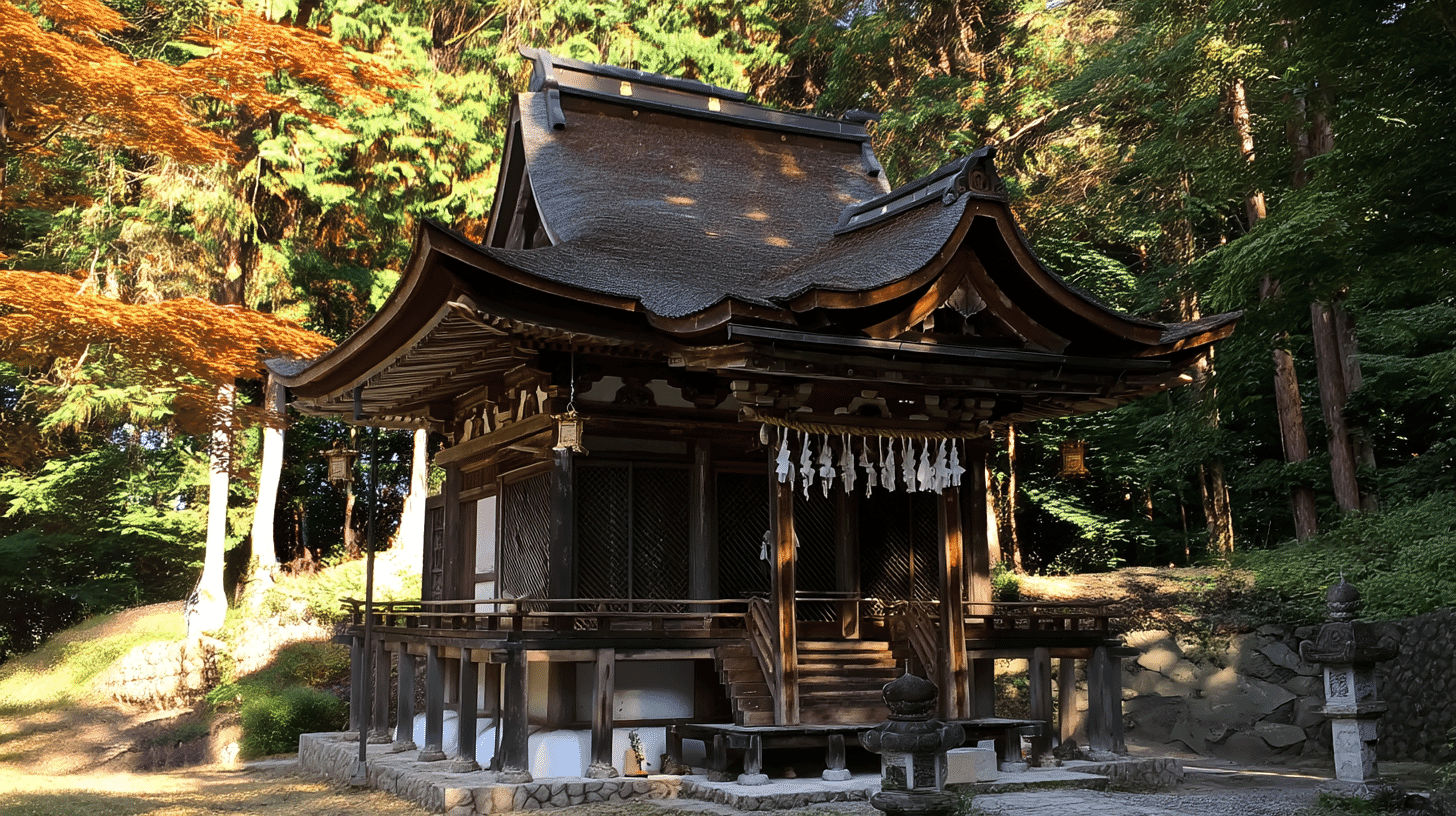
Ōsasahara Shrine Main Hall: A Hidden National Treasure of Muromachi-Period Craftsmanship

Tucked away amid rice paddies and quiet rural landscapes in Yasu City, Shiga Prefecture, Ōsasahara Shrine (大笹原神社) harbors one of Japan's most exquisite examples of medieval shrine architecture. Its main hall, or honden, was designated a National Treasure in 1961 — a recognition reserved for only the most historically and artistically significant cultural properties in the country. Built in 1414, just a decade after Kyoto's famous Kinkaku-ji (Golden Pavilion), this compact yet breathtakingly detailed structure represents the pinnacle of Higashiyama culture aesthetics in shrine design. For travelers seeking an authentic encounter with Japan's cultural heritage far from the tourist crowds, Ōsasahara Shrine offers a rare and deeply rewarding experience.

A Thousand Years of Sacred History

The origins of Ōsasahara Shrine reach back to the Heian period. In 986 (Kanna 2), a local warlord named Echi Morozane dedicated land and constructed a shrine hall, inviting the deity Gozu Tennō — a powerful protector against epidemics — to the site. For centuries, the shrine was known as "Gozu Tennō Sōsha" (the Grand Shrine of Gozu Tennō), and it became an important center of worship for the warrior clans of Ōmi Province, the historic name for present-day Shiga Prefecture.

During the Kamakura period (1185–1333), the powerful Sasaki clan, one of the most prominent samurai families of the region, adopted Ōsasahara Shrine as their tutelary deity. The famed warrior Sasaki Takatsuna, known for his legendary feat of fording the Uji River on horseback during the Genpei War, is among the deities enshrined here. Throughout the medieval era, successive lords contributed land and funds for the shrine's upkeep and expansion.

In 1414 (Ōei 21), Mabuchi Sadanobu, the castellan of nearby Iwakura Castle and a retainer of the Rokkaku clan, commissioned the complete reconstruction of the main hall. It is this reconstruction that survives today as one of the finest examples of medieval shrine architecture in all of Japan. When the main hall was rebuilt, the deities Susanoo-no-Mikoto and his consort Kushinadahime were formally invited from Kibi Province (present-day Okayama Prefecture) and enshrined within. The shrine retained its original name until the Meiji era, when it was renamed Ōsasahara Shrine under the modern system of Shinto shrines.

Why It Was Designated a National Treasure

Japan's Agency for Cultural Affairs describes the Ōsasahara Shrine main hall with succinct but powerful praise: although small in scale, the building displays particularly outstanding construction techniques in its details, with beautiful designs in the transoms and doors, making it one of the greatest masterpieces of medieval shrine architecture.

The main hall was first recognized as an Important Cultural Property (then called a "Special Protected Building") in 1901. In 1961, it was elevated to National Treasure status — the highest designation for cultural properties in Japan — together with eleven historical ridge plaques (munafuda) preserved inside the building. These wooden plaques, inscribed with dates and names of the builders and donors, provide invaluable documentation of the shrine's history spanning from 1316 (Shōwa 5) through the Ōei, Bunki, Eishō, and Kanbun eras.

The building is recognized for its exceptional architectural quality in several key areas: the sophistication of its woodworking techniques, the artistic brilliance of its decorative carvings, and the harmonious integration of Buddhist temple elements into a Shinto shrine form. These qualities make it a crucial example of the cross-pollination between religious architectural traditions during the Muromachi period.

Architectural Beauty: The Hallmarks of Higashiyama Culture

The main hall is a three-bay by three-bay (sangensha) structure with a single-story irimoya-zukuri (hip-and-gable) roof and a one-bay kohai (step canopy) at the entrance. The roof is covered with hiwadabuki — thin layers of Japanese cypress bark meticulously layered in a traditional technique that has been practiced in Japan since at least the 7th century. This cypress bark roofing is periodically renewed approximately every 40 years, a process requiring bark from 200 to 250 mature cypress trees.

While the structure is modest in size, its decorative program is astonishingly refined. What makes this building so remarkable is that all of its ornamental carvings are left in their natural, uncolored wood (shiraki) state — no pigments, no lacquer, no gold leaf. This restraint is the very essence of Higashiyama culture, the aesthetic movement associated with the later Muromachi period that emphasized quiet elegance, subtle beauty, and refined simplicity over ostentatious display.

The front three bays and one side bay of the outer sanctuary (gejin) feature hanazama kōshido — lattice doors adorned with openwork flower patterns carved into diamond-shaped lattice grids. Above these lattice doors, the transoms (ranma) are decorated with delicate openwork carvings. The kaerumata (frog-leg struts) placed between the pillars of the main structure and the step canopy also display fine sculptural work. On the side panels (wakishōji), beautiful relief carvings of young leaves create an effect of natural grace. The balustrade is in the hane kōran (projecting railing) style, adding another layer of sophisticated detail.

Internally, the hall is divided into three sections — an outer sanctuary, an inner sanctuary, and an innermost sanctuary — with the innermost section further subdivided into three chambers, each containing a sacred seat for a deity. This spatial complexity within such a compact building further demonstrates the advanced architectural planning of the era.

Highlights and Attractions Within the Shrine Grounds

Beyond the National Treasure main hall, the Ōsasahara Shrine grounds hold several other features well worth exploring.

Immediately to the left of the main hall stands the Shinohara Shrine (Shinohara Jinja), a small subsidiary shrine designated as a national Important Cultural Property. Built in 1427, just thirteen years after the main hall, this one-bay structure in the kasuga-zukuri style showcases the elegant simplicity of medieval shrine architecture on an intimate scale. Shinohara Shrine is also known as "Mochi no Miya" (the Shrine of Rice Cakes), because it enshrines the deity associated with kagami mochi — the traditional stacked rice cakes displayed during the Japanese New Year. The Ōshinohara area has been renowned since the Heian period for producing exceptionally glutinous, high-quality rice, and the rice cakes made here were famous souvenirs for travelers passing through the Shinohara post station on the old Tōsandō road (later the Nakasendō).

To the right of the main hall lies the Yorube Pond (Yorube no Ike), a mysterious pool said to be a bottomless marsh. According to local legend, during a severe drought, the people of Ōsasahara sank two portable shrines (mikoshi) into the pond as an offering to pray for rain. Since that time, the pond has never dried up, even during the most prolonged droughts. The two sunken mikoshi are said to remain at the bottom to this day. The pond lends an atmosphere of quiet mystery to the shrine grounds, and Ōsasahara Shrine is also revered as a shrine of the water deity.

The surrounding landscape of rice paddies, with the foothills of Mount Kagami in the background, creates a quintessentially Japanese countryside scene that changes beautifully with the seasons. Spring brings birdsong and fresh greenery, autumn brings vivid foliage that frames the shrine in warm colors, and the quiet winter months offer a serene stillness.

Nearby Attractions and Sightseeing in the Yasu Area

Yasu City is home to an impressive concentration of cultural heritage sites, making it an excellent base for exploring the historical riches of Shiga Prefecture.

Just a short bus ride away is Mikami Shrine (Mikami Jinja), whose main hall is also designated a National Treasure. Combining elements of shrine, temple, and palace architecture, the Mikami Shrine honden dates to the Kamakura period and represents a unique fusion of styles. The shrine sits at the foot of Mount Mikami, affectionately called "Ōmi Fuji" for its resemblance to Mount Fuji, offering a scenic hiking trail to the summit at 432 meters.

The Yasu City Museum of History and Folklore (Dōtaku Museum) houses fascinating displays of ancient bronze bells (dōtaku) unearthed nearby, including artifacts dating back over a thousand years. For those interested in the region's deep archaeological heritage, this museum is a rewarding stop.

Hyōzu Taisha Shrine, reachable by bus from Yasu Station, features a beautiful Japanese garden designated among the nation's finest, with particularly spectacular autumn illuminations. Shiga Prefecture as a whole ranks third in Japan for the number of buildings designated as National Treasures or Important Cultural Properties, and the area around Lake Biwa is rich with temples, shrines, and historic sites waiting to be discovered.

Practical Information for Visitors

Ōsasahara Shrine is freely accessible at all times with no admission fee, and there are no gates restricting entry. The shrine grounds are open for respectful visits year-round. A parking area accommodating approximately 25 standard vehicles is available along the approach path. The relaxed, unhurried atmosphere of this rural shrine — where you may well find yourself the only visitor — stands in welcome contrast to Japan's more heavily touristed destinations.

Please note that the main hall is a worship structure, and visitors view the building from the worship hall (haiden) located in front of it. While the fine carvings are partially visible from this vantage point, the building's most intricate details may be difficult to appreciate from a distance. Binoculars can be helpful for observing the decorative details more closely.

Signage at the shrine is primarily in Japanese. International visitors may wish to research the shrine's history beforehand or visit with a knowledgeable guide to fully appreciate the architectural significance. An automatic fire suppression system was installed in 2019 with national, prefectural, and municipal funding to protect this irreplaceable cultural treasure.

📍 Plan Your Visit to Shiga
Find tours, activities & transport passes near Osasabaru Shrine Main Hall
[ Hikone Castle & Lake Biwa Cruise Experiences ]

Q&A

QHow do I get to Ōsasahara Shrine from Kyoto or Osaka?
ATake the JR Biwako Line (Tōkaidō Line) to Yasu Station, which is about 25 minutes from Kyoto Station or about 75 minutes from Osaka Station. From Yasu Station's South Exit, take the bus bound for "Yasu Outlet" and alight at the "Ōshinohara" stop. From there, it is approximately a 15-minute walk to the shrine. By car, the shrine is about 15 minutes from the Meishin Expressway's Rittō IC or Ryūō IC. A parking area for about 25 cars is available.
QIs there an admission fee, and what are the visiting hours?
AThere is no admission fee, and the shrine grounds are freely accessible at all times. There are no gates or restricted hours. However, the shrine office operates from approximately 9:00 AM to 5:00 PM if you need assistance or information.
QCan I see the carvings on the main hall up close?
AThe main hall is a sacred structure, and visitors typically view it from the worship hall (haiden) located in front. This means the finest carvings on the doors, transoms, and side panels are at some distance. Bringing binoculars is recommended if you want to appreciate the intricate details. The overall form and atmosphere of the building, however, are impressive even from the standard viewing position.
QWhat is the best season to visit Ōsasahara Shrine?
AThe shrine is beautiful throughout the year, but autumn (mid-November to early December) is particularly lovely, as the surrounding trees display vibrant fall colors that beautifully complement the cypress-bark roof of the main hall. Spring (April–May) offers lush greenery and birdsong. Winter provides a serene, quiet atmosphere ideal for contemplative visits.
QCan I combine a visit to Ōsasahara Shrine with other National Treasure sites nearby?
AYes, this is highly recommended. Mikami Shrine, whose main hall is also a National Treasure, is located nearby in Yasu City and can be reached by community bus from the "Ōshinohara" stop. The two shrines make an excellent pair for a day of cultural exploration. The broader Shiga Prefecture area around Lake Biwa offers numerous other National Treasure sites, including temples in Ōtsu, Kōnan, and Kōra.

Basic Information

Name Ōsasahara Shrine Main Hall (大笹原神社本殿)
Designation National Treasure (designated April 27, 1961; previously Important Cultural Property since August 2, 1901)
Period Mid-Muromachi Period — Ōei 21 (1414)
Architectural Style Three-bay by three-bay, single story, irimoya-zukuri (hip-and-gable roof), one-bay step canopy (kohai), cypress bark shingle roofing (hiwadabuki)
Enshrined Deities Susanoo-no-Mikoto, Kushinadahime, Hachiōji-no-Mikoto, Emperor Uda, Prince Atsuzane, Sasaki Takatsuna, and others
Commissioned by Mabuchi Sadanobu, castellan of Iwakura Castle
Address 2375 Ōshinohara, Yasu City, Shiga Prefecture 520-2313, Japan
Access JR Biwako Line "Yasu Station" South Exit → Bus to "Ōshinohara" (approx. 10 min) → Walk approx. 15 min. By car: approx. 15 min from Meishin Expressway Rittō IC or Ryūō IC.
Hours Grounds freely accessible at all times (shrine office: 9:00–17:00)
Admission Free
Parking Approximately 25 spaces for standard vehicles
Contact Yasu City Tourism and Products Association — TEL: 077-514-7502

References

大笹原神社本殿 — Cultural Heritage Online (Agency for Cultural Affairs)
https://bunka.nii.ac.jp/db/heritages/detail/189283
大笹原神社 — Shiga Prefecture Official Tourism Site (Biwako Visitors Bureau)
https://www.biwako-visitors.jp/spot/detail/179/
大笹原神社 本殿[滋賀] — WANDER 国宝
https://wanderkokuho.com/102-01444/
大笹原神社 — Wikipedia (Japanese)
https://ja.wikipedia.org/wiki/%E5%A4%A7%E7%AC%B9%E5%8E%9F%E7%A5%9E%E7%A4%BE
Ōsasahara Shrine — Wikipedia (English)
https://en.wikipedia.org/wiki/%C5%8Csasahara_Shrine
大笹原神社 — Shiga Prefecture Shrine Association
https://www.shiga-jinjacho.jp/ycBBS/Board.cgi/02_jinja_db/db/ycDB_02jinja-pc-detail.html?mode:view=1&view:oid=495
神社・寺院の国宝建造物特集 大笹原神社 — Homemate Research
https://www.homemate-research-religious-building.com/useful/national_treasure/kansai/097/
大笹原神社 — Japan Geographic
https://japan-geographic.tv/shiga/yasu-osasaharajinja.html
大笹原神社 — 全国観光資源台帳 (Japan Travel Bureau Foundation)
https://tabi.jtb.or.jp/res/250005-
National Treasures and Cultural Assets of Shiga - Yasu Area — SHIGA BIWAKO (English)
https://en.biwako-visitors.jp/news/detail/215

Last verified: 2026.02.17