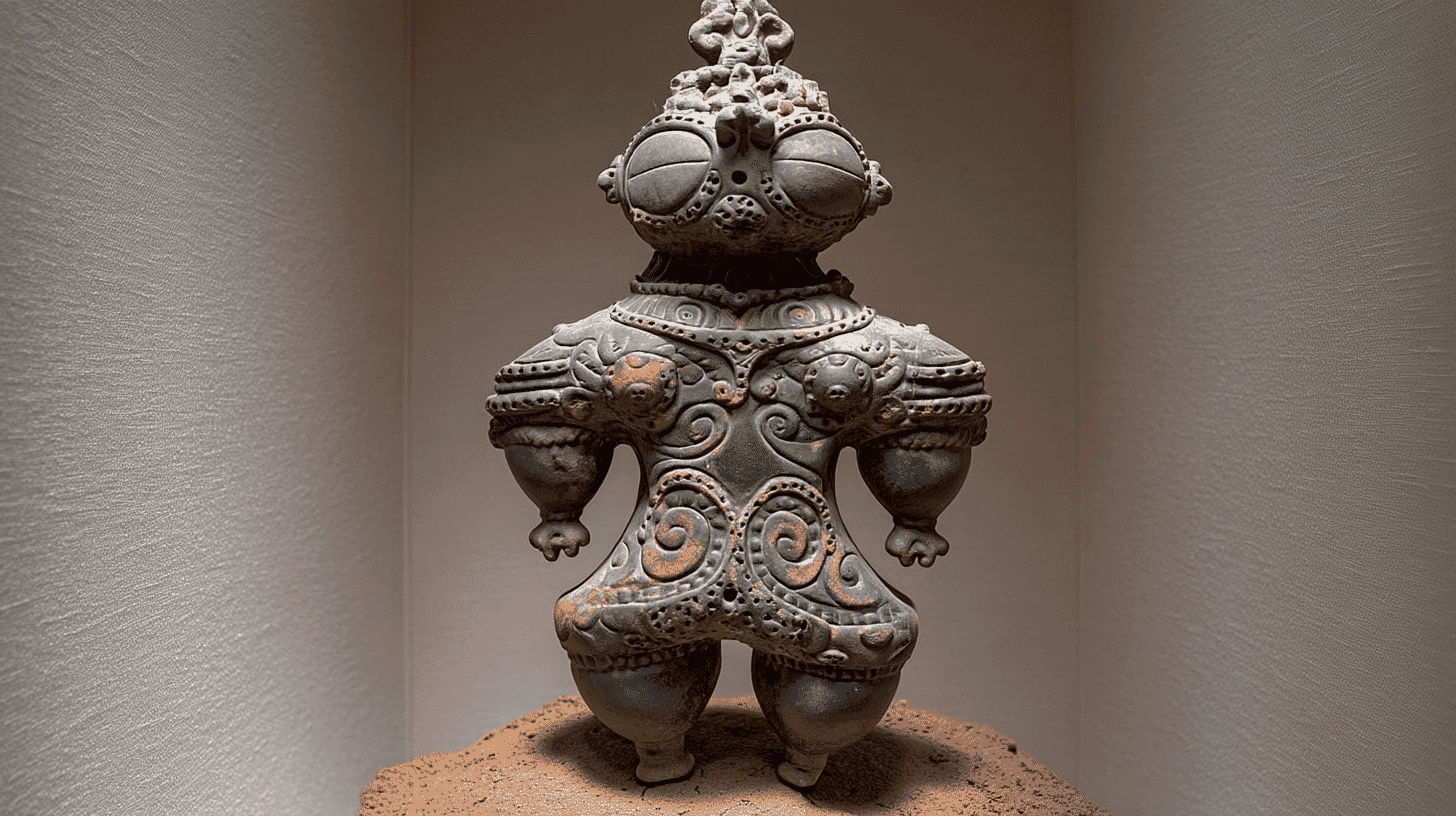
Discover the Ebisuda Shakōki-Dogū: Japan's Iconic Goggle-Eyed Clay Figurine
Standing at over 36 centimeters tall with its distinctive oversized eyes and elaborate decorative patterns, the Shakōki-dogū from the Ebisuda Site is one of the most captivating archaeological treasures from Japan's prehistoric Jomon period. This approximately 3,000-year-old clay figurine, now housed at the Tokyo National Museum as an Important Cultural Property, offers visitors a remarkable window into the artistic achievements and spiritual world of ancient Japan.
What is a Shakōki-Dogū?
The term "Shakōki-dogū" (遮光器土偶) translates literally as "light-blocking device clay figurine," referring to the distinctive goggle-like appearance of its eyes. This name was inspired by the snow goggles traditionally worn by Inuit peoples to protect their eyes from the intense glare of sunlight reflecting off snow—a similarity first noted by archaeologist Shogoro Tsuboi during his studies in London in the late 19th century.
These remarkable figurines flourished during the Final Jomon period (approximately 1000–400 BCE) primarily in the Tohoku region of northeastern Japan. They represent the pinnacle of clay figurine artistry in prehistoric Japan, characterized by their large slit-like eyes, exaggerated body proportions, and intricate surface decorations.
A Farmer's Remarkable Discovery
In 1943, during the height of World War II, a farmer working in the fields at Kabukuri in what was then Tajiri Town (now part of Osaki City) made an extraordinary discovery. While tilling the eastern edge of the Ebisuda archaeological site, he unearthed a large clay figurine in an almost perfect state of preservation—a rarity that initially led some scholars to suspect it might be a modern forgery.
The figurine was found within a stone enclosure, suggesting it had been deliberately and carefully buried by the Jomon people who created it. This careful deposition indicates the significant ritual or spiritual importance the figurine held for its ancient makers.
Why This Figurine is Culturally Significant
The Ebisuda Shakōki-dogū was designated as an Important Cultural Property of Japan on June 9, 1981, in recognition of its exceptional archaeological and artistic value. Several factors contribute to its significance:
First, its remarkable state of preservation is extremely unusual for clay figurines of this period. Most dogū are found intentionally broken, with arms, legs, or other body parts deliberately separated—possibly as part of healing or fertility rituals. Finding one nearly complete is exceptionally rare and provides invaluable information about the original form and craftsmanship of these objects.
Second, the figurine exemplifies the sophisticated "surikeshi-jōmon" (cord-erasure) decorative technique, where artisans created elaborate patterns by strategically applying and then partially erasing cord impressions to produce contrasting textured and smooth areas. The cloud-like interlocking designs covering the body demonstrate remarkable symmetry and artistic planning.
Third, the figurine retains traces of red pigment (likely iron oxide or cinnabar), particularly on the head, revealing that these objects were originally painted—a detail often lost to time in other examples.
Artistic Features and Symbolism
Every aspect of this figurine reflects the sophisticated artistic vision of Jomon craftspeople. The oversized head features a crown-like protrusion resembling rising flames or clouds, creating an impression of otherworldly authority. The enormous slit eyes dominate the face, while the ears, nose, and mouth are rendered in miniature, creating a striking visual contrast.
The body displays exaggerated feminine characteristics—broad shoulders, pronounced hips, and a narrow waist—typical of the stylized female forms seen in many Jomon figurines. The short, stubby limbs add a somewhat humorous quality that contrasts with the figurine's otherwise imposing presence.
The elaborate surface decoration covers virtually the entire body in symmetrical, interlocking patterns. These designs required exceptional skill to execute and suggest the figurine may represent a person wearing ceremonial clothing or body paint, or perhaps a spiritual being whose form transcends ordinary human appearance.
The Mystery of Dogū Purpose
Despite decades of research, the exact purpose of dogū figurines remains one of archaeology's most intriguing mysteries. Several theories have been proposed:
The most widely accepted theory suggests dogū served as ritual objects related to fertility, childbirth, and healing. The exaggerated feminine features support this interpretation, and the frequent discovery of deliberately broken figurines has led researchers to theorize that Jomon people may have ritually "transferred" illnesses or misfortunes to these figures before breaking them.
Some scholars propose dogū represented goddesses or spiritual beings worshipped by Jomon communities. The elaborate decoration and careful craftsmanship suggest these were not everyday objects but items of significant ceremonial importance.
More speculative theories have even suggested the goggle-eyed appearance represents beings from mythology or represents people wearing protective gear—though mainstream archaeology does not support such interpretations.
The Ebisuda Archaeological Site
The Ebisuda Site holds special importance in Japanese archaeology. Located along a tributary of the Kitakami River on a low hillside, this area saw continuous human habitation spanning approximately 8,000 years—from the Early Jomon period through the Late Jomon period, with additional artifacts from the Nara (710–794 CE) and Heian (794–1185 CE) periods.
Beyond the famous Shakōki-dogū, excavations at Ebisuda have yielded an impressive variety of artifacts including pottery with shell-impressed decorations, vessels with plant fiber temper, stone tools such as arrowheads and grinding stones, smaller clay figurines, and decorative ear ornaments. This wealth of material culture provides valuable insights into the daily lives, technological capabilities, and spiritual practices of the people who lived in this region over millennia.
Today, visitors to the Tajiri area can learn about this rich archaeological heritage at local facilities, where high-quality replicas of the famous figurine are displayed alongside other artifacts from the region's long history.
Visiting the Figurine at Tokyo National Museum
The original Ebisuda Shakōki-dogū is preserved in the collection of the Tokyo National Museum, Japan's oldest and most comprehensive museum of Japanese art and archaeology. As a highlight of the Japanese archaeology collection, the figurine is periodically displayed in the Heiseikan building's Japanese Archaeology Gallery or the Honkan's first-floor galleries, though display schedules vary.
The Tokyo National Museum is located in scenic Ueno Park, easily accessible from central Tokyo. The museum's extensive collection includes 89 National Treasures and over 640 Important Cultural Properties, making it an essential destination for anyone interested in Japanese cultural heritage.
When visiting, consider exploring the museum's other Jomon-period artifacts to gain a broader understanding of this fascinating prehistoric culture. The museum also offers audio guides and volunteer-led tours that can enhance your appreciation of these ancient treasures.
Surrounding Attractions
A visit to the Tokyo National Museum can easily be combined with exploration of Ueno Park's many cultural attractions. The National Museum of Western Art, designed by Le Corbusier and designated a UNESCO World Heritage Site, is just steps away. The National Museum of Nature and Science offers fascinating exhibits on Japan's natural history, while Ueno Zoo—Japan's oldest zoo—is perfect for families.
For those interested in tracing the Shakōki-dogū to its origins, the Osaki-Tajiri area in Miyagi Prefecture offers a different kind of journey. The region is known for its hot springs, seasonal migratory birds at the nearby Kabukuri-numa Wetland (a Ramsar Convention site), and beautiful cherry blossoms in spring. Local museums and cultural facilities display replicas of the famous figurine and provide context about the archaeological heritage of this historically rich region.
The Enduring Fascination of Jomon Art
The Shakōki-dogū from Ebisuda continues to captivate visitors and researchers alike, standing as testament to the remarkable artistic and spiritual achievements of Japan's Jomon people. In an era long before writing, metalworking, or agriculture reached these islands, the Jomon created some of the world's most distinctive and sophisticated prehistoric art.
Whether you are drawn by archaeological curiosity, artistic appreciation, or spiritual wonder, encountering this 3,000-year-old figure offers a profound connection across time to the creative spirit of ancient Japan. The combination of technical mastery, aesthetic sophistication, and enigmatic purpose ensures that the goggle-eyed figurines of the Jomon period remain among the most recognizable and beloved symbols of Japanese cultural heritage.
- 📍 Plan Your Visit to Tokyo
- Find tours, activities & transport passes near Clay Figurine / Excavated from Kabukuri Ebisuda, Tajiri Cho,
- [ Tokyo Skytree Asakusa & teamLab Experiences ]
Q&A
- Why is this figurine called "Shakōki-dogū" (goggle-eyed figurine)?
- The name comes from the figurine's distinctive large, slit-like eyes that resemble the snow goggles (shakōki) traditionally worn by Inuit peoples to protect against snow blindness. Archaeologist Shogoro Tsuboi first noted this similarity in the 1890s after seeing Inuit snow goggles at the British Museum in London. Despite the name, modern scholars believe the exaggerated eyes represent a stylistic choice emphasizing the importance of eyes in spiritual or symbolic contexts, rather than actual goggles.
- Can I see the original Shakōki-dogū from Ebisuda at the Tokyo National Museum?
- The figurine is part of the Tokyo National Museum's permanent collection, but like many precious artifacts, it is displayed on a rotating basis to preserve its condition. Check the museum's current exhibition schedule before visiting, as the figurine may be in storage during certain periods. When displayed, it typically appears in the Heiseikan Japanese Archaeology Gallery or Honkan Room 1.
- What makes this particular Shakōki-dogū special compared to others?
- The Ebisuda Shakōki-dogū is exceptional for its nearly complete state of preservation—most dogū are found deliberately broken. It ranks alongside the famous figurine from Kamegaoka (Aomori Prefecture) as one of the finest examples of this type. Its large size (36.1 cm tall), elaborate decorative patterns using the sophisticated surikeshi-jōmon technique, and surviving traces of red pigment all contribute to its status as an Important Cultural Property.
- Is the Ebisuda archaeological site open to visitors?
- The Ebisuda Site itself is primarily agricultural land with limited on-site facilities for visitors. However, high-quality replicas of the famous figurine and information about the site's archaeological significance are available at the Tajiri General Branch Office (田尻総合支所) in Osaki City and other local cultural facilities. The Osaki-Tajiri Tourism Association can provide guidance on experiencing the region's archaeological heritage.
- How old is the Ebisuda Shakōki-dogū, and how was its age determined?
- The figurine dates to the Final Jomon period, approximately 1000–400 BCE, making it roughly 3,000 years old. Its age is determined primarily through pottery typology—specifically, it belongs to the Ōbora C1 style period. The distinctive pottery styles and associated artifacts found at the Ebisuda Site provide reliable dating within the established Jomon chronological framework developed through decades of archaeological research in Japan.
Basic Information
| Official Name | Clay Figurine (Dogū) / Excavated from Ebisuda, Kabukuri, Tajiri-cho, Toda District, Miyagi Prefecture |
|---|---|
| Japanese Name | 土偶/宮城県遠田郡田尻町蕪栗恵比須田出土 |
| Type | Shakōki-dogū (Goggle-Eyed Clay Figurine) |
| Period | Final Jomon Period (ca. 1000–400 BCE) |
| Dimensions | Height: 36.1 cm, Width: 21.0 cm, Thickness: 10.1 cm, Weight: 1,368 g |
| Material | Terra-cotta (Fired clay) |
| Discovery Year | 1943 (Showa 18) |
| Cultural Property Status | Important Cultural Property (Designated June 9, 1981) |
| Collection | Tokyo National Museum (Collection No. J-38304) |
| Museum Address | 13-9 Ueno Park, Taito-ku, Tokyo 110-8712, Japan |
| Museum Hours | 9:30 AM – 5:00 PM (Until 8:00 PM on Fridays, Saturdays, and Sundays before Monday holidays) |
| Closed | Mondays (or following day if Monday is a holiday), Year-end/New Year holidays |
| Admission | Adults: ¥1,000 / University Students: ¥500 / Under 18 & Over 70: Free |
| Access | 10 min walk from JR Ueno Station; 15 min walk from Tokyo Metro Ueno Station (Ginza/Hibiya lines) |
References
- Cultural Heritage Online - Dogū (Agency for Cultural Affairs)
- https://bunka.nii.ac.jp/heritages/detail/168855
- e-Museum - National Institutes for Cultural Heritage
- https://emuseum.nich.go.jp/detail?langId=ja&content_base_id=100609
- Tokyo National Museum Collection - Clay Figurine with Goggle-Like Eyes
- https://www.tnm.jp/modules/r_collection/index.php?controller=dtl&colid=J38304&lang=en
- Osaki-Tajiri Tourism Association - Ebisuda Site
- https://www.osakitajiri-kanko.com/sightseeing-spots/恵比須田遺跡
- Tokyo National Museum - Visitor Information
- https://www.tnm.jp/modules/r_free_page/index.php?id=113&lang=en
- Wikipedia - Shakōki-dogū
- https://ja.wikipedia.org/wiki/遮光器土偶