
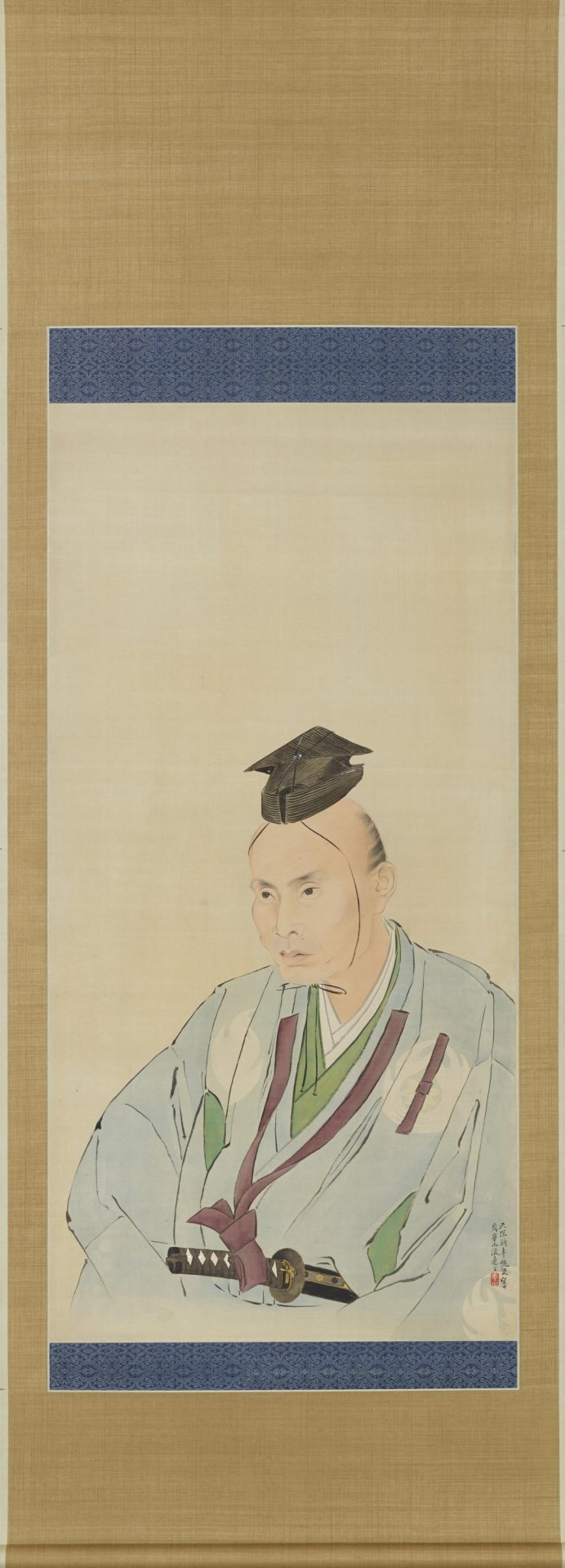
Portrait of Takami Senseki: A National Treasure of the Late Edo Period
In the summer of 1837, the painter Watanabe Kazan finished a portrait of his friend Takami Senseki, a senior retainer of the Koga domain and a scholar of Western learning. The work is a single hanging scroll measuring 115.1 by 57.2 centimeters, and an inscription dates it to the fifteenth day of the fourth lunar month of that year. It is held today at the Tokyo National Museum and was designated a National Treasure on June 9, 1951.
The painting is done in light color on silk, a restrained coloring method known in Japanese as tanpaku. Senseki appears seated in formal dress: a pale blue-green suō, the stiff hemp robe worn by samurai on ceremonial occasions, with a black folded eboshi cap on his head. At his waist he carries a short sword said to have come to him as a gift from his lord, Doi Toshitsura. His face is turned slightly to one side, the gaze direct and composed.
Two Scholars of Western Learning
Takami Senseki (1785 to 1858) served the Koga domain, in what is now Ibaraki Prefecture, and rose to the post of chief retainer stationed in Edo. Alongside his administrative duties he was a committed student of rangaku, the body of Western knowledge that entered Japan through Dutch traders at Nagasaki during the long period when foreign contact was tightly limited. He gathered maps, scientific instruments, and foreign-language books, and late in life he published one of the earliest Japanese-made maps of the Netherlands. The head of the Dutch trading post thought enough of him to bestow a Dutch name, Jan Hendrik Daper.
Watanabe Kazan (1793 to 1841) came from the small Tahara domain in Mikawa, present-day Aichi Prefecture, and likewise held a senior post while pursuing painting and Western studies. He trained first under Kaneko Kinryō and then under the celebrated Edo master Tani Bunchō, and he absorbed the perspective and shading he found in European prints. The two men knew each other through their shared interest in Western learning, with Senseki the elder colleague.
By tradition, the sitting followed a visit Senseki made to Seigan-ji, a temple in the Asakusa district of Edo, as his lord's representative. He stopped at Kazan's house on his way back, still in his ceremonial robes, and the painter recorded him as he was. The visit is often linked to the aftermath of the Ōshio Heihachirō uprising in Osaka earlier that same year, an event in which Senseki's lord helped restore order and Senseki himself played a significant supporting role.
Why the Painting Was Honored
What sets this portrait apart is the way Kazan brought together two visual languages in a single image. For the face he used shading derived from Western art, building a sense of three-dimensional form through gradations of tone rather than outline alone. Look closely and the modeling reveals individual strands of hair, eyebrows assembled from layered short strokes, and lips given a soft fullness. Scholars have even noted a small mole below one nostril, a detail that ties the likeness to one particular man rather than a generic type.
The robes follow a different logic. Here Kazan returned to the broader, more fluid brushwork of East Asian painting, letting the cloth fall in confident lines. The contrast between the closely observed face and the freely drawn garment gives the seated figure both presence and dignity. This blend of realism and traditional technique is the reason the work is regarded as the peak of Kazan's portraiture and one of the finest portraits in all of Japanese painting.
The inscription is signed "Kazan Watanabe Noboru," Noboru being the painter's given name. From the dating, the sitter was in his fifty-third year by the traditional Japanese way of counting age, while Kazan himself was about forty-five.
A Portrait Shadowed by History
The friendship behind the painting met a hard end. In 1839 Kazan was arrested in the Bansha no goku, a government crackdown on scholars accused of looking too favorably on the West. He was placed under house arrest in Tahara, and in 1841 he took his own life at the age of forty-nine. Senseki outlived him by many years, retiring to Koga and continuing his studies until his death in 1858.
The scroll stayed with Senseki's descendants for a century. In 1938 the Tokyo National Museum acquired it from Takami Kyūtarō, an editor and great-grandson of the sitter, and that purchase brought the portrait into a public collection for the first time.
As a National Treasure, the painting is not on permanent view. The museum brings it out for special exhibitions and rotations of its premodern painting galleries, so anyone hoping to see the original should check the current schedule before making the trip.
Following Senseki to Koga
While the portrait lives in Tokyo, the man it depicts is most closely tied to Koga, about an hour north of the capital by train. The Takami Senseki Memorial Hall there occupies the samurai residence where he spent his final years. The house is said to have been built in 1633 from timber left over when Koga Castle was constructed, and it now stands open to visitors at no charge.
Directly across the street, the Koga Historical Museum keeps the vast archive Senseki left behind: the maps, instruments, and records he gathered over a lifetime of study and intelligence work for his domain. Of the roughly thirteen thousand items, more than three thousand were designated an Important Cultural Property in 2004, and representative pieces are on regular display. Next to the memorial hall stands the relocated studio of the later painter Okuhara Seiko, which makes the area a compact circuit for anyone drawn to the cultural history of the closing decades of the Edo period.
Q&A
- Where can I see the original painting?
- It belongs to the Tokyo National Museum in Ueno Park, Tokyo. Because it is a National Treasure, it is shown only at intervals rather than year-round, so checking the museum's exhibition calendar in advance is the safest approach.
- What is the painting made of?
- It is a hanging scroll painted in light ink and mineral colors on silk, measuring 115.1 by 57.2 centimeters. This soft, restrained coloring is called tanpaku in Japanese.
- Who was Takami Senseki?
- He was a chief retainer of the Koga domain and a scholar of Western learning who collected foreign books and instruments. His administrative skill supported his lord, Doi Toshitsura, through several major events of the 1830s.
- Why is this portrait considered so important?
- Kazan modeled the face with Western-style shading to capture a living likeness, down to a mole and individual hairs, while painting the robes in traditional East Asian brushwork. That fusion makes it a landmark of Japanese portrait painting.
- What happened to the painter afterward?
- Watanabe Kazan was arrested in 1839 during a crackdown on scholars of Western learning, confined to his home domain of Tahara, and died there in 1841 at the age of forty-nine.
Basic Information
| Name | Portrait of Takami Senseki (Kenpon tansai Takami Senseki zō), by Watanabe Kazan |
|---|---|
| Location | Tokyo National Museum, 13-9 Uenokōen, Taitō City, Tokyo |
| Designation | National Treasure (painting); designated June 9, 1951 |
| Date | Edo period, Tenpō 8 (1837) |
| Format and size | One hanging scroll, light color on silk, 115.1 × 57.2 cm |
| Painter | Watanabe Kazan (1793 to 1841) |
| Owner | National Institutes for Cultural Heritage |
| Viewing | Displayed periodically; not on permanent view |
References
- e-Museum, National Institutes for Cultural Heritage — Portrait of Takami Senseki
- https://emuseum.nich.go.jp/detail?langId=en&content_base_id=100147
- National Database of Designated Cultural Properties, Agency for Cultural Affairs
- https://kunishitei.bunka.go.jp/bsys/maindetails/201/3
- Cultural Heritage Online (National Institute of Informatics)
- https://bunka.nii.ac.jp/heritages/detail/158935
- Tokyo National Museum Collection
- https://www.tnm.jp/modules/r_collection/index.php?controller=dtl&colid=A9972
- Takami Senseki Memorial Hall, Koga City
- https://www.city.ibaraki-koga.lg.jp/soshiki/rekihaku/kinenkan.html
- Koga City Tourism Association — Takami Senseki
- https://www.kogakanko.jp/history/senseki
Last verified: 2026.06.12