
A Cart Wheel Left in the Stream: The Carriage-Wheel Lacquer Box at the Tokyo National Museum
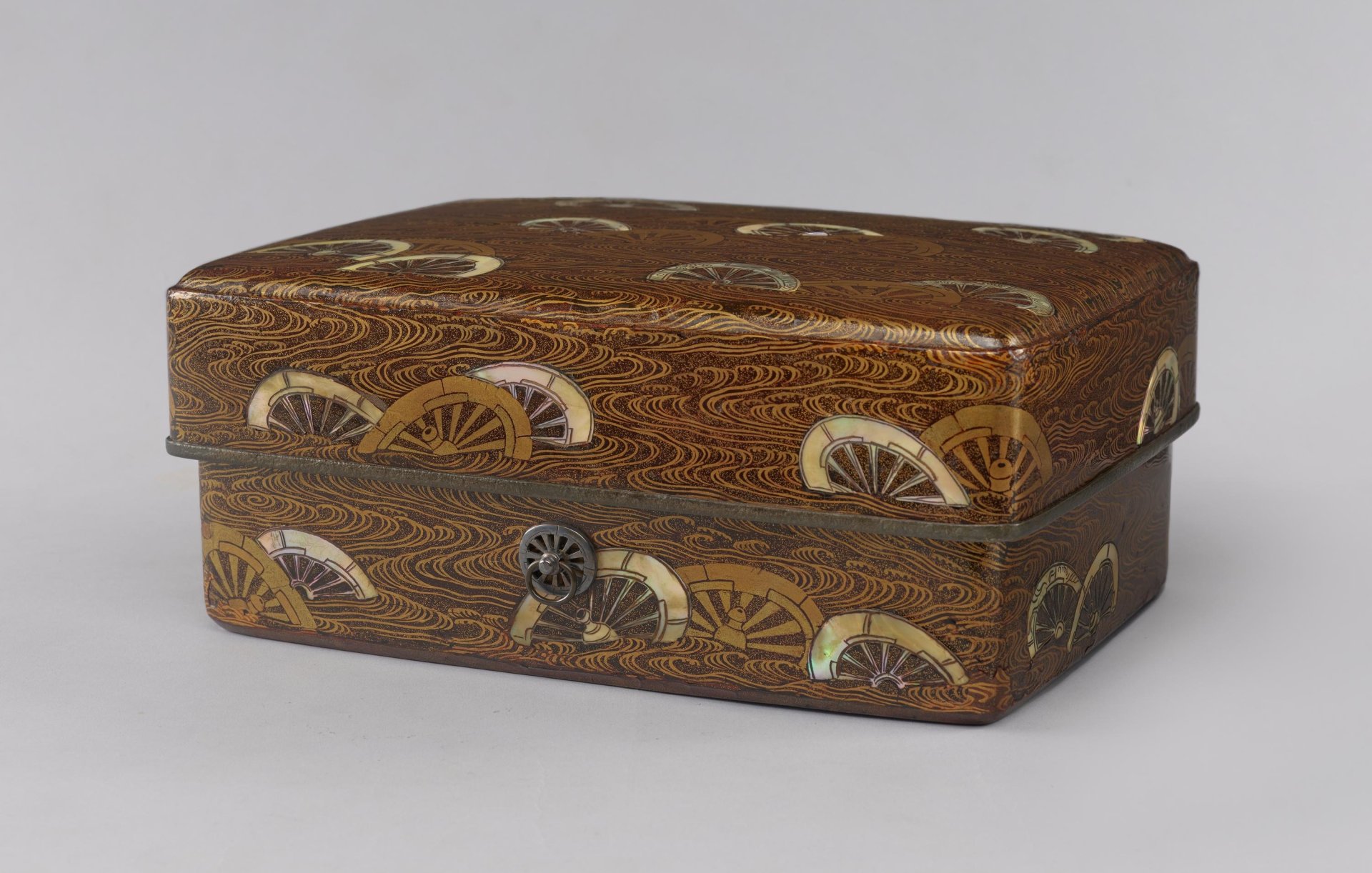
Across the golden surface of a thirteenth-century box, the wheels of an ox-cart sit half-sunk in running water. The image looks almost ordinary, yet it was rendered in some of the most demanding materials a Japanese lacquer workshop could command: gold powder packed so densely it forms a solid metallic field, and slivers of iridescent shell cut to the shape of spokes and rims. This is the Katawaguruma Maki-e Raden Tebako, a toiletry box designated a National Treasure and held by the Tokyo National Museum in Ueno.
The box measures roughly 35.5 centimeters across, 27.3 deep, and 21 high. Lid and body meet flush in what is called aiguchi construction, the join sealed by a thin rim of tin around the mouth. On each long side the museum's craftsmen of the day fixed a small silver fitting cut in the openwork shape of a wheel, once meant to anchor a silk cord. The dating given by the museum is the thirteenth century, the Kamakura period, and the piece is said to have passed down through the Matsudaira family of Matsue, the domain in old Izumo Province on the Japan Sea coast.
The Motif and How It Was Made
The design takes its name from the katawaguruma, the cart wheel shown partly submerged. Wooden ox-cart wheels were soaked in streams to keep them from drying out and splitting, and Heian-period artists turned that practical habit into a decorative subject. The same wheels-in-water pattern appears on bronze mirrors and on the dyed and painted papers used for ornamental sutras, and it remained a favorite long after the carts themselves had changed.
The surface technique is ikakeji: black lacquer dusted with gold powder until the ground reads as unbroken gold. Over it, the flowing water is drawn in tsukegaki, fine lacquer lines sprinkled with gold so the current ripples in low relief. The wheels themselves are cut from shell and set into the lacquer, the pale nacre flashing against the gold. The Japanese term for this inlay is raden, worked here from the cut pieces of luminous turban shell.
Lift the lid and the decoration continues. Comma-shaped tomoe motifs are scattered across the inner face over a sprinkled-gold ground, and the interior is lined with a brocade patterned in chrysanthemums. These are details a museum visitor rarely sees in a sealed display case, but they tell you the box was finished to the same standard inside and out.
Two Boxes, Two Centuries
This is where the piece becomes unusually instructive. The Tokyo National Museum holds a second National Treasure of the same name and the same subject, made about a century earlier in the late Heian period. Seen side by side, or even in photographs, the pair maps a shift in taste.
The older box is smaller, about 30.6 centimeters wide, and built with a deep lid that drops over the body like a cover. Its wheels drift across the water with a loose, scattered rhythm, and the gold is handled with restraint. Many scholars think it was made not for cosmetics at all but to hold Buddhist sutra scrolls, the water-and-wheel imagery carrying a quiet echo of the lotus pond of paradise.
The Kamakura box answers with weight. Its form is fuller and more confident, the gold stronger and more assertive, and the wheels are arranged with a deliberate regularity rather than the earlier free scatter. Set against its Heian predecessor, it shows how the same poetic image could be reworked a generation or two later into something bolder and more ordered, the mark of a new century's eye.
Seeing It in Ueno
Lacquer and shell are sensitive to light, so a National Treasure of this kind is not on permanent view. It rotates through the galleries of the Honkan, the museum's main Japanese building, usually in the room devoted to lacquerware and metalwork. Anyone making a special trip should check the museum's current exhibition listing before going, since the box may be resting in storage between showings. When it is out, the low gallery lighting is part of the experience: the gold reads differently as you move, and the shell wheels catch and lose the light with each step.
The museum sits at the north end of Ueno Park, a short walk from Ueno Station. The park rewards a full day. Within a few minutes are the National Museum of Western Art, the National Museum of Nature and Science, Ueno Zoo, and the quiet precinct of Kanei-ji temple, with Shinobazu Pond and its summer lotus close by. For travelers interested in lacquer and decorative arts, the Honkan's craft galleries reward a slow second loop after the headline objects.
Q&A
- What is a tebako, and was this one really used for cosmetics?
- A tebako is a lidded box for holding cosmetics, papers, and small personal articles. Boxes of this rank often served wider purposes; the related Heian box of the same design is widely thought to have held sutra scrolls rather than toiletries.
- Why are cart wheels shown sitting in water?
- Wooden ox-cart wheels were soaked in streams to stop the wood from drying and cracking. Heian-period designers adopted the scene as an elegant pattern, and it carried over into the Kamakura period seen here.
- How is this box different from the famous Heian one?
- This box dates to the Kamakura period and is fuller in form, stronger in its gold, and more regular in pattern. The Heian box is smaller, uses a cover-style lid, and arranges its wheels more loosely.
- Can I see it whenever I visit the museum?
- Not always. Because lacquer is light-sensitive, the box is shown on rotation rather than permanently. Check the Tokyo National Museum's exhibition schedule in advance to confirm it is on display.
- What does ikakeji raden mean?
- Ikakeji is a lacquer ground packed densely with gold powder so it reads as solid gold. Raden is the inlay of cut shell, here forming the cart wheels. Combined, they produce the gold-and-pearl contrast that defines the box.
Basic Information
| Name | Katawaguruma Maki-e Raden Tebako (Cosmetic Box with Carriage Wheels in Water) |
|---|---|
| Category | Craft / lacquerware |
| Designation | National Treasure (Important Cultural Property, 1931; National Treasure, 1953) |
| Period | Kamakura period, 13th century |
| Count | One box (with lid) |
| Dimensions | Approx. 35.5 cm (width) × 27.3 cm (depth) × 21.0 cm (height) |
| Materials and techniques | Wood with lacquer; ikakeji gold ground, raden shell inlay, tsukegaki gold lines, tin rim, silver fittings |
| Owner | National Institutes for Cultural Heritage |
| Location | Tokyo National Museum, 13-9 Uenokoen, Taito-ku, Tokyo |
| Viewing | Displayed on rotation in the Honkan (Japanese Gallery); not on permanent view |
References
- National Database of Designated Cultural Properties (Agency for Cultural Affairs)
- https://kunishitei.bunka.go.jp/bsys/maindetails/201/387
- e-Museum (National Institutes for Cultural Heritage): Katawaguruma Raden Tebako
- https://emuseum.nich.go.jp/detail?content_base_id=100198&content_part_id=0&content_pict_id=0&langId=ja
- Cultural Heritage Online (NII): Katawaguruma Maki-e Raden Tebako
- https://bunka.nii.ac.jp/heritages/detail/178012
- Japan Search / Tokyo National Museum: Cosmetic Box with Carriage Wheels in Water
- https://jpsearch.go.jp/item/cobas-84474
Last verified: 2026.06.12