
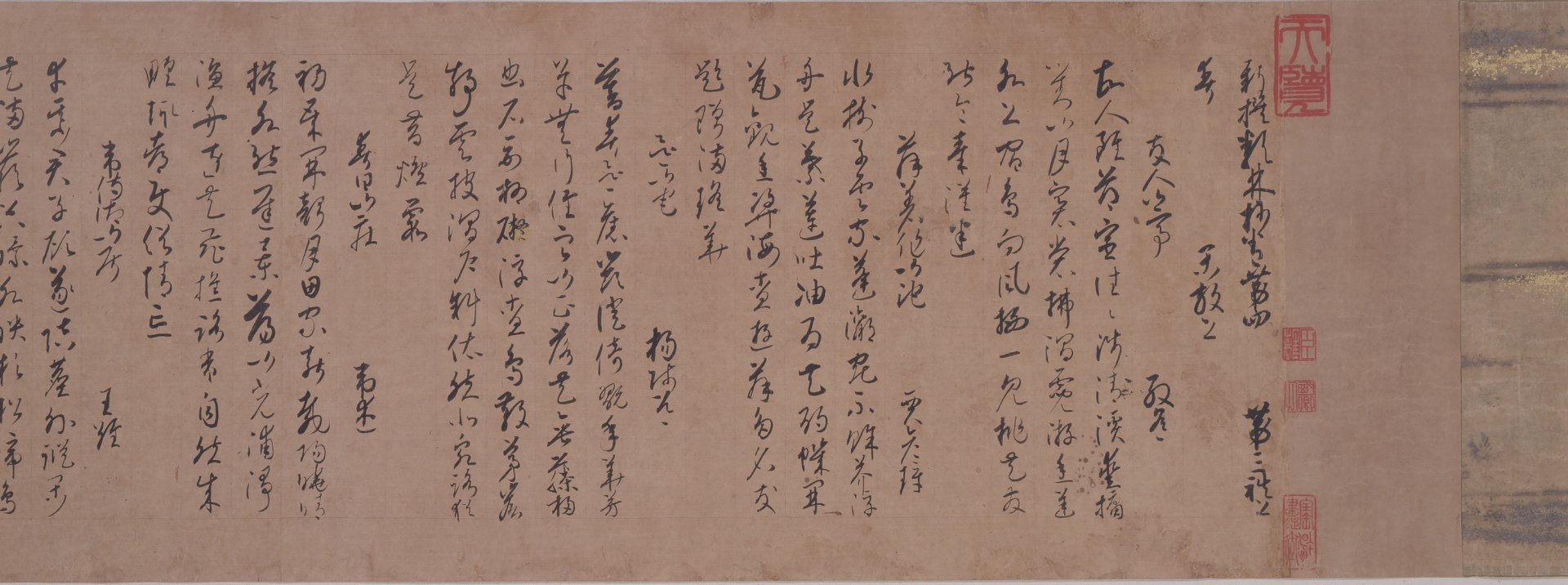
Shinsen Ruirinsho, Volume 4 Fragment: Lost Tang Poems on a Heian Scroll
Forty poems by twenty-one Tang dynasty poets, Li Bai (Li Po), Wang Wei, and He Zhizhang among them, run across five and a half meters of hemp paper in flowing cursive script. This is the surviving fourth volume of the Shinsen Ruirinsho, a Chinese poetry anthology copied in Japan in the early Heian period, during the ninth century. The scroll, 27 centimeters tall and 558 centimeters long, is held by the Kyoto National Museum and was designated a National Treasure on June 21, 1962.
The anthology itself is a puzzle. Its opening line reads "Shinsen Ruirinsho, Volume Four, Third Case, Part One," followed by a section heading: "Spring: Leisure, Part One." Poems were grouped by theme, season by season, mood by mood. Because only this single volume survives, nobody knows how many volumes the complete work once contained, or who compiled it. Scholars infer from its contents, which are limited to Tang poets, that the collection was assembled in China during the Tang dynasty (618 to 907) itself.
That makes the scroll something close to a message in a bottle. Anthologies of this kind circulated widely in Tang China and in the Japan that admired it, then almost entirely vanished. A copy made in ninth-century Japan preserved what the continent lost.
Why It Became a National Treasure
The scroll's value rests on two distinct foundations, one literary, one calligraphic.
As literature, it preserves Tang poetry in a textual lineage independent of the editions that later became standard in China. Some of the poets represented here, such as Yin Yao and Jia Yanzhang, are minor figures whose work survives only thinly elsewhere. For specialists in Chinese literature, a 282-line manuscript copied within a century or two of the poets' own lifetimes is primary evidence of how their verses actually read before centuries of reprinting and editing.
As calligraphy, the scroll is rarer still. Nearly all surviving Japanese manuscripts from the ninth century are Buddhist scriptures or official documents written in formal standard script. This scroll is written entirely in cursive script of the Tang style, brush moving swiftly, characters linked and abbreviated. Examples of full cursive writing from early Heian Japan are exceptionally scarce, and this scroll shows how thoroughly Japanese hands had absorbed continental brush technique within decades of the great embassies to Tang China.
An old tradition attributed the writing to Kukai (774 to 835), the founder of Shingon Buddhism and one of Japan's most celebrated calligraphers. Modern scholarship treats that attribution with caution: the Kyoto National Museum notes the writer remains unidentified, and the National Institutes for Cultural Heritage states plainly that the hand differs from Kukai's known works. The anonymous calligrapher was, in any case, someone of remarkable skill.
What to Look For
Start at the beginning. The inner title and the "Spring: Leisure" heading sit at the head of the scroll, and they reveal the anthology's architecture at a glance: this was a reference work, organized so that a reader composing a poem about an idle spring day could find models quickly. Heian courtiers wrote Chinese verse as a professional skill, and a classified anthology like this one was a working tool, not a display piece.
Then slow down over the script itself. Cursive Chinese writing compresses each character into a few continuous gestures, and reading it is a specialist's art even for native speakers. What a non-specialist can see is rhythm: the column sways, characters swell and contract, the brush lifts and lands without hesitation across all 282 lines. The ink-ruled guide lines (visible as faint vertical borders) keep the columns disciplined while the writing inside them moves freely.
One more layer of history is worth knowing. At some point, sections cut from manuscripts of this work entered the tea-ceremony and calligraphy-appreciation world as treasured fragments known as Nan'in-gire, mounted in albums and hanging scrolls. The Kyoto scroll lets you see the parent format those prized fragments came from.
A practical note: like most calligraphy of this caliber, the scroll is not on permanent view. The Kyoto National Museum rotates its collection through themed displays in the Heisei Chishinkan Wing, and fragile ink-on-paper works appear only periodically, for conservation reasons. Check the museum's exhibition schedule before planning a visit around this specific work. High-resolution images are available year-round through the e-Museum database run by the National Institutes for Cultural Heritage.
Around the Kyoto National Museum
The museum stands in Kyoto's Higashiyama district, about a seven-minute walk from Shichijo Station on the Keihan Line, or a short bus ride from Kyoto Station to the Hakubutsukan Sanjusangendo-mae stop. Directly across the street is Sanjusangendo, the 120-meter hall lined with 1,001 statues of Kannon, itself home to multiple National Treasures.
Within ten minutes on foot you can also reach Toyokuni Shrine, dedicated to Toyotomi Hideyoshi, and the temple of Chishakuin, whose wall paintings by Hasegawa Tohaku and his studio reward unhurried viewing. Kawai Kanjiro's House, the preserved home and workshop of the celebrated 20th-century potter, sits a little further north. The neighborhood makes a coherent half-day of art viewing, with the museum's own collection (ceramics, sculpture, paintings, and calligraphy spanning more than a millennium) as the anchor.
If the scroll itself is not on display during your visit, the museum's calligraphy galleries usually show other manuscripts from the same world: sutras, poem sheets, and letters that put the Shinsen Ruirinsho's cursive hand in context.
Q&A
- Can I see the Shinsen Ruirinsho scroll at any time?
- No. The Kyoto National Museum rotates its holdings, and delicate ink-on-paper manuscripts are displayed only occasionally. Check the museum's official exhibition schedule, or view high-resolution images anytime on the e-Museum website.
- Did Kukai really write this scroll?
- An old tradition credited Kukai, but the attribution is no longer accepted. The National Institutes for Cultural Heritage notes that the handwriting clearly differs from Kukai's authenticated works, and the museum lists the calligrapher as unknown.
- What does "fragment" (zankan) mean in the title?
- It means this is the only surviving volume of a longer work. The complete anthology's original length and its compiler are both unknown, since no other volumes have come down to us.
- Which famous poets appear in the scroll?
- The forty poems include works by Li Bai, Wang Wei, Wang Changling, Qian Qi, and He Zhizhang, alongside lesser-known Tang poets whose verse survives in few other sources.
- Is photography allowed in the Kyoto National Museum?
- Photography rules vary by gallery and exhibition, and loaned or fragile works are often excluded. Follow the signage in each room and confirm current rules at the museum on the day of your visit.
Basic Information
| Name | Shinsen Ruirinsho, Volume 4 Fragment (Shinsen Ruirinsho kan dai-yon zankan) |
|---|---|
| Designation | National Treasure (calligraphy and classical books), designated June 21, 1962 |
| Quantity | 1 handscroll |
| Period | Early Heian period, 9th century |
| Dimensions | 27.0 cm high, 558.0 cm long |
| Material | Ink on hemp paper, ruled in ink; Tang-style cursive script, 282 lines |
| Location | Kyoto National Museum, 527 Chayamachi, Higashiyama-ku, Kyoto |
| Owner | National Institutes for Cultural Heritage |
| Viewing | Displayed periodically in rotating exhibitions; not on permanent view |
References
- Agency for Cultural Affairs, National Database of Designated Cultural Properties: Shinsen Ruirinsho kan dai-yon zankan
- https://kunishitei.bunka.go.jp/bsys/maindetails/201/10518
- e-Museum (National Institutes for Cultural Heritage): Shinsen Ruirinsho kan dai-yon zankan
- https://emuseum.nich.go.jp/detail?content_base_id=101069&content_part_id=0&content_pict_id=0&langId=ja
- Kyoto National Museum Collection Database: Shinsen Ruirinsho kan dai-yon zankan
- https://knmdb.kyohaku.go.jp/3454.html
Last verified: 2026.06.11