
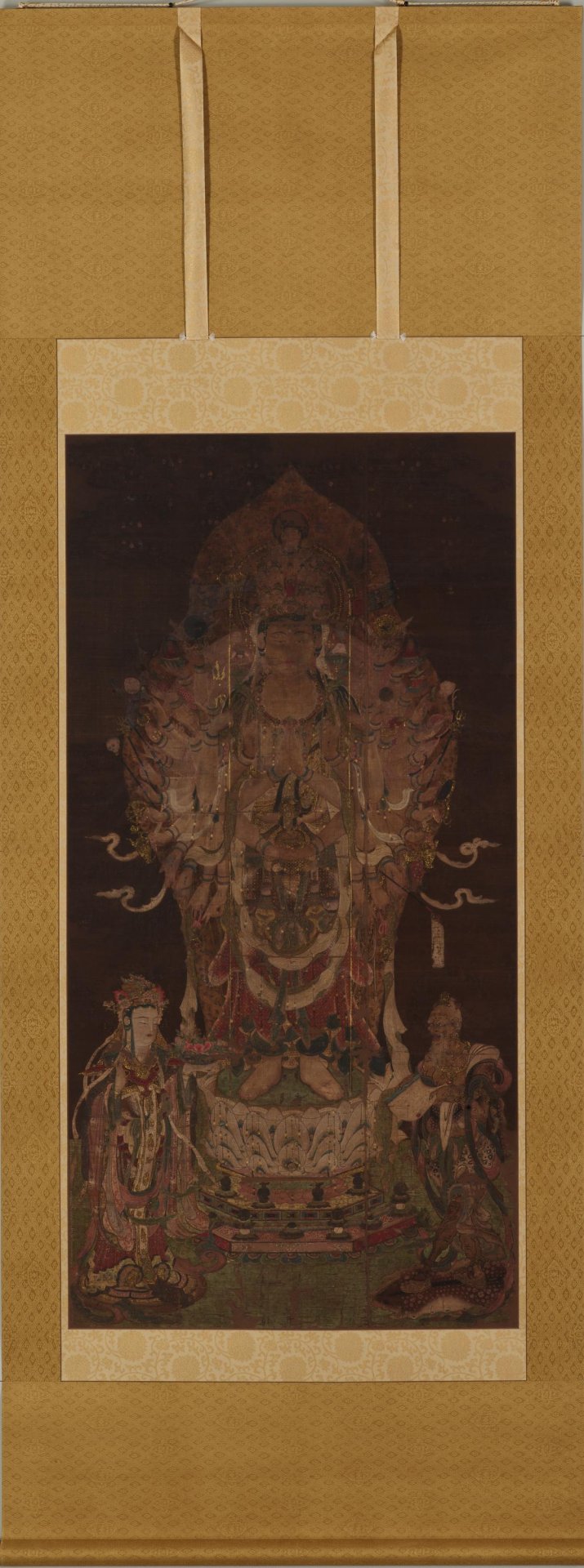
A Thousand-Armed Kannon Painted on Silk
Painted on silk in the twelfth century, this single hanging scroll measures 138.0 by 69.4 centimetres and shows Senju Kannon, the Thousand-Armed Kannon, a form of the bodhisattva of boundless compassion. It belongs to the Tokyo National Museum in Ueno, where it was designated a National Treasure on 2 February 1955.
Senju Kannon, Sahasrabhuja Avalokiteshvara in Sanskrit, had drawn worshippers in Japan since the Nara period in the eighth century. The deity was revered for reaching out to every suffering being with a thousand hands and a thousand eyes: a hand to lift each person, an eye to see each need. Surviving Heian-period paintings of this subject are rare, and this is counted among the finest of them.
Forty-Two Arms, and a Ring of Smaller Hands
Painters and sculptors rarely tried to render a literal thousand arms. The accepted convention, followed here, is to show forty-two principal arms and to imply the rest with many small hands. The number is not arbitrary. Two arms join at the chest in prayer, and the remaining forty are each understood to act across twenty-five planes of existence, so that forty multiplied by twenty-five yields the thousand.
In this scroll the small hands fan out between and behind the main arms, gathered into a clean circle that frames the figure almost like a second halo. Two attendants occupy the lower corners. The aged sage Vasu, called Basusen in Japanese, kneels at the lower right, and the goddess Kudokuten, an Indian deity of merit and fortune related to Lakshmi, sits at the lower left. This pairing around a central Kannon follows the arrangement seen in the Akasagarbha court of the Womb-World Mandala, one of the two great diagrams of esoteric Buddhism. The mandala shows that Kannon seated, while here the deity stands on a lotus pedestal, a quiet departure that a careful viewer can catch.
The Luxury of Cut Gold, and Two Eras in One Image
The surface is where this painting reveals its ambition. Robes, halo and pedestal are worked throughout with kirikane, a technique in which gold leaf is sliced into hair-thin strips and laid down one piece at a time to build fine patterns. The colouring stays restrained and delicate rather than loud, so the gold reads as quiet richness instead of glare.
Specialists place the work in the second half of the twelfth century, and the reason lies in its style. The elegant, ornamental manner of late-Heian Buddhist painting, visible in the supple line and the love of pattern, meets a firmer, more muscular handling that already points toward the Kamakura period. That coexistence of two sensibilities in a single image is unusual, and it is much of why the scroll is regarded as a masterwork of Senju Kannon painting.
From a Shipbuilder's Collection to the Nation
Before it reached the museum, the scroll passed through one of modern Japan's great private collections. It once belonged to Kawasaki Shozo (1837-1912), the Kobe industrialist who founded the Kawasaki Dockyard, forerunner of today's Kawasaki Heavy Industries, and who built what is often called Japan's first private art museum.
In the catalogue of his holdings, the Choshunkaku Kansho, published in 1914 two years after his death, this painting appears as the very first plate in the very first volume. That placement says a great deal about how the collection's compilers ranked it. The financial panic of 1927 scattered much of the collection, and the scroll entered the Tokyo National Museum in 1948, soon after the institution took its present national form.
Seeing the Painting, and Exploring Ueno
Silk and pigment are fragile under light, so the scroll is not on permanent display. It appears in the museum's National Treasure Gallery, the Kokuho-shitsu within the Honkan or Japanese Gallery, for limited spells only every few years. Checking the current schedule before a visit is the sensible move. When the painting is up, it rewards both distances: step close and the kirikane resolves into separate gold lines; step back and the ring of small hands reads as one luminous wheel.
The Tokyo National Museum stands at the north end of Ueno Park, a short walk from the Park exit of JR Ueno Station. As Japan's oldest and largest museum, it holds the country's broadest collection of art and antiquities across several buildings, all covered by one admission ticket. The park around it gathers more institutions within walking distance, among them the National Museum of Nature and Science, the National Museum of Western Art and the Tokyo Metropolitan Art Museum, along with Ueno Zoo, Shinobazu Pond and the cherry avenues that fill with visitors each spring.
Q&A
- What is Senju Kannon, the Thousand-Armed Kannon?
- It is a form of the bodhisattva of compassion who is said to save every being with a thousand hands and a thousand eyes. In painting and sculpture the figure is usually shown with forty-two arms, with the full thousand implied rather than drawn.
- Why forty-two arms rather than a thousand?
- Two hands join in prayer at the chest, and the other forty are each understood to work across twenty-five planes of existence. Forty multiplied by twenty-five comes to a thousand, so forty-two arms stand for the whole.
- Can I see this painting at any time?
- No. Because the silk is light-sensitive, it is shown only periodically, in the National Treasure Gallery of the Honkan at the Tokyo National Museum. Confirm the current display schedule on the museum's website before planning a visit.
- What is kirikane?
- It is a decorative technique in which gold leaf is cut into very thin strips and applied piece by piece to form patterns on robes, halos and other surfaces. It is a hallmark of refined Heian-period Buddhist painting.
- How did the scroll come to the museum?
- It was a prized work in the collection of the industrialist Kawasaki Shozo, where it headed the 1914 catalogue of his holdings. Much of that collection was dispersed after the 1927 financial panic, and the painting entered the Tokyo National Museum in 1948.
Basic Information
| Name | Senju Kannon zo (Thousand-Armed Kannon), colour on silk |
|---|---|
| Designation | National Treasure (Painting) |
| Date designated | 2 February 1955 |
| Period | Heian period, 12th century (latter half) |
| Format and medium | Hanging scroll; ink and colour on silk, with kirikane (cut gold leaf) |
| Dimensions | 138.0 cm high by 69.4 cm wide |
| Count | One scroll |
| Owner | National Institutes for Cultural Heritage |
| Location | Tokyo National Museum, 13-9 Uenokoen, Taito-ku, Tokyo |
| Museum inventory no. | A-10506 |
| Viewing | Shown periodically in the National Treasure Gallery (Honkan); not on permanent display |
References
- Cultural Heritage Online (National Institutes for Cultural Heritage)
- https://bunka.nii.ac.jp/heritages/detail/148198
- Database of National Cultural Properties (Agency for Cultural Affairs)
- https://kunishitei.bunka.go.jp/bsys/maindetails/201/110
- e-Museum, Senju Kannon zo (National Institutes for Cultural Heritage)
- https://emuseum.nich.go.jp/detail?content_base_id=100154&content_pict_id=0
- Tokyo National Museum
- https://www.tnm.jp/
Last verified: 2026.06.12