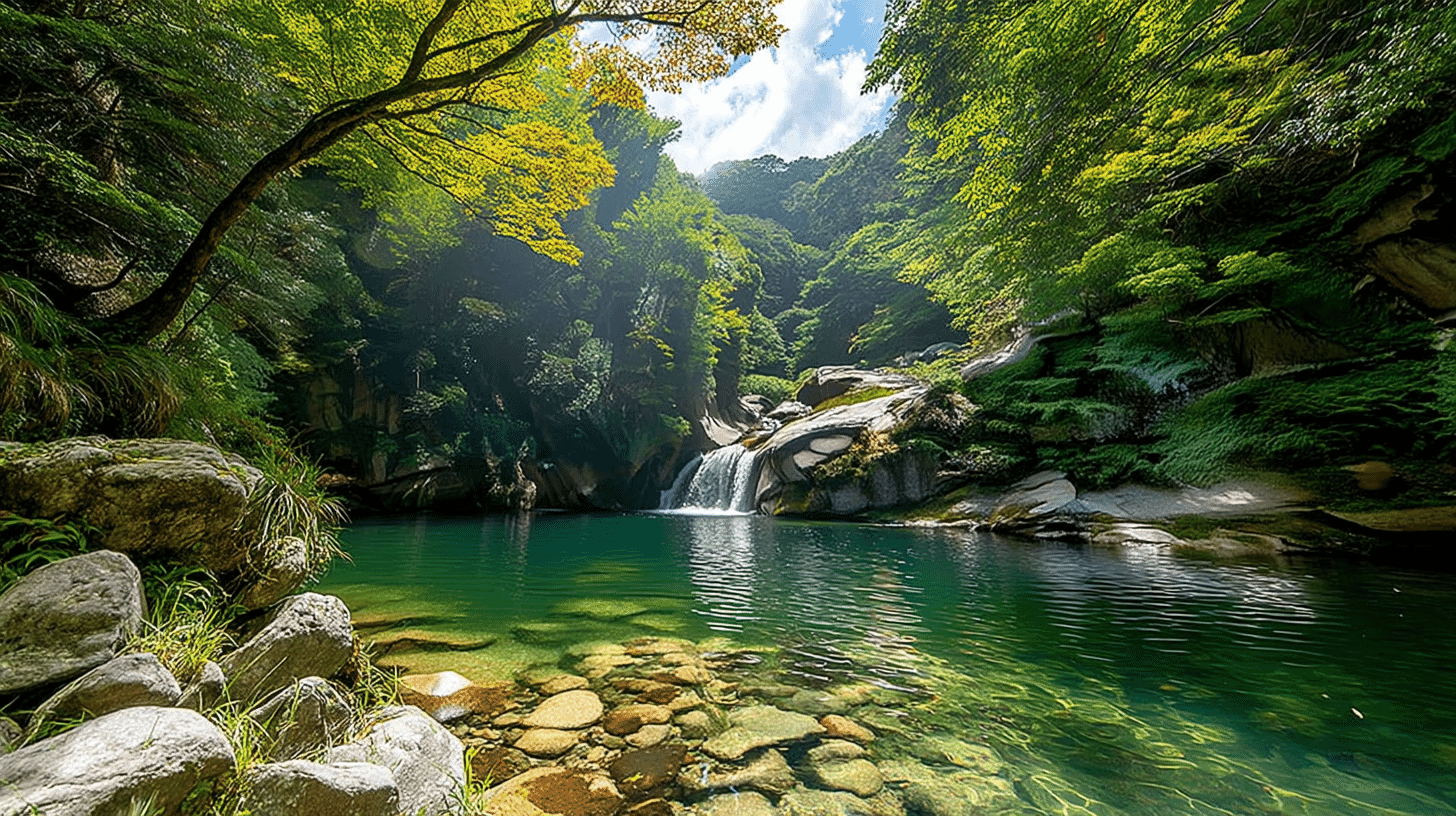
Oshikakei Gorge: A Hidden National Scenic Beauty in Tottori's Mountain Heart

Discover Oshikakei Gorge, a national scenic beauty nestled in Tottori Prefecture. Explore ancient waterfalls, mystical pools, and rare ecological phenomena along this 4km gorge near the famous Misasa Onsen and Nageiredo Temple.

Oshikakei Gorge: Where Nature Sculpts a Masterpiece

Hidden in the mountainous interior of Tottori Prefecture, Oshikakei Gorge (小鹿渓) is one of Japan's most captivating natural landscapes—a place where geological forces, rushing water, and unique ecological conditions have combined to create a scene of extraordinary beauty. Designated as a National Scenic Beauty (国指定名勝) in 1937, this 4.3-kilometer gorge along the Oshika River offers visitors a rare glimpse into a world shaped by millions of years of natural artistry.

Unlike the crowded tourist destinations that dominate many travel itineraries, Oshikakei remains a hidden treasure, known primarily to hikers, nature photographers, and those seeking authentic encounters with Japan's natural heritage. The gorge sits in the shadow of Mt. Mitoku, home to the famous National Treasure Nageiredo Temple, making this region a compelling destination for travelers who appreciate both natural wonders and cultural significance.

The Geological Story: A Landscape Forged by Fire and Water

Understanding Oshikakei's dramatic landscape requires looking back through geological time. The region sits atop the ancient granite foundation of the Chugoku Mountains. Over millions of years, this granite basement sank beneath the sea, accumulating layers of conglomerate rock. Later, volcanic activity pushed lava through these layers, creating a complex stratified geology.

When the heavy rainfall and snowfall characteristic of the San'in region began eroding these mountains, something remarkable happened. The boundary between the conglomerate and granite layers eroded at different rates—a process called differential erosion. This created the gorge's distinctive features: numerous caves, potholes (甌穴), and the dramatically steep, complex terrain that defines Oshikakei today.

The valley floor consists primarily of biotite granite, interspersed with bands of gabbro, diorite, and diabase that cut across the riverbed. These varying rock types have weathered differently over time, producing the diverse textures and colors visible throughout the gorge.

A Unique Ecological Phenomenon: The Inverted Forest

Perhaps Oshikakei's most scientifically fascinating feature is its inverted plant distribution. The gorge's steep cliffs and east-west orientation create an unusual microclimate where cool air becomes trapped at the valley floor while warmer air remains above. This temperature inversion has produced a remarkable botanical phenomenon.

At the bottom of the gorge, where temperatures remain cool year-round, highland plant communities thrive at elevations far lower than typically found in the region. Japanese beech (ブナ) forests grow here at 100 to 300 meters lower than anywhere else in Tottori Prefecture. Meanwhile, warm-climate Japanese red pines (アカマツ) flourish on the cliff tops above.

This botanical diversity extends to numerous tree species: Japanese beech, Japanese blue beech (イヌブナ), Japanese walnut (オニグルミ), Japanese wing nut (サワグルミ), Japanese horse chestnut (トチノキ), Mongolian oak (ミズナラ), urajirogashi oak (ウラジロガシ), Japanese evergreen oak (アカガシ), Japanese cherry birch (ミズメ), painted maple (イタヤカエデ), Japanese magnolia (ホウノキ), Japanese cedar (スギ), and katsura trees (カツラ).

The Twenty-One Views: Poetic Names for Natural Wonders

In 1931, the renowned Chinese poetry scholar Kokufu Saito published "Oshikakei Kisho Nijuikkei" (小鹿渓奇勝二十一景), or "Twenty-One Views of Oshikakei's Scenic Wonders." This poetic documentation gave evocative names to the gorge's most striking features and helped bring Oshikakei to national attention, leading to its designation as a National Scenic Beauty six years later.

Traveling upstream from the gorge's entrance, visitors encounter a series of named pools and waterfalls, each with its own character:

  • Tando-tan (丹戸潭) - The first major pool
  • Goro-tan (五郎潭) - A deep pool marking the start of the maintained trail
  • Kakebu-no-taki (懸布滝) - "Hanging Cloth Waterfall"
  • Amadare-daki (雨垂滝) - "Rain Drop Waterfall"
  • Yaroku-tan (弥六潭) - The legendary pool of the woodturner Yaroku
  • Suisho-daki (水晶滝) - "Crystal Waterfall"
  • Me-buchi (雌淵) - "Female Pool," with the elegant Tamamomaki Waterfall
  • Hyakujo-jiki no Kesho-iwa (百畳敷の化粧岩) - "Hundred-Tatami Makeup Rock"
  • O-buchi (雄淵) - "Male Pool," with the dramatic Kaminawa Waterfall
  • Choja-yashiki (長者屋敷) - "Millionaire's Mansion"
  • Otome-buchi (乙女淵) - "Maiden's Pool"
  • Shinji-daki (品字滝) - "Character Waterfall"

The flowing water and gentle pools have traditionally been described as having a feminine quality, with the interplay of light, shadow, and water creating scenes that change dramatically with the seasons and time of day.

Legend of Yaroku: Folklore at Yaroku Pool

Among the many named features of Oshikakei, Yaroku-tan (Yaroku Pool) carries perhaps the most poignant legend. According to local folklore, a woodturner named Yaroku lived in the village of Oshika. When his mother disappeared in the mountains, he went searching and discovered a giant water spider lurking in a deep pool—the creature that had devoured his mother.

Seeking revenge, Yaroku prayed at the local shrine. The village deity appeared and, in exchange for his life, transformed him into a giant toad. As a toad, Yaroku battled the water spider but found himself in mortal danger. He was saved by his betrothed, whom the deity had transformed into a dragon. Together, they defeated the water spider and avenged his mother's death.

Having fulfilled his purpose, Yaroku climbed the mountain and transformed into a rock, as promised to the deity. His betrothed, still in dragon form, is said to guard him eternally. The pool where the water spider dwelt became known as Yaroku-buchi—a reminder that even in Japan's most beautiful places, ancient stories speak of struggle, sacrifice, and enduring love.

Seasonal Beauty: When to Visit

Oshikakei offers distinct experiences throughout the year, each season revealing different aspects of the gorge's beauty.

Spring (April-May): Fresh green leaves emerge on the beech and maple trees, creating a luminous canopy over the gorge. The contrast between new growth and the ancient rocks is particularly striking.

Early Summer (May-June): This is when Oshikakei's famous Tsukushi-shakunage (ツクシシャクナゲ), the town flower of Misasa, blooms along the gorge. These wild rhododendrons add splashes of pink and white to the green landscape.

Autumn (October-November): The gorge transforms into a corridor of fiery colors as maple, beech, and other deciduous trees turn red, orange, and gold. The town tree of Misasa, the horse chestnut (トチノキ), produces its distinctive bitter nuts during this season.

Winter: Despite its relatively low elevation of around 400 meters, the gorge receives significant snowfall due to seasonal winds channeling through the east-west valley. The snow-covered landscape offers a quieter, more contemplative experience.

A rare phenomenon occurs in the gorge when cold air trapped at the valley floor causes autumn leaves fallen on the water to drift upstream—seeming to defy nature's laws and adding to the gorge's mystical atmosphere.

Historical Context: From Isolation to Recognition

For centuries, Oshikakei served as a natural barrier, isolating the Nakatsu district upstream from the outside world. This remote community developed its own traditions and is associated with the Heike fugitives (平家の落人)—warriors who fled after their clan's defeat in the Genpei War of the 12th century.

The gorge remained largely unknown until 1911, when the poet Sugawara Somei introduced it in his writings. However, it was Kokufu Saito, a respected Chinese poetry scholar who taught at the Imperial Household Ministry and at Tokyo and Keio Universities, who truly brought Oshikakei to national prominence with his 1931 publication documenting the gorge's scenic wonders.

Recognition as a National Scenic Beauty came in 1937. However, the landscape changed significantly in 1953 when Tottori Prefecture constructed the Nakatsu Dam upstream for hydroelectric power generation. This dramatically reduced water flow through the gorge and altered the sightseeing route—where visitors once walked along the riverbed looking up at cliff faces, they now follow a trail above, looking down into the valley.

Nearby Attractions: Complete Your Journey

Misasa Onsen (三朝温泉): Just 15 minutes by car from Oshikakei, this famous hot spring town offers one of Japan's highest concentrations of radon in its waters, believed to have therapeutic properties. The town and Mt. Mitoku were designated as Japan's first "Japan Heritage" site in 2015.

Nageiredo Temple (投入堂): This National Treasure, built into a cliff face on Mt. Mitoku, is one of Japan's most extraordinary architectural achievements. Legend says the temple was thrown into place by the mystical priest En no Gyoja using supernatural powers. Reaching it requires a challenging mountain climb.

Sanbutsu-ji Temple (三仏寺): The main temple complex at the base of Mt. Mitoku, founded in 706 CE, features Important Cultural Properties and offers a more accessible introduction to the area's spiritual heritage.

Utsubuki-Tamagawa District (打吹玉川): A well-preserved traditional merchant district in nearby Kurayoshi, designated as an Important Preservation District for Groups of Traditional Buildings.

Important Notice: Current Access Status

Please be aware that as of August 2023, the Oshikakei walking trail has been closed due to damage from Typhoon No. 7. Disaster recovery work on the Prefectural Route Misasa-Naka Line has necessitated closure of the trail for visitor safety. The closure is expected to continue until the end of fiscal year 2026 (approximately March 2027).

While the trail itself is closed, the scenic area can still be viewed from certain vantage points, and the surrounding region—including Misasa Onsen and Mt. Mitoku—remains accessible. Visitors planning to see Oshikakei should contact the Misasa Tourism Association for the latest information before traveling.

📍 Plan Your Visit to Tottori
Find tours, activities & transport passes near Ojikakei
[ Tottori Sand Dunes & Camel Riding Experience ]

Q&A

QWhat makes Oshikakei special compared to other Japanese gorges?
AOshikakei is distinguished by its unique inverted plant distribution—a rare phenomenon where highland plants grow at the cool valley floor while warm-climate species thrive on the cliffs above. Combined with its dramatic geology, rich folklore, and historical significance as a National Scenic Beauty since 1937, Oshikakei offers an experience found nowhere else in Japan.
QHow do I get to Oshikakei Gorge?
AFrom JR Kurayoshi Station, take a bus bound for "Kamikura" via Misasa Onsen (approximately 50 minutes), then disembark at "Kamikura" and walk about 40 minutes. By car, the gorge is approximately 35 minutes from JR Kurayoshi Station, 15 minutes from Misasa Onsen, or 60 minutes from Yubara IC on the Yonago Expressway.
QWhat is the best season to visit Oshikakei?
AEach season offers unique beauty. Early summer (May-June) brings blooming wild rhododendrons (shakunage), while autumn (October-November) showcases spectacular foliage. Spring offers fresh greenery, and even winter provides a serene snow-covered landscape. Check the current trail status before planning your visit.
QCan I combine a visit to Oshikakei with other attractions?
AAbsolutely. Oshikakei is ideally located near Misasa Onsen (15 minutes by car) and the National Treasure Nageiredo Temple on Mt. Mitoku. The area was designated as Japan's first "Japan Heritage" site in 2015, making it perfect for a multi-day cultural and natural heritage itinerary.
QIs the hiking trail at Oshikakei suitable for beginners?
AWhen open, the maintained trail section (approximately 1 km between Goro-tan and O-buchi) is accessible for most visitors with reasonable fitness. However, please note that the trail is currently closed due to typhoon damage until approximately March 2027. Contact the Misasa Tourism Association for updated information.

Basic Information

Name Oshikakei Gorge (小鹿渓)
Cultural Designation National Scenic Beauty (国指定名勝), designated 1937
Location Kamikura and Nakatsu, Misasa Town, Touhaku District, Tottori Prefecture
Geographic Coordinates 35°22'25.62"N, 133°58'31.81"E
Gorge Length Approximately 4.3 km
Elevation Approximately 400 meters
Trail Status Currently closed (as of December 2025) due to typhoon damage; expected to reopen after fiscal year 2026
Access by Car Approximately 60 minutes from Yubara IC (Yonago Expressway); 15 minutes from Misasa Onsen; 35 minutes from JR Kurayoshi Station
Access by Public Transport From JR Kurayoshi Station, take bus to "Kamikura" (approx. 50 min), then walk 40 min
Contact Misasa Onsen Tourism Association: 0858-43-0431
Misasa Town Tourism Division: 0858-43-3514

References

小鹿渓 - Wikipedia
https://ja.wikipedia.org/wiki/%E5%B0%8F%E9%B9%BF%E6%B8%93
【立入禁止】小鹿渓 | 三朝温泉ポータルサイト
https://misasaonsen.jp/sightseeings/sightseeing-1025/
小鹿渓 | とっとり旅 鳥取県観光旅行情報サイト
https://www.tottori-guide.jp/tourism/tour/view/343
三徳山三佛寺 | 三朝温泉ポータルサイト
https://misasaonsen.jp/sightseeings/mitokusan/
三徳山三佛寺 公式ホームページ
https://www.mitokusan.jp/

Last verified: 2025.12.05

Nearby heritages