
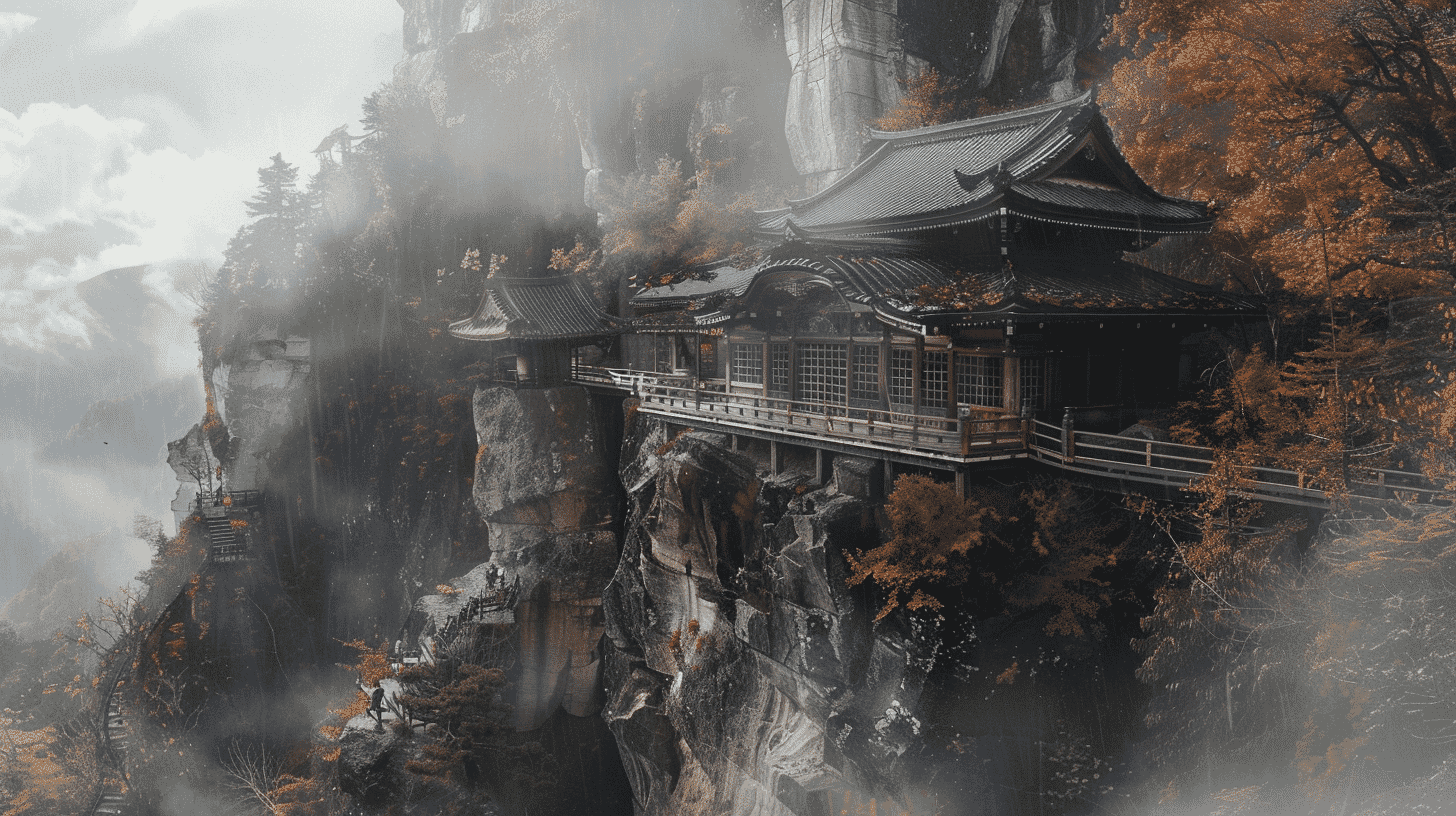
A Late Heian Hall on Stilts, National Treasure since 1952
Sanbutsuji Temple Okuin, the Nageire Hall (三仏寺奥院(投入堂), Sanbutsuji Okunoin, Nageiredo) is a late Heian Buddhist hall at Mitoku, Misasa Town, Tohaku District, Tottori Prefecture, designated a National Treasure in 1952, on 29 March. It had become an Important Cultural Property on 18 February 1904. The quantity is one building. It belongs to Sanbutsuji.
Its form is recorded as kakezukuri construction, one bay along the front, two bays deep, single storey, nagare roof with lean-to and corner lean-to roofs on both sides, cypress bark. The Aizendo is listed as attached property.
The Agency for Cultural Affairs opens from the name. The Nageiredo was formerly called the Zaoden, the tutelary hall of Sanbutsuji. Its date of building is not clear, but it has the style of the Heian period. Of its later history only a repair in 1375 is known; the rest is not clear.
Neither the date of building nor the history is known. What is known is that the style is Heian and that a repair took place in 1375. The Agency says no more because no more is recorded.
Kakezukuri: A Floor Carried on Long Posts
The Agency describes the building: the hall is a small structure built into a rock hollow on the mountainside, hanging on the cliff, its floor carried below on extremely long posts, in what is called kakezukuri construction.
Kakezukuri raises a level floor over a slope or rock face by setting posts of differing length beneath it. The stage of the main hall at Kiyomizudera uses the same method. At the Nageiredo the posts vary to follow the uneven floor of the hollow, so the hall sits within the recess in the rock.
The hall itself is small, one bay by two. The height of the posted space below carries more of the eye than the hall above it. That proportion, more support than building, is what gives the Nageiredo its outline.
Why It Was Designated: Slender Members, Shallow Pitch
The Agency's judgement rests on observed detail. Throughout, the members are slender; the columns, purlins, beams and rafters are widely chamfered; the pitch of the rafters is shallow; and lean-to roofs are added on both sides of the nagare-roofed core. This varied construction expresses the character of the Heian period well.
The proportion of members is what kimari means here, and slenderness is taken as a Heian trait. Wide chamfering, cutting back the corners of a member to a bevel, makes timber read as lighter. A shallow rafter pitch belongs to the same period.
The conclusion follows: this hall is the oldest in the San'in region, and with its fine Heian design and its startling composition it is a survival of rare kind.
That the citation reaches for a word like startling is unusual. The composition itself, a hall fitted into a rock hollow on long posts, is part of what is being valued.
The citation closes on the attached property: the Aizendo to the right of the hall is a small building, but is thought to have been built at the same time as the Nageiredo.
The Name Nageiredo
The present name, the hall thrown in, comes from a tradition that En no Gyoja hurled the building up from the valley by supernatural power. The Agency records only that it was formerly called the Zaoden and does not mention the tradition.
That the date is unknown and that a tradition grew up are two sides of one fact. With no record of how it was built, an account involving throwing survived. This article treats the tradition as tradition rather than fact.
Nor is there settled opinion on how it was actually built. Scaffolding raised from below and lowering from above the hollow have both been proposed, and both remain conjecture.
Visiting: Conditions for Entry
The path to the Nageiredo is an ascetic's trail, with chained sections and stretches climbed by gripping tree roots. It is not an ordinary temple approach, and Sanbutsuji sets conditions on entry.
No one may go alone; parties of two or more are required. Clothing and footwear are inspected, and a pilgrim's stole is worn. Those in unsuitable shoes buy straw sandals and change into them. Entry is barred in rain, in snow and when the ground is muddy.
Registration runs from 8:00 a.m. to 3:00 p.m. and a fee applies. The trail closes for the winter. Whether it opens on any given day depends on the weather, so check with the temple before travelling.
There is also a way to see the hall without climbing. From the distant worship point along the approach the hall can be seen across the valley. That option existed but was not stated in the earlier text.
From JR Kurayoshi Station the bus takes about 40 minutes to the Mitokusan Sanbutsuji stop.
- 📍 Plan Your Visit to Tottori
- Find tours, activities & transport passes near Sanbutsuji Temple Okuin (Nageire Hall)
- [ Tottori Sand Dunes & Camel Riding Experience ]
Q&A
- When was the Nageiredo built and designated?
- The Agency for Cultural Affairs states that the date of building is not clear but that the hall has the style of the Heian period. It became an Important Cultural Property on 18 February 1904 and a National Treasure in 1952, on 29 March. The only later event recorded is a repair in 1375.
- What is kakezukuri construction?
- A method of raising a level floor over a slope or rock face by setting posts of differing length beneath it. At the Nageiredo the posts follow the uneven floor of the rock hollow. The hall is small, one bay by two, and the posted space below carries more of the eye than the hall itself.
- Why was the Nageiredo designated?
- The Agency notes slender members, wide chamfering of columns, purlins, beams and rafters, a shallow rafter pitch, and lean-to roofs on both sides of the nagare-roofed core, all expressing Heian character. It calls the hall the oldest in the San'in region and a survival of rare kind, with fine Heian design and a startling composition.
- Where does the name Nageiredo come from?
- From a tradition that En no Gyoja hurled the hall up from the valley by supernatural power. The Agency records only that it was formerly called the Zaoden and does not mention the tradition. With no record of how it was built, such an account survived; how it was actually raised remains conjecture.
- Can the Nageiredo be visited?
- The path is an ascetic's trail with chained sections. No one may go alone; two or more are required. Clothing and footwear are inspected and a stole worn. Entry is barred in rain or snow, and the trail closes in winter. Registration runs 8:00 a.m. to 3:00 p.m. The hall can also be seen across the valley from the distant worship point.
Basic Information
| Name | Sanbutsuji Temple Okuin, the Nageire Hall (三仏寺奥院(投入堂), Sanbutsuji Okunoin, Nageiredo) |
|---|---|
| Location | 1010 Mitoku, Misasa Town, Tohaku District, Tottori Prefecture |
| Designation | National Treasure (structure); Mount Mitoku is a Place of Scenic Beauty and a Historic Site |
| Year Designated | 1904 (18 February), Important Cultural Property; 1952 (29 March), National Treasure |
| Quantity | 1 building; the Aizendo as attached property |
| Dimensions | Kakezukuri construction, 1 bay along the front, 2 bays deep, single storey, nagare roof with lean-to and corner lean-to roofs on both sides, cypress bark. Floor carried on extremely long posts. Late Heian period |
| Owner | Sanbutsuji |
| Public Access | Ascetic's trail. No solo entry; 2 or more required. Clothing and footwear inspected. Barred in rain or snow, closed in winter. Registration 8:00 a.m. to 3:00 p.m. Visible from the distant worship point without climbing |
References
- Cultural Heritage Online: Sanbutsuji Temple Okuin (Nageiredo)
- https://bunka.nii.ac.jp/heritages/detail/123947
- Tottori travel information: Mitokusan Sanbutsuji
- https://www.tottori-guide.jp/tourism/tour/view/168
- Misasa Town official site
- https://www.town.misasa.tottori.jp/
- Mitokusan Sanbutsuji official site
- https://www.mitokusan.jp/
Last verified: 2026.09.03