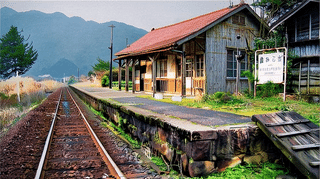
Wakasa Railway: A 19.2-Kilometre Branch Line Registered Station by Station
Wakasa Railway (若桜鉄道, Wakasa Tetsudō) is a 19.2-kilometre single-track line in Tottori Prefecture that runs between Kōge Station in Yazu Town and Wakasa Station in Wakasa Town; it opened in full in 1930 as the Ministry of Railways' Wakasa Line, and on 8 July 2008 twenty-three of its structures became Registered Tangible Cultural Properties.
Tottori City's tourism office describes it as the first time so many facilities of a single line were registered together in Japan. None of them is a showpiece. They are the working parts of an early Shōwa branch line: timber station buildings, stone-faced platforms, riveted steel bridges, concrete sheds that keep snow and falling rock off the rails, and at the terminus the little buildings that once turned, watered and switched steam locomotives.
The line climbs the valley of the Hattō River. Trains cross the river again and again after leaving Kōge, the mountains close in, and the stations spread farther apart. Wakasa, the end of the line, is a mountain town near the eastern edge of Tottori Prefecture, and the rails simply stop there.
How the Line Came to Be
The route first appears in the revised Railway Construction Act of 1922, which listed a railway linking Kōge, by way of Wakasa, with the Yōka area of Hyōgo Prefecture. Construction began in December 1927. The Kōge to Hayabusa section opened on 20 January 1930 and the line reached Wakasa on 1 December the same year. The extension into Hyōgo was never started, so Wakasa has remained a dead-end terminus ever since.
In its early years the Wakasa Line carried timber and other freight out of the valley as well as passengers. Abe Station was added in February 1932. After the war the line passed to Japanese National Railways, and freight handling ended across the line in 1974.
In 1981 it was placed on the first list of loss-making lines slated for closure. Local ridership campaigns bought time, and on 14 October 1987 the newly formed Wakasa Railway Company took over as a third-sector operator. Since April 2009 the towns of Yazu and Wakasa have owned the track and stations while the company runs the trains, a split known in Japan as public ownership with private operation. That arrangement is why most of the registered structures are listed as municipal property.
The 23 Registered Structures, Mile by Mile
The twenty-three break down into eight structures in the yard at Wakasa Station, station buildings and platforms along the line, six bridges, and a snow shed and a rockfall shed. Riding from the Kōge end, they appear in this order.
- Between Yazu Kōkō-mae and Inaba-Funaoka: Hattō River Bridge No. 1, at 139 metres the longest on the line
- Inaba-Funaoka and Hayabusa stations: station building and platform registered as one item each
- Abe Station: station building and platform registered separately
- Hattō Station: station building and platform registered separately
- Between Hattō and Tampi: Iwabuchi River Bridge and Hattō River Bridge No. 2
- Tampi Station: station building and platform registered as one item
- Between Tampi and Wakasa: Hosomi River Bridge, Hattō River Bridge No. 3, the rockfall shed, the snow shed and Wakasa River Bridge
- Wakasa Station yard: station building and platform, storeroom and lamp room, the former west and east switchman's huts, vehicle shed, locomotive turntable, water tower and snow drainage channel
Every bridge is a steel or wrought-iron plate girder. The three big crossings of the Hattō River were built new for the opening. The three small ones, over the Hosomi, Iwabuchi and Wakasa rivers, reuse girders made for other lines in the Meiji and Taishō eras, cut down to fit, so a single ride takes you through several generations of Japanese standard bridge design. The intermediate stations share one template, single-storey timber with a gabled roof and clapboard walls, and then differ in small ways: where the door is, how the waiting shelter is glazed.
At Wakasa the full kit of a steam-era terminus survives: turntable, water tower, switchman's huts and the lamp room that once held the signal levers. They make most sense read together, as a working yard, and the preserved C12 167, a tank engine that once ran on the Wakasa Line, now sits beside the turntable and water tower it was built to use.
Getting There
By rail, take the JR Inbi Line from Tottori Station to Kōge, about 15 minutes, then change to Wakasa Railway for the roughly 30-minute run to Wakasa. A one-day pass valid anywhere on the line between Kōge and Wakasa costs 760 yen and is sold at Wakasa Station and on board. It is the easy option for hopping off at intermediate stations to look at the buildings and bridges. Trains are infrequent, so check the time of the next one before you get off.
By car, Wakasa Station is about 25 minutes from the Tottori-Minami interchange on the Tottori Expressway, and there is free parking at the station.
The station building and waiting room at Wakasa are open to anyone, ticket or not. To walk into the paid part of the yard where the turntable and water tower stand, buy a yard admission ticket at the window: 300 yen, free for elementary-school children and younger. Staff instructions apply inside, and roped-off areas are closed.
Seeing the Structures Along the Line
The station buildings and platforms are in daily use, so you can wait in them like any passenger. The bridges and the two sheds are seen either from the train as it passes or from nearby roads and riverbanks. The track and the bridge decks are off limits, and there is no approaching the rails for a photograph.
Winter in the Wakasa valley is snowy. The snow shed, the drainage channel at Wakasa and the meltwater feed in the turntable pit all show how the line has lived with snow, and they are easiest to understand when there is snow on the ground. Roads change in the snow season, though, so keep any driving tour of the bridges modest.
References
- Registered Tangible Cultural Properties (Wakasa Railway Co., Japanese)
- https://wakatetsu.co.jp/bunkazai
- About Wakasa Railway: history and chronology (Wakasa Railway Co., Japanese)
- https://wakatetsu.co.jp/about/
- Wakasa Railway: 23 registered properties (Agency for Cultural Affairs, Japan Heritage portal, Japanese)
- https://japan-heritage.bunka.go.jp/ja/culturalproperties/result/4487/
- Wakasa Railway as modern industrial heritage (Yazu Town Tourism Association, Japanese)
- https://yazukanko.jp/feature/wakasarailroad/
- Timetable, fares and one-day pass (Wakasa Railway Co., Japanese)
- https://wakatetsu.co.jp/info/
- C12 display runs and yard admission (Wakasa Railway Co., Japanese)
- https://wakatetsu.co.jp/c12
- Wakasa Station, Wakasa Railway (Tottori City official tourism site, Japanese)
- https://www.torican.jp/spot/detail_1231.html
- Wakasa Valley public transport revitalisation (Ministry of Land, Infrastructure, Transport and Tourism, Japanese)
- https://www.mlit.go.jp/common/000046212.pdf
- Wakasa Railway Wakasa Station Building and Platform (Agency for Cultural Affairs, Database of National Cultural Properties, Japanese)
- https://kunishitei.bunka.go.jp/bsys/maindetails/101/00007287
Last verified: 2026.09.26
Basic Information
| Name | Wakasa Railway |
|---|---|
| Location | Yazu Town and Wakasa Town, Yazu District, Tottori Prefecture |
| Owner | Yazu Town, Wakasa Town and others |
| Designation | Registered Tangible Cultural Properties (23) |
| Coordinates | 35.35698, 134.36453 |