
Edo
Tottori · 江戸Browse Tottori’s cultural heritage from the Edo period (1603 – 1868). Filter by type and keyword, with concise stories, maps, and travel tips.
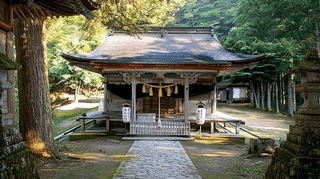
Four Edo-period shrine buildings in Tottori Prefecture. The listing here keeps an older name, while the owner itself now uses a much newer one instead.
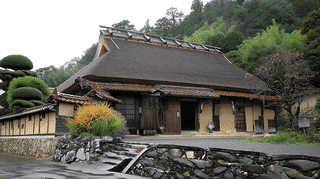
A farmhouse residence in Kagodani, Tottori Prefecture. Its own reading field there covers the bracketed location set within its own name here as well.

The Yabe Family Residence in Yazu, Tottori, a large thatched hip-and-gable farmhouse of the early Edo period (1615 to 1660), is one of the oldest in the prefecture.
The main house of the Ishio merchants in Shikano, Tottori, from the late Edo period (1830 to 1868), fronts the old road with fine lattices and carved brackets.
The main house of the Iwata Family Residence in Tottori is a late-Edo townhouse 8 bays wide, with a deep lean-to, projecting lattice, slit windows and red tiles.
Gabled pantile front gate of the Endo estate in Bōryō, Daisen, dated to 1860 by a ridge tablet: four posts in a row, wicket doors, board walls and bracing posts.
A late Edo two-storey storehouse at the back of the Endo estate in Bōryō, Daisen: weatherboarded sides, a white plaster east front with namako-kabe tile panels.
Late Edo main house of the Endo family, retainers of Daisen-ji, in Bōryō, Daisen: a 264 m² thatched hipped roof, staggered four-room plan and formal entrance.
An 1860 annex beside the Endo estate's front gate in Bōryō, Daisen, probably a retirement room: latticed windows to the road, two 6-mat rooms off a central passage.
Built in 1830 and registered in 2024, this Tottori shrine gate has an off-centre ridge: guardians sit enclosed on one side, visitors stand in the open on the other.
Rebuilt in 1833, the only Edo-period building in this Tottori precinct, it carries a cusped porch gable and three carved dragons under its eaves. Listed in 2018.
The Sasaki Family Residence Grain Storehouse in Hino, Tottori, is an 1829 clay-walled store with a detached roof and two doorways, one capped by a stone lintel.
The Sasaki Family Residence Main House in Hino, Tottori, is a late Edo farmhouse with a broad earth floor and a staggered four-room plan, registered in 2017.
Completed in 1818 and rebuilt in 1838, Joninji's main hall in Tottori keeps cherry-birch pillars, a coved coffered ceiling and a hybrid altar. Registered in 2008.
This 1741 worship hall and offering hall at Tachikawa Inari Shrine in Tottori, once part of Kitano Shrine, has a karahafu porch with stacked kaerumata carvings.
Nagata Shrine Heihaiden in Tottori joins a worship hall and offering hall in one plain, square-posted building, moved here in 1924; visitors enter it for prayers.
The Edo-period main hall of Nagata Shrine in Tottori, moved here in 1924, is the only one of eight registered buildings judged a model of form for its gabled porch.
Late Edo earthen storehouse in the southeast corner of the Funakoshi estate in Yonago: 32 m², plastered to the eaves, one window, and older than the main house.
The Higashikadowaki main house in Tokorogo, Daisen, is a 9-ken farmhouse whose ridge tag dates it to 1818 and names its carpenter, a benchmark for late Edo houses.
The Maniji Main Hall in Tottori, built in 1860 for Taishakuten, layers a dormer gable over a curved porch carved with dragons and waves; registered in 2014.