
Taishō
Yamagata · 大正Browse Yamagata’s cultural heritage from the Taishō period (1912 – 1926). Filter by type and keyword, with concise stories, maps, and travel tips.
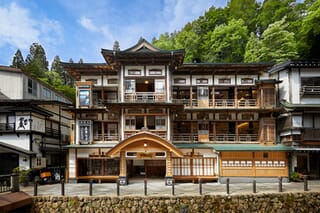
A three-storeyed Taisho timber building in the Ginzan hot-spring town, Yamagata, Japan. Its ground-floor bath faces the street; its river verandas shape the town.

Treasure hall of Uesugi Shrine in Yonezawa, Yamagata, opened in 1923 and attributed to Ito Chuta, a shrine-style concrete hall for the heirlooms of the Uesugi lords.
A late Taisho workshop at the Uzen Kenren works in Tsuruoka where silk is boiled clean, venting steam through a raised roof, with rails to tanks. Registered 2024.
A late-Taisho shed at a working silk works in Tsuruoka, Yamagata, where silk is rinsed and dried, hipped at one end and gabled at the other. Registered in 2024.
A long late Taisho workshop at the Uzen Kenren works in Tsuruoka where shrunken silk is set right, with a central vent roof and winding machines. Registered 2024.
A two-storey plastered storehouse from the late Taisho period, moved in 1940, holding the goods at a working silk works in Tsuruoka, Yamagata. Registered in 2024.
Completed in 1922 at Kaminoyama in Yamagata, this earthen-walled storehouse holds an altar room and a formal parlour downstairs, under heavy curved beams.
At just 9.2 square metres, this late-Taisho miso storehouse at Kaminoyama in Yamagata is the smallest of the five buildings registered on the site in 2022.
Built in the late Taisho era and registered in 2020, the Main House of the former Enman Orimono in Yonezawa has six high-ceilinged rooms and an exposed truss roof.
A 16-metre timber fence of about 1919 around the north garden of a Yonezawa sake brewery house, its copper coping crossing at the corner in a bird-perch finish.
The only two-storey brewing storehouse registered at a Yonezawa sake brewery, built in 1922 on a tall stone plinth, its windowed gable facing the south road.
A late Taisho timber work hall linking the storehouses of a Yonezawa sake brewery, where Nos. 3 and 4 open onto it and the bottling line joins on the north.
A late Taisho corrugated-iron warehouse at the southeast corner of a Yonezawa sake brewery, joined to its neighbour by a wedge link and lined with rubbing boards.
The long-fronted 1919 shop and residence of a Yonezawa sake brewery founded in 1597, with a tall 18-mat reception room and four formal rooms. Seen from the street.
A 1919 bracket-armed gate and yamato-uchi board fence closing the front garden of a Yonezawa sake brewery, with copper ridge and coping ending in bird-perch curls.
Nine wire-gabion groynes of 1925 below the No. 16 dam on the Shohoji River in Tendo: Kawasaki-type gabions two tiers high, densely saddled: the sturdiest type.
The uppermost stone dam on the Kitasawa branch of the Shohoji River in Tendo, built in 1922: 14 m long, 4.6 m high, dry-laid dressed stone in level courses.
Built in 1922 about 55 m below the No. 1 dam on the Kitasawa branch of the Shohoji River in Tendo: a 29 m dry-laid stone dam, battered alike on both faces.
A 1923 dry-laid stone dam on the Kitasawa branch of the Shohoji River in Tendo, 24 m long and 3.0 m high, one of a closely spaced series sharing the sediment load.
A 1922 dry-laid stone dam on the Kitasawa branch of the Shohoji River in Tendo, 40 m long and 4.6 m high, with 1-wari spillway shoulders; foreman Sato Soichiro.