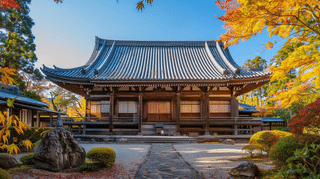
Kozanji Temple Somon: A Muromachi-Period Gate Welcoming Visitors to a National Treasure Temple

Standing quietly at the eastern entrance of Kozanji Temple in the historic castle town of Chofu, Shimonoseki, the Somon (Main Gate) serves as the first architectural encounter for visitors approaching one of western Japan's most storied Zen Buddhist temples. This wooden four-legged gate, known as a shikyakumon, preserves the structural framework of the mid-Muromachi period (15th century) and was registered as a Nationally Registered Tangible Cultural Property in 2004. Though modest in scale compared to the imposing two-story Sanmon (Mountain Gate) that lies further up the stone steps, the Somon carries centuries of history within its weathered pillars and tile-covered roof, standing as a gateway to a temple compound that houses a National Treasure, the tombs of feudal lords, and the site where one of the most dramatic events of the Bakumatsu era unfolded.

Historical Background of Kozanji Temple and Its Somon

Kozanji Temple traces its origins to 1327, when it was founded as Chofukuji, a Rinzai Zen temple, by the monk Koan Genjaku. The temple's most important structure, the Buddha Hall (Butsuden), was actually built earlier in 1320, as confirmed by ink inscriptions on the interior pillars. This Butsuden is now designated a National Treasure as one of the oldest verified Zen-style Buddhist halls in Japan.

During the Muromachi period, the temple enjoyed the patronage of the Ouchi clan, the powerful lords of Suo and Nagato provinces. Ouchi Masahiro restored the temple in 1476, and it was during this era of Ouchi patronage that the Somon is believed to have been constructed. The gate's main structural framework — its cylindrical pillars set on foundation stones with circular seats, horizontal penetrating tie beams (nuki), and boat-shaped bracket arms (funehijiki) — all reflect the architectural conventions of the mid-Muromachi period.

The temple's fortunes shifted dramatically in 1557 when Ouchi Yoshinaga, the last lord of the Ouchi clan, took his own life within the temple grounds after being defeated by the Mori clan. The temple fell into disrepair but was revived in 1602 by Mori Hidemoto, the first lord of the Chofu domain, who converted it to a Soto Zen temple. After Hidemoto's death in 1650, the temple was renamed Kozanji in his honor, using characters from his posthumous Buddhist name.

While the temple underwent significant changes over the centuries, the Somon survived, though its eaves and roofline were substantially modified during the Edo period. The gate thus represents a fascinating architectural palimpsest — a Muromachi-era skeleton dressed in Edo-period exterior details.

Why the Somon Was Designated a Registered Tangible Cultural Property

The Somon was registered as a Nationally Registered Tangible Cultural Property on July 23, 2004, under the registration criterion of being a structure that would be difficult to reproduce. This designation recognizes that the gate preserves irreplaceable historical and architectural value despite the modifications it has undergone.

The gate is constructed in the Zen-style (zenshūyō) four-legged gate format, a type historically associated with the formal entrances of Zen monasteries. Its main pillars extend upward to the ridge beam — a characteristic feature of Zen-style architecture that distinguishes it from other gate forms. The round pillars are set on foundation stones with circular pillar seats, a detail that speaks to careful craftsmanship and traditional building methods.

While the eaves and upper portions were significantly altered during the Edo period, the gate's core structural system — the pillars, tie beams, and fundamental framing — retains mid-Muromachi characteristics. This combination of periods within a single structure provides valuable evidence of how Japanese temple architecture evolved and was adapted over time, making the Somon an important document in wood and stone of Japan's architectural heritage.

Architectural Highlights and Seeing the Gate

The Somon stands at the eastern entrance to the temple precinct, marking the formal boundary between the secular world and the sacred space of the monastery. With a span of approximately 4.4 meters, it is a relatively compact gate, yet it commands attention through its dignified proportions and the patina of age on its timbers.

Visitors approaching the gate will notice several distinctive features. The round pillars, set on carefully shaped foundation stones, convey a sense of stability and permanence. The horizontal tie beams that pass through the pillars — the nuki — bind the structure together, while at the level of the head tie beam (kashiranuki), boat-shaped bracket arms and eave purlins support the roof rafters. Above the gate hangs a plaque inscribed with the characters for "Kaiyu Daiichi Mine" (meaning "The Foremost Peak West of the Sea"), and beside the entrance stands a stone marker with the traditional Zen inscription prohibiting the entry of pungent vegetables and alcohol into the monastery grounds.

The tile-covered roof, while largely an Edo-period reconstruction, complements the rustic atmosphere of the gate and the tree-lined approach path. The Somon serves as a prelude to the increasingly dramatic architectural experiences that await visitors as they ascend the stone steps through a corridor of towering maple and camphor trees toward the magnificent two-story Sanmon and the National Treasure Butsuden beyond.

Visitor Information

Kozanji Temple's grounds, including the Somon and the National Treasure Butsuden, are open for free viewing during daylight hours. Visitors who wish to see the interior of the Hatto (Dharma Hall), the Shoin (study hall with the historic "Room of the Five Court Nobles"), and the temple garden may do so for an admission fee of 300 yen for adults and 100 yen for junior and senior high school students. Children of elementary school age and younger enter free of charge. The shoin and garden are open from 9:00 AM to 5:00 PM.

The temple is located in the Chofu district of Shimonoseki City and can be reached by taking a Sanden Kotsu bus from JR Shimonoseki Station or JR Chofu Station to the "Jokamachi Chofu" bus stop, followed by a walk of approximately 10 minutes. For those arriving by car, a paid parking area is available near the temple entrance at a cost of 200 yen for a half day. The temple is approximately 15 minutes by car from the Shimonoseki Interchange on the Chugoku Expressway.

The approach to the temple through the Somon and up the stone-stepped path to the Sanmon is particularly beautiful during the autumn foliage season, typically reaching its peak in late November. The large maple trees along the path create a stunning canopy of red and orange, and the temple is considered one of the finest autumn foliage spots in the Chofu area. Spring cherry blossoms in early April also make for a lovely visit.

Surrounding Attractions in the Castle Town of Chofu

The Somon and Kozanji Temple are situated within the beautifully preserved castle town of Chofu, a district rich in samurai-era heritage and well worth exploring on foot. A leisurely walk through the area reveals earthen walls, stone-paved lanes, and historic residences that transport visitors back to the Edo period.

Nearby attractions include the Chofu Mori Residence, a Meiji-era mansion built in 1903 for the 14th head of the Chofu Mori family, which features a lovely stroll garden and traditional architecture. The Furue Shoji, a narrow lane lined with traditional earthen walls (neri-bei), is considered the most atmospheric street in the castle town and offers excellent photography opportunities. The Chofu Garden, a spacious Japanese garden on the former estate of a high-ranking retainer, provides a tranquil setting with a pond, teahouse, and seasonal flowers.

History enthusiasts will also want to visit the Shimonoseki City Museum of History, located near Kozanji, which houses collections related to the Mori clan and the Meiji Restoration. The Nogi Shrine, dedicated to General Nogi Maresuke who grew up in Chofu, and the Imi Shrine, one of the oldest shrines in the region, are also within walking distance. The Dangugawa River, which flows through the castle town, is lined with cherry trees and is a charming spot for a stroll, with small cafés and tea houses along its banks.

📍 Plan Your Visit to Yamaguchi
Find tours, activities & transport passes near Kosanji Temple Main Gate
[ Kintaikyo Bridge & Hagi Castle Town Tours ]

Q&A

QWhat is the Somon of Kozanji Temple, and why is it culturally significant?
AThe Somon is the main entrance gate to Kozanji Temple, a Zen-style four-legged gate (shikyakumon) whose core structural framework dates to the mid-Muromachi period (15th century). It was registered as a Nationally Registered Tangible Cultural Property in 2004, recognized as a structure that would be difficult to reproduce. While the eaves were modified during the Edo period, the gate's pillars and framing preserve Muromachi-era construction techniques, making it a valuable example of how Japanese temple architecture evolved over the centuries.
QIs the Somon the same as the large two-story gate visible in photos of Kozanji?
ANo, the two-story gate that appears prominently in many photographs is the Sanmon (Mountain Gate), which was built in 1773 and is designated as a Shimonoseki City Cultural Property. The Somon is the more modest gate located at the foot of the approach path, at the eastern entrance to the temple grounds. Visitors pass through the Somon first and then walk up the stone steps to reach the larger Sanmon.
QWhat is the connection between Kozanji Temple and Takasugi Shinsaku?
AIn January 1865 (the 12th month of Genji 1 by the old calendar), the samurai revolutionary Takasugi Shinsaku launched a bold uprising from Kozanji Temple with only about 80 followers. Before taking action, he visited the five exiled court nobles who were sheltering in the temple's shoin to declare his intentions. This event, known as the Kozanji Uprising (Kozanji Kyohei), was a pivotal moment that shifted the Choshu domain toward the movement to overthrow the Tokugawa shogunate. A bronze equestrian statue of Takasugi stands in the temple grounds.
QWhen is the best time to visit Kozanji Temple and the Somon?
AKozanji is beautiful year-round, but two seasons stand out. Late November is the prime autumn foliage season, when the large maple trees along the approach from the Somon to the Sanmon create a spectacular canopy of color. Early to mid-April brings cherry blossoms throughout the temple grounds. The temple also hosts a flower festival (Hana Matsuri) on April 8 each year. Summer offers lush greenery, and the quiet of winter allows for contemplative visits without crowds.
QCan I visit the National Treasure Butsuden and other buildings at Kozanji?
AThe temple grounds, including exterior views of the Somon, Sanmon, and the National Treasure Butsuden, are freely accessible during daylight hours. To enter the Hatto (Dharma Hall), the shoin (with the historic "Room of the Five Court Nobles"), and the temple garden, an admission fee of 300 yen for adults is required (100 yen for students). Visiting hours are from 9:00 AM to 5:00 PM. Photography of the garden is permitted for non-commercial purposes.

Basic Information

Name Kozanji Temple Somon (功山寺総門)
Cultural Property Designation Nationally Registered Tangible Cultural Property (registered July 23, 2004)
Registration Number 35-0044
Registration Criteria A structure that would be difficult to reproduce
Period Core structure: mid-Muromachi period (15th century); eaves modified in the Edo period
Architectural Style Zen-style (zenshūyō) four-legged gate (shikyakumon)
Construction Wooden, tile-roofed, span of 4.4 meters
Owner Religious Corporation Kozanji
Temple Affiliation Soto Zen Buddhism (Kinzan Kozanji)
Address 1-2-3 Chofu Kawabata, Shimonoseki City, Yamaguchi Prefecture 752-0979
Access Sanden Kotsu bus from JR Shimonoseki Station (~23 min) or JR Chofu Station (~10 min) to "Jokamachi Chofu" stop, then approx. 10-minute walk
Grounds Admission Free (shoin and garden: adults 300 yen, students 100 yen)
Hours Grounds: daylight hours; Shoin/garden: 9:00 AM – 5:00 PM
Contact 083-245-0258
Official Website http://kouzanji.org/

References

功山寺総門 - 文化遺産オンライン
https://bunka.nii.ac.jp/heritages/detail/195299
功山寺 - Wikipedia
https://ja.wikipedia.org/wiki/%E5%8A%9F%E5%B1%B1%E5%AF%BA
功山寺|観光スポット|山口県観光サイト おいでませ山口へ
https://yamaguchi-tourism.jp/spot/detail_10468.html
功山寺 | 下関観光ガイドブック「海峡出会い旅」WEB版
https://shimonoseki-kgb.jp/spot/%E5%8A%9F%E5%B1%B1%E5%AF%BA/
功山寺(山口県下関市長府)の歴史、観光情報、所在地、アクセス
https://suoyamaguchi-palace.com/kozanji/
功山寺 | 中国観音霊場
https://www.kannon.org/author/jiin22/
城下町長府コース | 下関観光ガイドブック
https://shimonoseki-kgb.jp/course/%E5%9F%8E%E4%B8%8B%E7%94%BA%E9%95%B7%E5%BA%9C%E3%82%B3%E3%83%BC%E3%82%B9/

Last verified: 2026.04.17