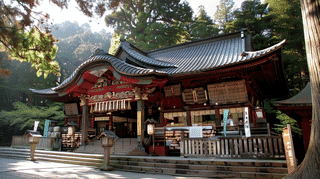
Kitaguchi Hongu Fuji Sengen Shrine: Three Main Halls at the Foot of the Yoshida Trail
Kitaguchi Hongu Fuji Sengen Shrine (北口本宮冨士浅間神社, Kitaguchi Hongū Fuji Sengen Jinja) is the shrine at the start of the Yoshida Trail up Mount Fuji in Kamiyoshida, Fujiyoshida City, Yamanashi Prefecture, and its oldest surviving building, the Togu Main Hall of 1561, heads a group of eleven buildings designated Important Cultural Properties of Japan.
The name is a description of place. According to the shrine, Kitaguchi Hongu means "the shrine at the base of the north entrance," the north entrance being the Yoshida route to the summit. Long before anyone climbed the mountain for religious reasons, this was a place to worship Fuji from below.
Spellings vary. The shrine writes Fuji with an unusual form of the first character, 冨, and so does the Agency for Cultural Affairs for the eight buildings designated in 2017, while its entries for the three main halls use the standard 富. Readings vary too: the Agency gives Togu and Nishimiya for the east and west halls, while Yamanashi Prefecture and Fujiyoshida City read them Higashinomiya and Nishinomiya.
Why Kitaguchi Hongu Fuji Sengen Shrine Has Three Main Halls
Shrine tradition traces its origin to the year 110, when the legendary prince Yamato Takeru is said to have paid homage to Mount Fuji from the nearby mound of Otsuka. After an eruption in 781, the provincial governor Ki no Toyoniwa built a shrine north of the mound in 788 and moved the deity there. Yamanashi Prefecture also dates the move to the present site to 788.
Each time a new main hall went up, the old one was not torn down but moved aside. Takeda Shingen rebuilt the main hall in 1561. When Asano Ujishige, who governed the Gunnai district, built a new main hall in 1594, Shingen's building was moved to the east side and became the Togu, according to the prefecture. In 1615 Torii Narutsugu, lord of the Yamura domain, built the present main hall, and the shrine records that Asano's hall was then moved to the west to become the Nishimiya.
In the mid-Edo period Murakami Kosei, leader of one of the large Fuji pilgrim confraternities (Fujiko) based in Edo, paid for a sweeping rebuilding of the precinct. The shrine dates this work to 1733 through 1738 and says most of today's buildings and layout were fixed then. Fujiyoshida City gives 1736 for the Zuishinmon gate, 1739 for the worship hall and offering hall, and 1745 for the water pavilion, so construction ran on for several years.
Kitaguchi Hongu Fuji Sengen Shrine is also part of the World Heritage property "Fujisan, sacred place and source of artistic inspiration," listed by Shizuoka Prefecture as component 1-6 of the Fujisan mountain area.
The Precinct of Kitaguchi Hongu Fuji Sengen Shrine and Its Eleven Designated Buildings
From the entrance on National Route 138, an avenue of old cedars and mossy stone lanterns leads to the great torii, then through the Zuishinmon gate to the kagura hall and water pavilion, with the worship hall beyond. Yamanashi Prefecture notes that the worship hall and offering hall face roughly north, and that the main hall behind them is shielded by a tall fence whose posts join the offering hall. The small Ebisu shrine stands behind that fence.
The Togu Main Hall stands east of the main hall and the Nishimiya Main Hall to the west, both facing north. Standing before the worship hall, the Togu is at the back on your left and the Nishimiya at the back on your right. The shrine's English page explains that the torii on the west side of the precinct marks the entrance to the Yoshida Trail, the traditional starting point of the pilgrimage climb.
The designations came in three stages. The Togu Main Hall was designated an Important Cultural Property on August 28, 1907; the main hall and Nishimiya Main Hall on March 31, 1953; and eight more buildings on November 28, 2017: the worship hall and offering hall, the Ebisu shrine with its openwork fence, the kagura hall, the water pavilion, the Zuishinmon gate, the Fukuchi Hachiman shrine, the worship hall of Suwa Shrine and the shrine office. That makes eleven in all.
The three main halls were built in turn by the local rulers of their day, the Takeda, the Asano and the Torii, in the late Muromachi, Momoyama and early Edo periods. Most of the eight later buildings were paid for by Fujiko pilgrims in the first half of the 18th century, and the prefecture values them as evidence of how strong the confraternities had become. Walking the precinct, you pass from the age of warlords into the age of pilgrims.
Visiting Kitaguchi Hongu Fuji Sengen Shrine
The grounds of Kitaguchi Hongu Fuji Sengen Shrine are open and free to enter, according to Shizuoka Prefecture's guide to the Fujisan sites. All of the designated buildings are viewed from outside; the page for each building explains where to stand.
By public transport, take a Fujikyu bus bound for Lake Yamanaka or similar from Fujisan Station on the Fujikyu Line and get off at Sengen Jinja-mae, about 5 minutes away; the shrine is right by the stop. On foot it is about 20 minutes from Fujisan Station, according to Yamanashi Prefecture's tourism site. By car, the shrine is about 3 kilometers via Route 139 from either the Kawaguchiko interchange on the Chuo Expressway or the Fujiyoshida interchange on the Higashi-Fujigoko Road. There are normally seven parking areas, the largest being lot 1 on Route 138 with about 50 spaces, plus temporary parking on festival days.
On August 26 and 27 every year the shrine and its subsidiary Suwa Shrine hold the Yoshida Fire Festival, which Fujiyoshida City describes as marking the end of the summer climbing season that opens on July 1, with giant torches set up through the town. The precinct is crowded then, so pick another day if you want to study the buildings closely. For inquiries, call the shrine at 0555-22-0221.
References
- Database of National Cultural Properties (Agency for Cultural Affairs): Kitaguchi Hongu Fuji Sengen Shrine Togu Main Hall
- https://kunishitei.bunka.go.jp/bsys/maindetails/102/845
- Database of National Cultural Properties (Agency for Cultural Affairs): Kitaguchi Hongu Fuji Sengen Shrine Main Hall
- https://kunishitei.bunka.go.jp/bsys/maindetails/102/846
- Database of National Cultural Properties (Agency for Cultural Affairs): Kitaguchi Hongu Fuji Sengen Shrine Nishimiya Main Hall
- https://kunishitei.bunka.go.jp/bsys/maindetails/102/847
- Yamanashi Prefecture: Cultural Properties Guide KB0001, Togu Main Hall
- https://www.pref.yamanashi.jp/bunka/bunkazaihogo/bunkazai_data/yamanashinobunkazai_kb0001.html
- Yamanashi Prefecture: Cultural Properties Guide KB0026, Nishimiya Main Hall
- https://www.pref.yamanashi.jp/bunka/bunkazaihogo/bunkazai_data/yamanashinobunkazai_kb0026.html
- Yamanashi Prefecture: Cultural Properties Guide KB0027, Main Hall
- https://www.pref.yamanashi.jp/bunka/bunkazaihogo/bunkazai_data/yamanashinobunkazai_kb0027.html
- Yamanashi Prefecture: Cultural Properties Guide KB0050, eight buildings of Kitaguchi Hongu Fuji Sengen Shrine
- https://www.pref.yamanashi.jp/bunka/bunkazaihogo/bunkazai_data/yamanashinobunkazai_kb0050.html
- Fujiyoshida City: Nationally Designated Cultural Properties
- https://www.city.fujiyoshida.yamanashi.jp/page/1096.html
- Kitaguchi Hongu Fuji Sengen Shrine: History (Japanese)
- https://www.sengenjinja.jp/yuisho/index.html
- Kitaguchi Hongu Fuji Sengen Shrine: Access (Japanese)
- https://www.sengenjinja.jp/access/index.html
- Kitaguchi Hongu Fuji Sengen Shrine: English page
- https://www.sengenjinja.jp/english/index.html
- Shizuoka Prefecture: Component parts of the Fujisan World Heritage property
- https://www.pref.shizuoka.jp/kankosports/kanko/mtfuji/1002802/1020132.html
- Yamanashi Prefecture official tourism site: Kitaguchi Hongu Fuji Sengen Shrine
- https://www.yamanashi-kankou.jp/kankou/spot/p1_8016.html
Last verified: 2026.10.03
Basic Information
| Name | Kitaguchi Hongu Fuji Sengen Shrine |
|---|---|
| Location | 5558 Kamiyoshida, Fujiyoshida City, Yamanashi Prefecture |
| Owner | Kitaguchi Hongu Fuji Sengen Shrine |
| Designation | Important Cultural Property (4) |
| Coordinates | 35.47061, 138.79241 |