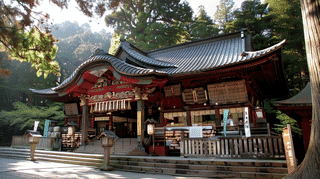
Kitaguchi Hongu Fuji Sengen Shrine Main Hall: An Irimoya-Roofed Sanctuary of 1615
Kitaguchi Hongu Fuji Sengen Shrine Main Hall (北口本宮富士浅間神社本殿, Kitaguchi Hongū Fuji Sengen Jinja Honden) is the sanctuary built in 1615 at the shrine in Kamiyoshida, Fujiyoshida City, Yamanashi Prefecture, and it was designated an Important Cultural Property on March 31, 1953.
It was built by Torii Narutsugu, lord of the Yamura domain and ruler of Tsuru District. The Agency for Cultural Affairs dates it to the early Edo period and describes it as a one-bay shrine with an Irimoya-zukuri roof, a porch under a cusped karahafu gable and a roof of Hiwadabuki cypress bark. Fujiyoshida City adds the plan: a core one bay wide and two bays deep, with a one-bay Kōhai porch in front. A Munafuda ridge tablet is included in the designation as an attached item.
The shrine has three buildings called main halls, and this is the newest. The Togu and Nishimiya halls are both of the simpler nagare-zukuri type, with a single long sweeping roof. Only the main hall has the hipped-and-gabled irimoya form, and the roof alone tells you which of the three was meant to rank highest.
Why the Main Hall of Kitaguchi Hongu Fuji Sengen Shrine Is Valued
The Agency calls the Kitaguchi Hongu main hall a comparatively large shrine building and says its lacquered surfaces, carving and gilded metal fittings stand comparison with the Momoyama-period architecture of the Kinki region around Kyoto and Osaka.
Yamanashi Prefecture goes further. It describes the building as an outstanding survival that shows the full range of Momoyama decorative techniques and, more than that, decoration designed as one with the structure. The carving and metalwork were not applied afterward as ornament; they belong to the same design as the posts and bracketing.
The Tokugawa shogunate was only a little over a decade old when this hall went up on the northern slopes of Mount Fuji, a long way from Kyoto. That a provincial shrine could commission work of this standard is the main point of its value.
What to Look For at Kitaguchi Hongu Main Hall, and Its Repairs
The main hall of Kitaguchi Hongu Fuji Sengen Shrine stands directly behind the worship hall and offering hall. The shrine explains that the three are joined into a single Gongen-zukuri complex. Yamanashi Prefecture notes that the fence (mizugaki) around the main hall was built especially tall to protect it, with its posts running into the offering hall.
As a result you see the main hall mostly from outside the fence, looking up at the roof. The detail to look for is the karahafu porch set in front of the irimoya roof, a combination found on neither of the flowing-roofed halls to either side. Compare the layered bark roof with the roofs of the Togu and Nishimiya and the difference in status is plain.
Repairs are recorded. Fujiyoshida City says that in 1649 Akimoto Tomitomo, lord of the Yamura domain, restored the main hall together with the buildings in front of it. In 1739 Fuji pilgrims led by Murakami Kosei built the present worship hall and offering hall, replacing what stood before the sanctuary. The main hall itself remains the building of 1615.
Seeing the Kitaguchi Hongu Fuji Sengen Shrine Main Hall
Because the Kitaguchi Hongu Fuji Sengen Shrine Main Hall sits inside the fence behind the worship hall, visitors cannot approach it and the interior is not opened. From the front of the worship hall it is almost hidden; walk around the side toward the Togu or Nishimiya halls and look up over the fence to see the roof.
The shrine's website gives no rules on photography. Hold off while ceremonies or prayers are under way, and ask at the shrine office if in doubt. Directions and general visiting information are on the page for Kitaguchi Hongu Fuji Sengen Shrine.
- 📍 Plan Your Visit to Yamanashi
- Find tours, activities & transport passes near Kitaguchi Hongu Fuji Sengen Shrine Main Hall
- [ Mt. Fuji & Lake Kawaguchiko Day Tours ]
Q&A
- When was the Kitaguchi Hongu Fuji Sengen Shrine Main Hall built and designated?
- It was built in 1615 and designated an Important Cultural Property on March 31, 1953, together with one ridge tablet as an attached item.
- Who built the Kitaguchi Hongu Fuji Sengen Shrine Main Hall?
- Torii Narutsugu, lord of the Yamura domain. The shrine says the previous main hall was moved to the west and became today's Nishimiya Main Hall.
- How does the Kitaguchi Hongu main hall differ from the Togu and Nishimiya halls?
- It is the only one of the three with an irimoya roof, fronted by a porch under a karahafu gable. The Togu and Nishimiya halls are both of the nagare-zukuri type.
- Can I see the Kitaguchi Hongu Fuji Sengen Shrine Main Hall up close or go inside?
- No. It stands behind the worship hall inside a tall fence, and the interior is not open. Walk around the side of the worship hall to see the roof over the fence.
- Why is the Kitaguchi Hongu Fuji Sengen Shrine Main Hall considered important?
- The Agency for Cultural Affairs says its lacquer, carving and gilded fittings bear comparison with Momoyama architecture in the Kyoto region, and Yamanashi Prefecture praises decoration designed as one with the structure.
Basic Information
| Name | Kitaguchi Hongu Fuji Sengen Shrine Main Hall (北口本宮富士浅間神社本殿) |
|---|---|
| Location | Kamiyoshida Suwanai, Fujiyoshida City, Yamanashi Prefecture |
| Designation | Important Cultural Property (Building) |
| Year Designated | March 31, 1953 |
| Quantity | 1 building (with 1 ridge tablet as an attached item) |
| Dimensions | 1 bay wide, 2 bays deep; one-bay shrine with irimoya roof, 1-bay karahafu porch, cypress-bark roof |
| Owner | Kitaguchi Hongu Fuji Sengen Shrine |
| Public Access | Grounds open to worshippers. The hall stands inside a fence and is seen from outside it; interior not open |
References
- Database of National Cultural Properties (Agency for Cultural Affairs): Kitaguchi Hongu Fuji Sengen Shrine Main Hall
- https://kunishitei.bunka.go.jp/bsys/maindetails/102/846
- Yamanashi Prefecture: Cultural Properties Guide KB0027, Main Hall
- https://www.pref.yamanashi.jp/bunka/bunkazaihogo/bunkazai_data/yamanashinobunkazai_kb0027.html
- Yamanashi Prefecture: Cultural Properties Guide KB0050, eight buildings of Kitaguchi Hongu Fuji Sengen Shrine
- https://www.pref.yamanashi.jp/bunka/bunkazaihogo/bunkazai_data/yamanashinobunkazai_kb0050.html
- Fujiyoshida City: Nationally Designated Cultural Properties
- https://www.city.fujiyoshida.yamanashi.jp/page/1096.html
- Kitaguchi Hongu Fuji Sengen Shrine: History (Japanese)
- https://www.sengenjinja.jp/yuisho/index.html
Last verified: 2026.10.03