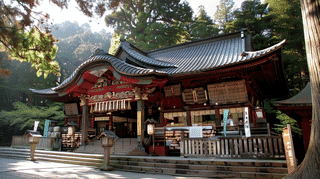
Kitaguchi Hongu Fuji Sengen Shrine Togu Main Hall: The Oldest Building in the Precinct
Kitaguchi Hongu Fuji Sengen Shrine Togu Main Hall (北口本宮富士浅間神社東宮本殿, Kitaguchi Hongū Fuji Sengen Jinja Tōgū Honden, also read Higashinomiya) is a small shrine sanctuary built in 1561 in Kamiyoshida, Fujiyoshida City, Yamanashi Prefecture, designated on August 28, 1907, the date the Agency for Cultural Affairs records for its Important Cultural Property designation.
The Agency reads the name Togu Honden; Yamanashi Prefecture and Fujiyoshida City read it Higashinomiya Honden. Both mean the main hall of the east shrine. The Agency dates the building to the late Muromachi period and classes it as a one-bay Nagare-zukuri shrine with a Hiwadabuki cypress-bark roof, and one Munafuda ridge tablet is included in the designation. The prefecture names the enshrined deity as Hikohohodemi no Mikoto and notes that the hall was long known as Fuji Gongen.
The Togu stands east of the present main hall and faces north, so when you face the worship hall it is at the back on your left. Of the shrine's three main halls, it is the smallest and the oldest.
How the Kitaguchi Hongu Togu Main Hall Became the East Shrine
Shrine records attribute the founding of the Togu to Hojo Yoshitoki, regent of the Kamakura shogunate. Yamanashi Prefecture gives the year as 1224, while Fujiyoshida City and the shrine give 1223, so the sources differ by a year.
The present building is the main hall that Takeda Shingen rebuilt in 1561. Fujiyoshida City says he built it to pray for victory in his wars at Kawanakajima. In other words, the Kitaguchi Hongu Fuji Sengen Shrine Togu Main Hall did not begin as a side shrine; it was the centre of the whole shrine.
Its role changed in 1594. When Asano Ujishige, a senior retainer of the Asano lords of Kofu Castle who governed the Gunnai district, built a new main hall, this building was moved to serve as the Togu, according to the prefecture. Repairs followed in 1615 under Torii Narutsugu of the Yamura domain, in 1649 and 1678 under the Akimoto lords of the same domain, and in 1735 under the pilgrim leader Murakami Kosei. Long after it lost its central place, successive lords and pilgrims kept it in repair.
What Makes the Togu Main Hall of Kitaguchi Hongu Valuable
Yamanashi Prefecture says the Kitaguchi Hongu Togu Main Hall shows Muromachi-period features in its structure and methods, but that the painted color and carving on the outside were added during repairs from the Momoyama period onward. The frame is Muromachi; the dress is later. It is worth remembering this before dating the building by its decoration.
The hall is a one-bay nagare-zukuri shrine with a one-bay porch in front and a Kirizuma-zukuri gabled roof in cypress bark. Fujiyoshida City describes the core as one bay by one bay. The prefecture calls it somewhat smaller than the main hall and the Nishimiya, and the light, forward-sweeping roof reads all the more clearly beside the irimoya roof of the main hall next door.
The Togu also served as a model. According to the prefecture, the Fukuchi Hachiman shrine in the same precinct was rebuilt in 1684 to the same size and plan as the Togu Main Hall, and Fujiyoshida City believes its reconstruction in 1740 also took the Togu as its model. A copy built within the same grounds shows how highly the old main hall was regarded.
Its designation came early, too. The 1907 date is the earliest of any building at the shrine; the main hall and Nishimiya followed 46 years later, in 1953.
Seeing the Kitaguchi Hongu Fuji Sengen Shrine Togu Main Hall
The Kitaguchi Hongu Fuji Sengen Shrine Togu Main Hall stands east of the main hall, at the back left as you face the worship hall, and can be seen from within the grounds. The interior is not opened. The porch and the long line of the roof running forward over it are easiest to read from a slight angle rather than straight on.
Since the color and carving belong to later repairs, look also at the framing: the thickness of the posts and brackets and the depth of the eaves. The shrine's website gives no rules on photography; avoid ceremonies and ask at the shrine office if unsure. Directions and general visiting information are on the page for Kitaguchi Hongu Fuji Sengen Shrine.
- 📍 Plan Your Visit to Yamanashi
- Find tours, activities & transport passes near Kitaguchi Hongu Fuji Sengen Shrine Togu Main Hall
- [ Mt. Fuji & Lake Kawaguchiko Day Tours ]
Q&A
- When was the Kitaguchi Hongu Fuji Sengen Shrine Togu Main Hall built and designated?
- It was built in 1561 and designated on August 28, 1907, which the Agency for Cultural Affairs records as its Important Cultural Property designation date. One ridge tablet is included as an attached item.
- Did Takeda Shingen build the Kitaguchi Hongu Fuji Sengen Shrine Togu Main Hall?
- Yes. The present building is the main hall he rebuilt in 1561, which Fujiyoshida City links to prayers for victory at Kawanakajima. It was moved to become the Togu in 1594.
- Is the Kitaguchi Hongu Togu Main Hall read Togu or Higashinomiya?
- The Agency for Cultural Affairs reads it Togu Honden, while Yamanashi Prefecture and Fujiyoshida City read it Higashinomiya Honden. Both are in use.
- Is the decoration on the Kitaguchi Hongu Togu Main Hall from the Muromachi period?
- Not entirely. Yamanashi Prefecture says the structure shows Muromachi features but the external color and carving were added in repairs from the Momoyama period on.
- Where is the Kitaguchi Hongu Fuji Sengen Shrine Togu Main Hall, and can I go inside?
- It stands east of the main hall, facing north, at the back left as you face the worship hall. You can see the exterior from the grounds, but the interior is not opened.
Basic Information
| Name | Kitaguchi Hongu Fuji Sengen Shrine Togu Main Hall (北口本宮富士浅間神社東宮本殿) |
|---|---|
| Location | Kamiyoshida Suwanai, Fujiyoshida City, Yamanashi Prefecture |
| Designation | Important Cultural Property (Building) |
| Year Designated | August 28, 1907 |
| Quantity | 1 building (with 1 ridge tablet as an attached item) |
| Dimensions | One-bay nagare-zukuri shrine, 1-bay porch, gabled cypress-bark roof (1 bay by 1 bay according to Fujiyoshida City) |
| Owner | Kitaguchi Hongu Fuji Sengen Shrine |
| Public Access | Grounds open to worshippers. Exterior visible from the grounds; interior not open |
References
- Database of National Cultural Properties (Agency for Cultural Affairs): Kitaguchi Hongu Fuji Sengen Shrine Togu Main Hall
- https://kunishitei.bunka.go.jp/bsys/maindetails/102/845
- Database of National Cultural Properties (Agency for Cultural Affairs): Kitaguchi Hongu Fuji Sengen Shrine Main Hall
- https://kunishitei.bunka.go.jp/bsys/maindetails/102/846
- Database of National Cultural Properties (Agency for Cultural Affairs): Kitaguchi Hongu Fuji Sengen Shrine Nishimiya Main Hall
- https://kunishitei.bunka.go.jp/bsys/maindetails/102/847
- Yamanashi Prefecture: Cultural Properties Guide KB0001, Togu Main Hall
- https://www.pref.yamanashi.jp/bunka/bunkazaihogo/bunkazai_data/yamanashinobunkazai_kb0001.html
- Yamanashi Prefecture: Cultural Properties Guide KB0050, eight buildings of Kitaguchi Hongu Fuji Sengen Shrine
- https://www.pref.yamanashi.jp/bunka/bunkazaihogo/bunkazai_data/yamanashinobunkazai_kb0050.html
- Fujiyoshida City: Nationally Designated Cultural Properties
- https://www.city.fujiyoshida.yamanashi.jp/page/1096.html
- Kitaguchi Hongu Fuji Sengen Shrine: History (Japanese)
- https://www.sengenjinja.jp/yuisho/index.html
Last verified: 2026.10.03