
Historic Sites, Places of Scenic Beauty, and Natural Monuments of Aichi
愛 知 県 の 史 跡 名 勝 天 然 記 念 物Aichi · Historic Sites, Places of Scenic Beauty, and Natural Monuments
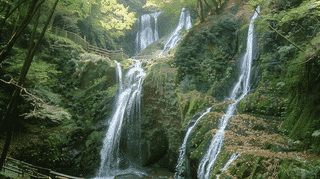
A seven-step waterfall on the Atera River in Shinshiro, Aichi, dropping 62 metres in all. Designated in 1934 for its conglomerate bed and deep potholes.

Aozuka Kofun in Inuyama City, Aichi Prefecture, is a magnificent keyhole-shaped tumulus measuring approximately 123 meters in length, built in the mid-fourth century. As the second-largest ancient tomb in Aichi, it was designated a National Historic Site in 1983 and now anchors the Aozuka Kofun Historic Park, where reconstructed pottery cylinders, lush bamboo-grass slopes, and an on-site guidance facility immerse visitors in over 1,600 years of layered history—from the powerful chieftains of ancient Owari to a Sengoku-era fortress.
Ano Ichirizuka in Toyoake City, Aichi Prefecture is a pair of milestone mounds built in 1604 by order of Tokugawa Ieyasu, marking the 86th ri from Nihonbashi along the old Tokaido. As one of the very few sites in Japan where both the east and west mounds still survive in their original positions across the road, it was designated a National Historic Site in 1936—a quiet but uniquely vivid window into Edo-period travel.
Located at the tip of the Atsumi Peninsula in Tahara City, Aichi Prefecture, the Irago Tōdai-ji Tile Kiln Ruins are a nationally designated historic site where roof tiles were fired for the Kamakura-period reconstruction of Tōdai-ji's Great Buddha Hall in Nara. Excavated eaves tiles inscribed with 'Tōdaiji Daibutsuden Kawara' and other artifacts are displayed at the Atsumi Folk Museum, bearing witness to the extraordinary scale of medieval Japan's greatest rebuilding project and the exceptional ceramic craftsmanship of the Atsumi kilns.
Uma-no-se-iwa, a National Natural Monument in Aichi, is a 122-metre volcanic dike in the Ure River bed near Yuya Onsen, left standing as softer rock eroded away.
Urigō Site in Toyohashi, Aichi, is a Yayoi wetland village on the lower Toyokawa. Wooden tools, charred rice and shell mounds reveal farming, fishing and hunting.
The Ō-Arako Old Kiln Site fired medieval stoneware on the Atsumi Peninsula. An inscribed jar dates it to a 12th-century governor, rare in early Japanese ceramics.
Found under a Nagoya stadium in 1939, the Oguruwa Shell Mound is an Early Jomon site of clay figurines, burials and seashells, now an open park lawn with displays.
A Natural Monument on Mikawa-Oshima off Gamagori, Aichi, for a lancelet habitat. The chordate, linked to vertebrate origins, was last confirmed here in 1968.
The earthworks of Odaka Castle and two Oda forts in Nagoya, where young Tokugawa Ieyasu ran rice through the siege lines on the eve of the 1560 Battle of Okehazama.
In Okazaki, Aichi, a low mound marks the eightieth ri from Edo on the old Tōkaidō. The city’s only surviving milestone, it became a National Historic Site in 1937.
Ruins of Oyama-dera, a mountain temple above Komaki, Aichi, founded in the late 600s. Seventeen pagoda foundation stones remain, with the finds at the city museum.
Genji fireflies light the June nights along rivers in eastern Okazaki, a National Natural Monument since 1935, flashing together in a synchronized two-second beat.
This national historic site in Toyoake marks where Imagawa Yoshimoto is said to have fallen in 1560, with seven stone markers from 1771 and a rare eulogy monument.
Inazawa's Owari Provincial Temple Site holds the plan of a Nara-period state temple. Four pagoda stones mark the ground, their dates matching the ancient chronicles.
Kaigaragayama Shell Mound in Kiyosu City, Aichi Prefecture, is a nationally designated historic site where early Yayoi Ongagawa-type pottery and Jomon-derived combed-pattern pottery were found together. As part of the Asahi Archaeological Site — one of Japan's largest Yayoi moated settlements — visitors can explore the dawn of rice-farming culture over 2,300 years ago at the Aichi Asahi Archaeological Site Museum.
Below Mount Chausu lies Aichi's only wild grove of hananoki, a Japanese red maple that outlived the ice ages. Its branches redden in spring, its leaves in autumn.
The Spherical Granite of Mount Sanage, a National Natural Monument located on the slopes of Mount Sanage in Toyota City, Aichi Prefecture, features exceptionally rare orbicular structures resembling chrysanthemum flowers. Known locally as 'Kiku-ishi' (Chrysanthemum Stones), this geological wonder can be explored along the scenic Sanage Seven Waterfalls Trail.
Begun in 1615 by Owari's Tokugawa Yoshinao, this 30,463 m² stroll garden is Japan's largest surviving castle-residence garden, with bold blue-stone groupings.
On a chert ridge above the Kiso River in Inuyama, this 72-meter square-front, square-back tomb yielded eleven bronze mirrors and rich early-Kofun grave goods.
More from Aichi
Aichi’s registered properties across designations, with featured heritage and travel notes.
The complete kokuhō catalogue — browse by prefecture, period, and category.
Nationwide jūyō bunkazai — architecture, sculpture, painting, crafts, and documents.