
Important Cultural Property of Aomori
青 森 県 の 重 要 文 化 財Aomori’s Important Cultural Properties — designated for their value to the nation’s cultural history.
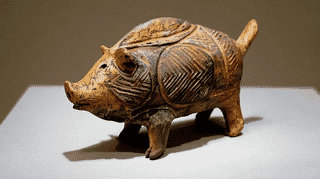
Discover the remarkable Boar-shaped Clay Object, a 4,000-year-old Important Cultural Property from Japan's Jomon period. Visit Hirosaki City Museum in Aomori to see this exceptional artifact showcasing ancient spiritual culture and artistic mastery.

The Ishiba Family Residence, located opposite the Kameoka Gate of Hirosaki Castle in Aomori Prefecture, is one of the finest surviving Edo-period merchant houses in the Tsugaru region. Designated as an Important Cultural Property of Japan, this grand timber-framed building features massive adze-finished beams and a distinctive komise snow arcade, and continues to operate as a sake shop to this day.
Iwakiyama Shrine's worship hall in Aomori began as a Buddhist temple's main hall, built 1603 to 1640. The vermilion five-bay hall still reads as a temple sanctuary.
Iwakiyama Shrine's Romon in Aomori is a vermilion five-bay tower gate built in 1628 as a Buddhist temple's gate, inherited by the shrine after the Meiji reforms.
The Edo Family Residence in Gonohe, Aomori, was home to rural samurai of the Nanbu domain. The large thatched house dates from around 1783; exterior viewing only.
At Engaku-ji in Fukaura, Aomori, this cabinet-shrine of 1506 holds the Medicine Buddha. A one-bay, Zen-style structure, it is reckoned Aomori's oldest building.
The Former Ōminato Water Source Waterworks Facility in Mutsu City, Aomori Prefecture, is an Important Cultural Property of Japan built between 1902 and 1910 as the first modern waterworks in the Tōhoku region. Discover its stunning gravity-arch stone dam and seasonal cherry blossoms in Suigenchi Park.
The thatched main hall of Kakushuji, mortuary temple of the Tsugaru founder. A large early-1600s Soto Zen hall by the Iwaki River, an Important Cultural Property.
The Former Kasaishi Residence, a thatched 18th-century farmhouse in Towada, Aomori, gives a third of its floor to a stable, the mark of a horse-rearing region.
Maekawa Kunio's first building, completed in 1932 after training under Le Corbusier. One of Japan's earliest modernist works, now an Important Cultural Property.
Built in 1907 by banker Tsushima Gen'emon, this 19-room wooden mansion in Kanagi, Aomori, is novelist Dazai Osamu's birthplace and an Important Cultural Property.
Hirosaki's oldest surviving samurai house, named in a 1756 register. A national Important Cultural Property built in hiba, its roof frame left open. Free entry.
Standing on the northeastern tip of Honshu, Shiriyazaki Lighthouse is a graceful brick tower designed by British engineer Richard Henry Brunton and first lit in 1876. As Tōhoku's earliest Western-style lighthouse and Japan's tallest active brick lighthouse at 32.8 meters, it pioneered the country's first fog signal and first electric beacon. Designated a National Important Cultural Property in 2022, the lighthouse sits within a windswept moorland where Aomori's natural-monument Kandachime horses graze, where the Pacific Ocean meets the Tsugaru Strait.
Discover the Former Fifty-Ninth Bank Head Office Main Building in Hirosaki, a nationally designated Important Cultural Property of Japan. Built in 1904 by master builder Horie Sakichi, this stunning Renaissance-style wooden building features rare kinkarakami ceilings and exquisite Japanese-Western hybrid craftsmanship.
The Tsugaru Family Mausolea, five structures designated as Important Cultural Properties of Japan, stand within the grounds of Choshoji Temple in Hirosaki, Aomori Prefecture. Built between 1631 and 1753, these mausolea honor successive lords and ladies of the Hirosaki Domain. Their austere unpainted wood exteriors conceal brilliantly painted ceilings featuring dragons and celestial beings. Located at the end of Zenringai — a unique avenue of 33 Soto Zen temples — they offer a profound encounter with the feudal history and sacred architecture of northern Japan.
Discover the Tsugaru Clan Mausolea (Tsugaru-ke Tamaya), five Important Cultural Properties from the Edo period at Choshoji Temple in Hirosaki, Aomori. Explore their history, architecture, and visiting tips.
The Toshogu Main Hall in Hirosaki, Aomori Prefecture, built in 1628, is the northernmost Toshogu shrine architecture on mainland Japan. Established as the very first Toshogu enshrinement outside Nikko through the devotion of Matehime, Tokugawa Ieyasu's adopted daughter, this Important Cultural Property preserves Momoyama-era construction techniques within its distinctively austere unfinished-wood design.
The Nanbu Toshiyasu Tamaya in Nanbu Town, Aomori Prefecture, is a nationally designated Important Cultural Property built in 1632 by the second lord of the Morioka Domain to mourn his son's untimely death at age 24. Adorned with black lacquer, vivid polychrome paintings, and gilt metal fittings in the Momoyama style, this exquisite mausoleum crafted from the finest Kiso hinoki cypress is praised as the most splendid memorial hall in the Tohoku region.
Discover the Hirosaki Gakuin Foreign Missionary Residence, an Important Cultural Property built in 1906 in Aomori Prefecture. This elegant Western-style building with its distinctive octagonal turret showcases the fusion of American and Japanese architectural traditions in Meiji-era Tohoku.
Discover the Important Cultural Property artifacts excavated from the Tangodaira Tumulus Group in Hachinohe, Aomori. Explore ancient swords, jewels, and a unique Korean-made gilt-bronze sword pommel at the Hachinohe City Museum.
More from Aomori
Aomori’s registered properties across designations, with featured heritage and travel notes.
The complete kokuhō catalogue — browse by prefecture, period, and category.
Nationwide jūyō bunkazai — architecture, sculpture, painting, crafts, and documents.