
Important Preservation Districts for Groups of Traditional Buildings of Japan
重 要 伝 統 的 建 造 物 群 保 存 地 区Browse Japan’s Important Preservation Districts for Groups of Traditional Buildings nationwide. Filter by prefecture, period, and category, with concise stories, maps, and practical travel tips.
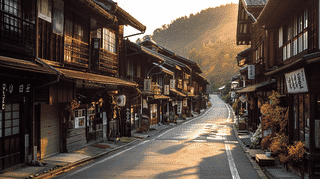
A lacquerware town in Shiojiri, Nagano Prefecture, Japan. One street sells and a parallel one makes, with lacquering stores deep in the narrow lots behind.

Just six kilometers southwest of Ishigaki Island, Taketomi Island preserves one of the most evocative village landscapes in Japan — red-tiled timber houses, dry-stacked coral limestone walls, and lanes paved in bright white sand. Designated in 1987 as a national Important Preservation District for Groups of Traditional Buildings (Island Agricultural Village), the 38.3-hectare district is a living community of around 350 residents who maintain the streetscape daily and carry forward traditions such as the 600-year-old Tanadui festival.
Tonaki Island, an Important Preservation District for Groups of Traditional Buildings designated in 2000, preserves Okinawa's primal landscape of red-tiled roofs, white sand lanes, and Fukugi windbreak groves on a tiny island northwest of Naha. Discover its unique sunken houses, footlit nighttime alleys, and unhurried island life.
A river port on the Ariake Sea tides in Ureshino, Saga, an Important Preservation District since 2005, with plastered izoya merchant houses and riverside stone walls.
The samurai quarter of the Chiran District of Minamikyushu City, Kagoshima, an Important Preservation District since 1981, with hedges on stone walls.
Kakunodate in Akita is among Japan's first preservation districts, an Edo-era samurai quarter of long black plank fences and nationally protected weeping cherries.
Above Yaizu, thirty-odd households line a valley road at Hanazawa. Stone-terraced plots and farm buildings made it Shizuoka's first preservation district in 2014.
Four villages in the hills of Kaga once lived by burning charcoal. Their red-tiled farmhouses with smoke vents form a protected mountain landscape selected in 2011.
Shiramine, a snowbound village below Mt. Hakusan, lines a river terrace with tall houses that once raised silkworms upstairs, a preservation district since 2012.
Sawara in Chiba prospered as a Tone River port supplying Edo. Clay-walled shops and stone landings line its Ono River canal, the Kanto's first protected townscape.
On Kobe's Rokko hillside, this district preserves the ijinkan, Western houses built by foreign residents around 1900, including the Weathervane and Moegi houses.
Usukuchi light soy sauce was born here in 1666. Tatsuno's old castle town keeps its Edo street plan and plastered machiya, a preservation district since 2019.
A mountain village in Yabu, Hyogo, selected in 2017 as an Important Preservation District, where three-storey silkworm houses with roof ventilators stand together.
Below Mount Hakodate, the Motomachi-Suehirocho port town lines its slopes with hybrid houses, churches and brick warehouses, the only such district in Hokkaido.
More across Japan
The complete kokuhō catalogue — browse by prefecture, period, and category.
Nationwide jūyō bunkazai — architecture, sculpture, painting, crafts, and documents.
UNESCO-inscribed cultural and natural sites across the archipelago.