
Meiji
Chiba · 明治Browse Chiba’s cultural heritage from the Meiji period (1868 – 1912). Filter by type and keyword, with concise stories, maps, and travel tips.
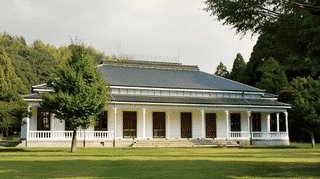
A Meiji-period assembly hall in Chiba Prefecture. Its own reading there differs between the national record and the city's very own one even now today.

Oya Ryokan is a nationally Registered Tangible Cultural Property inn located beside the Isumi Shrine approach in Otaki, Chiba Prefecture. Founded in the late Edo period with its current building dating to around 1885, this historic inn is famed for its connections to poet Masaoka Shiki and manga artist Tsuge Yoshiharu, offering guests an authentic stay in Meiji-era heritage architecture.
Discover Kōunkaku, a nationally registered tangible cultural property within the precincts of Katori Shrine in Chiba. This grand Meiji-period Japanese-style hall, completed around 1900, features elegant karahafu-style entrance and harmonizes beautifully with one of Japan's most revered shrines.
An 1876 thatched house in Narita's Sanrizuka Memorial Park that passed from an American adviser's home to farm office, then to an imperial guesthouse in 1919.
Choshi's Nishihiro main house joins an 1877 merchant hall to a 1937 cypress wing, with the Inubosaki coast carved into its alcove window. Registered in 2018.
Kujukuri Church in Sammu City, Chiba Prefecture, is a Registered Tangible Cultural Property built in 1887. Missionary James Curtis Hepburn — creator of the Hepburn romanization system — contributed funds and design input for this early Japanese Protestant chapel, whose blend of Japanese and Western architecture reflects the dawn of Christianity in rural Meiji Japan.
The Sakamoto Sohonten Store in Yokaichiba, Sosa City, Chiba Prefecture, is a two-story kura-zukuri (warehouse-style) merchant building constructed in 1905, featuring distinctive black lacquer-plastered walls and registered as a national Tangible Cultural Property. Founded in 1805, this historic confectionery continues to sell its signature peanut crackers, originally created for the Crown Prince in 1911, offering visitors a living encounter with Meiji-era architecture and centuries-old culinary traditions.
Sasaya Dozo is a nationally registered tangible cultural property in Nagareyama City, Chiba Prefecture — a Meiji-era earthen storehouse relocated in 1898 and originally linked to a tailor shop serving the famous Echigoya (predecessor of Mitsukoshi Department Store) in Nihonbashi, Edo. Featuring striking white and black plaster walls and robust double-beam construction, this two-story dozo now operates as a charming café and bar, offering visitors a taste of the historic streetscape that once thrived on Edo River commerce.
Near Tōjō Beach in Kamogawa, the Suzuki family's hiire-gura stored sake through its final pasteurization, a heat technique Japan used long before Pasteur.
An early Meiji merchant storehouse in Omigawa, raised against floods behind 60cm plaster walls. Registered 1999, it opens free as a shellfish-purple dye museum.
The Inari shrine at the Someya residence is early Meiji. On high ground, a small nagare-zukuri shrine sits within a gabled shelter for the household deity.
The fertilizer shed at the Someya residence is a plain early-Meiji building. Its earthen floor is split in two for making and storing fertilizer for the fields.
The front storehouse at the Someya residence dates to 1893 and began as a rice granary. Its plastered walls and namako base recall a farming family that also traded.
Built in 1889 along the historic Edogawa waterway in Nagareyama, the Former Terada-en Shop is a Nationally Registered Tangible Cultural Property. This black-lacquered kura-style merchant storehouse, the only one of its kind remaining on Nagareyama Honcho main street, now serves as a kaleidoscope gallery and Japanese tea cafe.
Tomoe Bridge in Tateyama City, Chiba Prefecture, is a single-arch stone bridge built in 1906 by a local stonemason. Having survived the Great Kanto Earthquake tsunami and wartime tank crossings, it is registered as a National Registered Tangible Cultural Property as one of the few remaining Meiji-era stone arch bridges in the Kanto region.
Toyonotsuru Sake Brewery Factory in Otaki, Chiba, is an 1875 shed of 417 square metres: two gabled ranges under a lean-to, roof trusses left open. Registered 2011.
Toyonotsuru Sake Brewery Sake Storehouse in Otaki, Chiba, is an 1875 store of 213 square metres, its ground floor one room on close-set posts. Registered in 2011.
Toyonotsuru Sake Brewery Main House in Otaki, Chiba, is an 1874 tsushi-nikai machiya with deep degeta eaves and shutters, registered in 1999. Access notes.
Toyonotsuru Sake Brewery Rice Polishing House and Storehouse in Otaki, Chiba, is an early Meiji building of 114 square metres holding two rooms. Registered in 2011.
Built in 1891 to hold grain, this two-story earthen kura survives from a Tsudanuma merchant's estate in Narashino, with battened siding and bold interior beams.