
Important Cultural Property of Fukuoka
福 岡 県 の 重 要 文 化 財Fukuoka’s Important Cultural Properties — designated for their value to the nation’s cultural history.
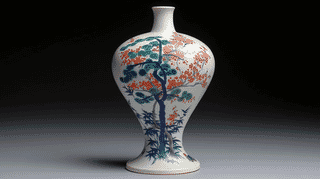
An Edo-period porcelain sake bottle held at Dazaifu in Fukuoka Prefecture, Japan. Its own matching fellow there, of the very same form, is still unlisted.
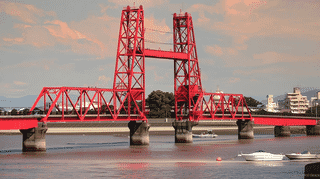
A Showa-period lift bridge between Fukuoka and Saga Prefectures. It was registered first there and it was only ever designated later on than that one.
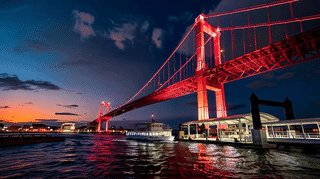
A Showa-period steel suspension bridge in Kitakyushu, Fukuoka Prefecture. Reading glosses sit right within its own commentary there in round brackets.
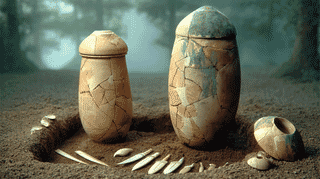
Yayoi-period archaeological finds from Chikushino, Fukuoka Prefecture, Japan. One single excavation there was split between two quite separate listings.

Discover the Gojō Family Documents, an Important Cultural Property in Yame, Fukuoka. This collection of 369 documents across 17 scrolls preserves imperial letters from the Southern Court era, offering a rare window into Japan's dramatic Nanbokuchō period.
Held at the Kyushu National Museum, this Nara-period ledger records paper and other supplies issued to an office copying the Buddhist canon in 772-773.
From an 1888 Yamaguchi tomb, this set holds a bronze mirror with the Wei reign name Zhengshi (240 CE), long central to the debate over Queen Himiko's gift mirrors.
A 31-cm Nabeshima porcelain dish at Kyushu National Museum. Red and white peonies rise from a Taihu rock in a ribbed bowl, made at Saga's secret kiln c. 1680-1700.
Held at the Kyushu National Museum, this Important Cultural Property is a Yuan-dynasty Chinese tea bowl from the 13th–14th century. A rare kiln effect at the boundary of its black and brown glazes produces a silvery 'rainbow' band that gave the bowl its name. Its provenance traces back to the shogun Ashikaga Yoshimasa.
Discover the Arima Family Mausoleum at Bairinji Temple in Kurume, Fukuoka—five mausoleum buildings designated as Important Cultural Properties, built between 1630 and 1655 by the lords of Kurume Domain. Explore samurai heritage, Zen spirituality, and plum blossoms in one remarkable site.
Located in eastern Fukuoka City, the Main Hall of Kashii-gu is a nationally designated Important Cultural Property, rebuilt in 1801 by the 10th lord of the Fukuoka domain. It is the sole surviving example of the unique "Kashii-zukuri" architectural style, enshrining Emperor Chūai and Empress Jingū. As one of only 16 imperially commissioned shrines in Japan, it preserves 1,800 years of sacred history.
Sakurai Shrine in Itoshima keeps its 1632 main hall, worship hall, and gate before a sacred cave from 1610, listed as an Important Cultural Property in 2023.
A 3.35-meter granite pagoda on a Dazaifu hill, raised in the 13th century on the site of the lost Hannya-ji temple, its four faces carved with Sanskrit syllables.
A 47.6 m concrete tower built in 1943 in Shime, Fukuoka, to haul navy coal. Japan's only surviving tower-winding headframe and an Important Cultural Property.
Hakata's Sumiyoshi Shrine main hall, rebuilt in 1623, keeps the ancient Sumiyoshi-zukuri form: a straight roof, no bracket sets, and red-and-white walls.
An 1842 thatched farmhouse on the pilgrimage road to Mount Hiko in Soeda, Fukuoka. A dated inscription fixed its age; split bamboo clads its rain-struck east wall.
Built in 1541 by the Harada clan and designated an Important Cultural Property in 2023, Takasu Shrine's main hall in Itoshima is Fukuoka's oldest surviving shrine hall.
Built in 1591 over Sugawara no Michizane's grave, this Momoyama-era Important Cultural Property in Fukuoka is being restored through 2026. Worship continues at Sou Fujimoto's living-roof kariden.
Built in 1458, Shiga Shrine is Dazaifu Tenmangu's oldest building, a one-bay hall for the sea gods by the drum bridge, an Important Cultural Property since 1907.
Housed in the Kyushu National Museum in Dazaifu, Fukuoka, the Tahō Senbutsu Sekitō is a 5.5-meter-tall, 3.5-ton octagonal stone Buddhist banner-pillar carved in northern China in 1084 CE under the Khitan-ruled Liao dynasty. Densely covered with buddhas, bodhisattvas, celestial musicians, kalavinka birds and Sanskrit dharani inscriptions, it is a benchmark masterpiece of Liao-period Buddhist sculpture and Japan's only stone banner-pillar of Chinese origin designated as an Important Cultural Property.
More from Fukuoka
Fukuoka’s registered properties across designations, with featured heritage and travel notes.
The complete kokuhō catalogue — browse by prefecture, period, and category.
Nationwide jūyō bunkazai — architecture, sculpture, painting, crafts, and documents.