
Registered Tangible Cultural Properties of Fukushima
福 島 県 の 登 録 有 形 文 化 財Fukushima · Registered Tangible Cultural Properties
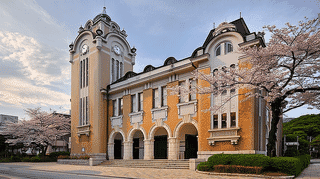
Discover Koriyama City Public Hall, a stunning Neo-Renaissance building designed by Japan's National Diet Building architect. Built in 1924, this Registered Tangible Cultural Property features elegant stained glass and Renaissance ceilings, symbolizing the pioneering spirit of Fukushima Prefecture.

A late Edo farmhouse in Okuma, Fukushima, registered in December 2019. Its six-room plan and formal alcove room mark a household of standing on the Hamadori coast.
An early Meiji earthen storehouse in Okuma, Fukushima, registered in 2019. Its tiled roof stands on posts clear of the mud walls, keeping rain off and air moving.
A tiny plank granary in Okuma, Fukushima, registered in December 2019. Grooved posts, board walls and a raised floor kept unhulled rice dry through the year.
A mid-Meiji gate in Okuma, Fukushima, registered in 2019. It is built over the stone bridge across the farmstead channel, so entering and crossing become one step.
Rebuilt after the May 1934 Tajima fire by an Echigo master carpenter, this two-storey inn in Minamiaizu, Fukushima keeps a curved karahafu porch. Registered 1999.
A Meiji-era clay-walled storehouse set deep in an inn's grounds in Minamiaizu, Fukushima, its okiyane roof still scarred by the 1934 Tajima fire. Registered 1999.
Tucked inside a historic high school campus in Iwaki, Fukushima, Sakuragaoka Kaikan is a 1938 wooden library building whose round windows and arched modernist details earned it Registered Tangible Cultural Property status — and gave the school its present name.
Standing in Tochikubo, Kashima Ward of Minamisoma City in Fukushima, the Otani Family Residence Middle Storehouse is a two-story earthen-walled storehouse from the early Showa period, registered as a national cultural property. Together with the East Storehouse and gate, it lines the historic Salt Road that linked the coastal Hamakaido with the inland Oshu-kaido, preserving refined details such as spiral-motif wall bands and namako-kabe checkered walls. Discover how sake, soy sauce, and the trading culture of old Soma shaped this landscape.
Standing along the historic Salt Road in Tochikubo, Minamisoma City, the Ogaike Family Residence East Storehouse is a late Meiji-period rice warehouse. This nationally registered tangible cultural property features namakokabe lattice walls, ornate plaster reliefs including a water-wheel crest, and together with its neighbouring Middle Storehouse and gate forms one of Fukushima's most intact merchant streetscapes.
The Ōtani Family Residence Gate in Tochikubo, Kashima-ku, Minamisoma, is a nationally registered tangible cultural property. Built in the early Shōwa era in the traditional Kōrai-mon style, this wooden gate stands between two plaster storehouses along the historic Salt Road, preserving the atmosphere of a once-thriving merchant trading hub.
The Former Yoshida Family Residence Main Building in Miharu, Fukushima, is an 1895 silk merchant's sukiya house of rare woods, registered in 2020, open free.
Shiunkaku at the Former Yoshida Family Residence in Miharu, Fukushima, is an 1895 storehouse sitting room with dragon carvings and red lacquer, reopened 2023.
Built in 1908 next to a cocoon dealer's storehouse at Koori, Fukushima, this low tiled house holds four rooms, a tokonoma alcove and a projecting bath wing.
A 1908 earthen-walled shop storehouse on the old Oshu Kaido in Koori, Fukushima. Built by a cocoon dealer, it keeps its suriage-do shutters and a cocoon loft above.
At the end of a Fukushima hot spring village stands a thatched inn of 1871, still trading, its hearth room open to blackened beams, the source said to rise below.
The priests' quarters at Tokushoji in Minamiaizu, Fukushima. Ink written on its timbers dates it to 1820: a farmhouse plan, a two-part roof, registered in 2001.
A ten square metre Konpira hall of 1776 at Tokushoji in Minamiaizu, Fukushima. A local carpenter built it, and its deep degeta eaves reward a close look.
The main hall of Tokushoji, a Soto Zen temple in Minamiaizu, Fukushima. A carpenter from Echigo raised it in 1844: six rooms, 327 sq m, registered in 2001.
A tiny household guardian shrine at the Sasa Masamune sake brewery in Kitakata, Fukushima. Built in 1886, it was one of two buildings spared by the June 2026 fire.
More from Fukushima
Fukushima’s registered properties across designations, with featured heritage and travel notes.
The complete kokuhō catalogue — browse by prefecture, period, and category.
Nationwide jūyō bunkazai — architecture, sculpture, painting, crafts, and documents.