
Historic Sites, Places of Scenic Beauty, and Natural Monuments of Hiroshima
広 島 県 の 史 跡 名 勝 天 然 記 念 物Hiroshima · Historic Sites, Places of Scenic Beauty, and Natural Monuments
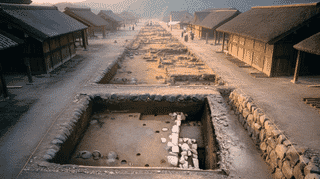
The seat of an ancient province in Fuchu, Hiroshima Prefecture, Japan. It shows the whole course over there from its own rise to its own decline even now.

The Takayama, Nitakayama and Mihara castle sites of the Kobayakawa clan in Mihara, Hiroshima, a Historic Site since 1957, tracing a move from mountain to coast.
Eight Yayoi-period tombs on a hilltop in northern Hiroshima preserve the transition to chiefly burial in unusual completeness, including three four-cornered protruding mounds. Designated a National Historic Site in October 2021.
Sandankyo Gorge stretches some 16 kilometres through the mountains of northwest Hiroshima Prefecture. Designated a Place of Scenic Beauty in 1925 and elevated to Special Place of Scenic Beauty in 1953, it is the only gorge with this highest rank west of Kansai. Five iconic vistas — Kurobuchi, Sarutobi, Nidan Falls, Sandan Falls, and Mitsu Falls — combine with primaeval forest, traditional ferry boats, and spectacular autumn foliage to enchant visitors year-round.
Located in Fuchū Town, Hiroshima Prefecture, the Shimo-okada Kanga Site is a Nara-period government facility designated as a National Historic Site in 2021. Almost certainly the 'Aki Umaya' post-station on the ancient Sanyō Highway, the site preserves two L-shaped tile-roofed stone-foundation buildings and yielded wooden tablets (mokkan), illuminating how Japan's early centralized state managed long-distance administration.
A 1620 daimyo garden in central Hiroshima by tea master Ueda Soko. Its arched stone bridge survived the 1945 atomic blast. Designated a National Place of Scenic Beauty.
A Place of Scenic Beauty at Jōdo-ji, Onomichi. Designed 1806 by Hasegawa Senryū, descendant of Sesshū. White sand, stones, and the Rotekian tea house above.
Five Yayoi-period mounds in Miyoshi, Hiroshima preserve the earliest known examples of Japan's distinctive four-cornered tomb form. Designated a National Historic Site in 2000.
Off Abashima island near Takehara in Hiroshima, a 1,500-meter-radius circle of Seto Inland Sea was made a National Natural Monument in 1930 to protect a breeding aggregation of finless porpoises.
An 18-km karst gorge in northeastern Hiroshima, designated a Place of Scenic Beauty in 1923. Features the 90-meter Onbashi natural bridge and dragon-shaped Lake Shinryū.
In Mihara, Hiroshima, a pine-shaded slope preserves Ehime ayame, a small purple iris and ice-age relict—Natural Monument since 1935, open two weeks each April.
On a ridge above the Miyoshi Basin, the Hanazono Site is a Yayoi-period cemetery of three stone-faced burial precincts holding pit graves and stone coffins.
Set on a low wooded hill in Fukuyama City, Hiroshima Prefecture, Futagozuka Kofun is a 68-meter keyhole-shaped tumulus from the late 6th to early 7th century. Its 14.9-meter horizontal stone chamber—the longest in Hiroshima Prefecture—housed a sarcophagus of Tatsuyama-ishi tuff from distant Harima, along with a unique gilt-bronze twin-dragon sword pommel. Designated a National Historic Site in 2009, it stands as one of the last great keyhole tombs in western Japan and a key witness to the political relationship between the Yamato court and the Kibi region.
The Funasa and Yamauchi Reverse Fault Zone is a National Natural Monument extending some sixteen kilometers across Akitakata, Miyoshi, and Shobara Cities in Hiroshima Prefecture. Its outcrops show ancient granite and porphyrite thrust over far younger Neogene and Quaternary strata, offering a rare and clear record of the crustal movements that shaped the Chugoku Mountains and the Seto Inland Sea.
Set on ground devastated by the world's first atomic bombing, Hiroshima Peace Memorial Park is a city park created to honor the victims and to pray for lasting peace, and the first postwar park designated a National Place of Scenic Beauty. Architect Kenzo Tange's masterful axis aligns the Atomic Bomb Dome, the Cenotaph, and the Peace Memorial Museum, weaving history and modern landscape design into a deeply moving symbol of global peace.
Mitsujo Kofun in Higashihiroshima City is a National Historic Site comprising three burial mounds, including the largest keyhole-shaped tomb in Hiroshima Prefecture, built in the early 5th century. Faithfully restored to its original appearance with cladding stones and about 1,800 reconstructed haniwa, the site offers a rare and immersive view of the Kofun period, including glass-covered burial chambers. Believed to be the tomb of a powerful chieftain who ruled the ancient province of Aki, it pairs well with a stroll through the famous Saijo sake district.
Located in Yoshida-chō, Akitakata City, Hiroshima Prefecture, this National Historic Site comprises two castle ruins: Tajihi Sarugake Castle, where Mōri Motonari (1497–1571) spent his youth, and Kōriyama Castle, the great mountain stronghold he expanded into the headquarters of his clan. With more than 270 terraces spread across an entire mountain, Kōriyama is among the largest mountain castles in western Japan and was the stage of the famous 1540 Battle of Yoshida-Kōriyama, in which Motonari repulsed an Amago force said to number 30,000. From earthworks and ridge-cuts to Motonari's tomb, Kiyomi Shrine, and the Akitakata City Museum of History and Folklore at the foot of the mountain, the site offers an unforgettable journey into the Sengoku period.
A late-Yayoi mounded burial in Hiroshima, Yatani Tumulus has flared corners in the Izumo style, offering pottery from Kibi, and nearby plots with Roman glass beads.
Discover Yorikura Rock Shelter, a designated National Historic Site in Hiroshima's Taishakukyo Gorge. This Jomon-era cave dwelling preserves 13 layers of pottery, tools, and 50 burials that became the chronological standard for prehistoric western Japan.
Renjuku, in Fukuyama, Hiroshima, is a late-Edo academy founded by scholar Kan Chazan. Its lecture hall, the founder's house, and the original canal survive intact.
More from Hiroshima
Hiroshima’s registered properties across designations, with featured heritage and travel notes.
The complete kokuhō catalogue — browse by prefecture, period, and category.
Nationwide jūyō bunkazai — architecture, sculpture, painting, crafts, and documents.