
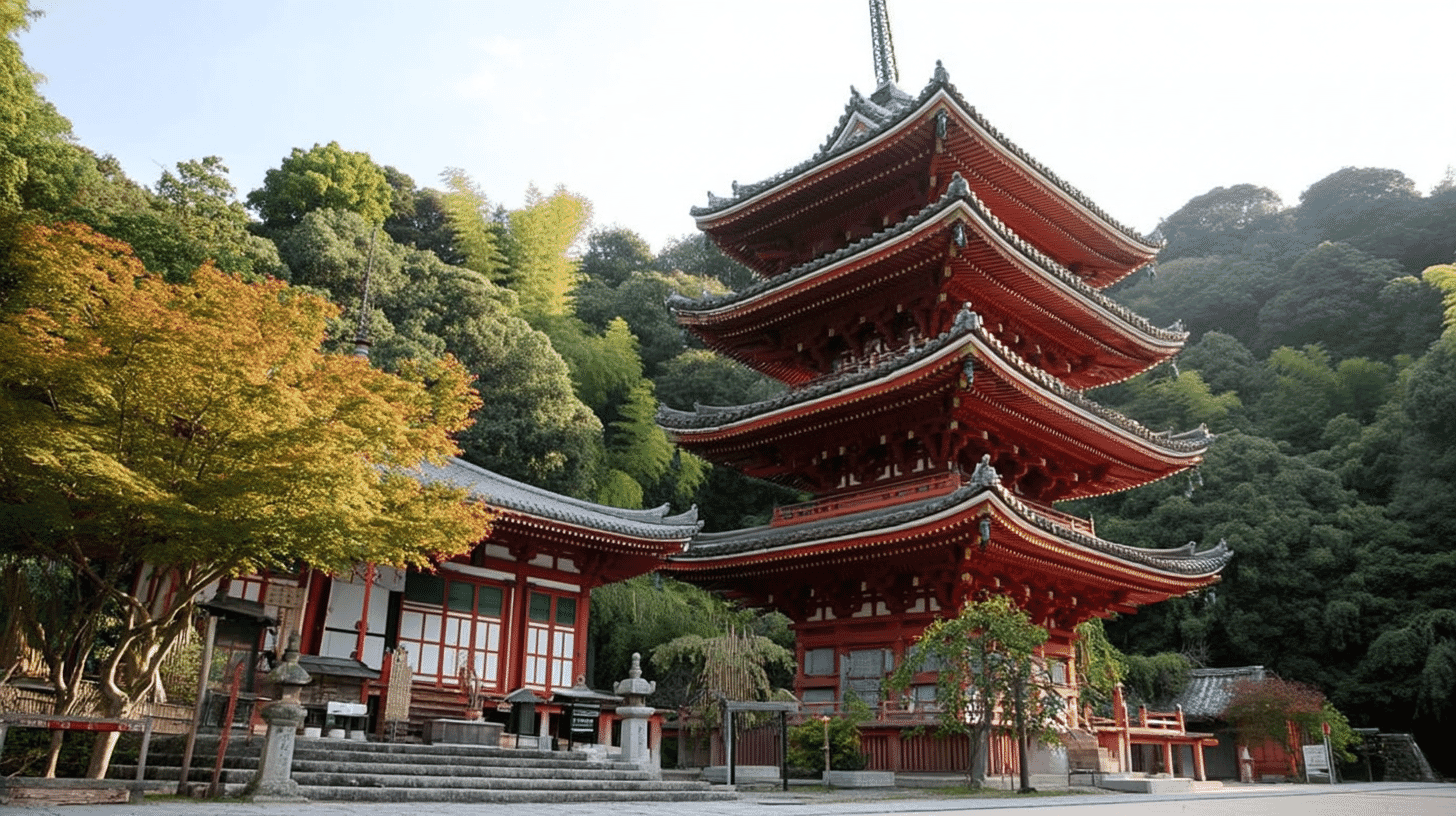
One Pagoda, National Treasure since 1953
Myoo-in Five-Storied Pagoda (明王院五重塔, Myooin Gojunoto) is an early Muromachi structure at Kusado-cho, Fukuyama City, Hiroshima Prefecture, made an Important Cultural Property on 14 April 1913 and designated a National Treasure on 31 March 1953. The quantity is one pagoda and the owner the temple.
It is counted with the measure word for towers, the second such case here after the Jodoji pagoda. It is a five-storeyed pagoda of three bays, roofed in plain tile, and the date field gives 1348.
The temple's main hall became an Important Cultural Property on 7 April 1900 and a National Treasure on 26 May 1964: eleven years after the pagoda. At Jodoji, hall and pagoda were designated on one day, the reverse of this.
An Image Renamed by Investigation
The record notes a change in the name of an image housed in the pagoda.
An altar is set within the four central pillars of the first storey, holding an image formerly called Dainichi Nyorai, renamed Miroku Bosatsu after an investigation in 1993, along with two guardian figures.
The old name and the new name both stand in one record, the change written into a bracket.
At the Toshodaiji sutra repository, the origin of the building was recorded as established by recent investigation: something unknown became known.
Here something taken as known was altered. Investigation replaced one name with another.
The record keeps both rather than simply substituting, so the earlier identification remains visible.
The Building Stayed; the Temple's Registry Moved to It
The name of this temple changed partway through.
It was formerly called Jofukuji, belonged to the Ritsu school and was a branch of Saidaiji.
Then, in the Genna era, 1615 to 1624, Mizuno Katsunari entered Fukuyama and moved another temple's registry here, whereupon the place became Myoo-in.
A registry was transferred, and with it the name. The buildings stayed where they were.
At the Fudoin main hall, a Zen Buddha hall from Yamaguchi was carried to Hiroshima and became a Shingon golden hall: the building moved and the school changed.
Here the reverse. The pagoda went up in 1348 and the name changed in the Genna era, some two hundred and seventy years later.
The Day the Finial Went Up Is Known
The ground for the date runs to the day.
An inscription cut into the bowl-shaped member of the finial shows that the nine rings were raised on the eighteenth day of the twelfth month of 1348.
The nine rings form part of the finial at the summit. The day they were raised is fixed as the eighteenth.
The inscription is on the bowl below them, another part of the finial: characters cut into its surface are the evidence.
At the Himeji Castle turrets, an ink inscription gave the date of the great keep; at the Fudoin main hall, an inscription on a ceiling painting. At the Jodoji pagoda, sutras lay inside the finial.
Here the evidence is cut into the outside of the finial, and it records not the year of building but the day of one particular operation.
Visiting
The pagoda stands at Kusado-cho, Fukuyama City, Hiroshima Prefecture, owned by the temple. It stands in the precinct and its exterior can be seen on a visit.
The structure has a peculiarity: the central pillar stops at the second storey. The pillar running up the middle of the pagoda does not reach the top.
The painting inside is described closely. The walls carry narrative scenes of the eight patriarchs of the Shingon school, the four central pillars thirty-six figures of the Diamond World, and the side pillars and tie-beams are painted throughout. With the central figure, the pillars hold thirty-seven.
How much survives is recorded: apart from the doors and the screen behind the altar, which are later replacements, the decoration of the time of building is well preserved.
The commentary ends by naming its source, a dictionary of National Treasures published in 2019, the third such case here after the Himeji Castle turrets and the Jodoji pagoda. Access to the interior follows the temple's own arrangements. Check before travelling.
Q&A
- When was the pagoda designated?
- It became an Important Cultural Property on 14 April 1913 and a National Treasure on 31 March 1953. The quantity is one pagoda, at Kusado-cho, Fukuyama City, owned by the temple.
- What is housed inside?
- The Agency records an image formerly called Dainichi Nyorai, renamed Miroku Bosatsu after an investigation in 1993, together with two guardian figures. Both names stand in the record.
- Did the temple's name change?
- Yes. The Agency records that it was formerly called Jofukuji and belonged to the Ritsu school, and that in the Genna era Mizuno Katsunari moved another temple's registry here. The buildings stayed in place.
- When was it built?
- The Agency records that an inscription on the finial shows the nine rings were raised on the eighteenth day of the twelfth month of 1348, so the day of that operation is known.
- Does the painting inside survive?
- The Agency records that apart from the doors and the screen behind the altar, which are later replacements, the decoration of the time of building is well preserved. The walls carry scenes of the eight patriarchs of the Shingon school.
Basic Information
| Name | Myoo-in Five-Storied Pagoda (明王院五重塔, Myooin Gojunoto); the temple's main hall in the same precinct is also a National Treasure |
|---|---|
| Location | Kusado-cho, Fukuyama City, Hiroshima Prefecture |
| Designation | National Treasure (structure, religious architecture) |
| Year Designated | 1913 (14 April), Important Cultural Property; 1953 (31 March), National Treasure |
| Quantity | 1 pagoda |
| Dimensions | A 5-storeyed pagoda of 3 bays, roofed in plain tile. The date field gives 1348, and an inscription on the finial shows the nine rings were raised on 18 December of that year. The central pillar stops at the 2nd storey. The period is the early Muromachi |
| Owner | Myoo-in |
| Public Access | Standing in the precinct; the exterior can be seen on a visit, while the interior follows the temple's own arrangements |
References
- Cultural Heritage Online: the Myoo-in five-storeyed pagoda
- https://bunka.nii.ac.jp/heritages/detail/195800
- Cultural Heritage Online: the Myoo-in main hall
- https://bunka.nii.ac.jp/heritages/detail/202069
- Fukuyama City: Myoo-in
- https://www.city.fukuyama.hiroshima.jp/soshiki/bunka/64287.html
- Agency for Cultural Affairs, National Cultural Properties Database
- https://kunishitei.bunka.go.jp/
Last verified: 2026.09.05