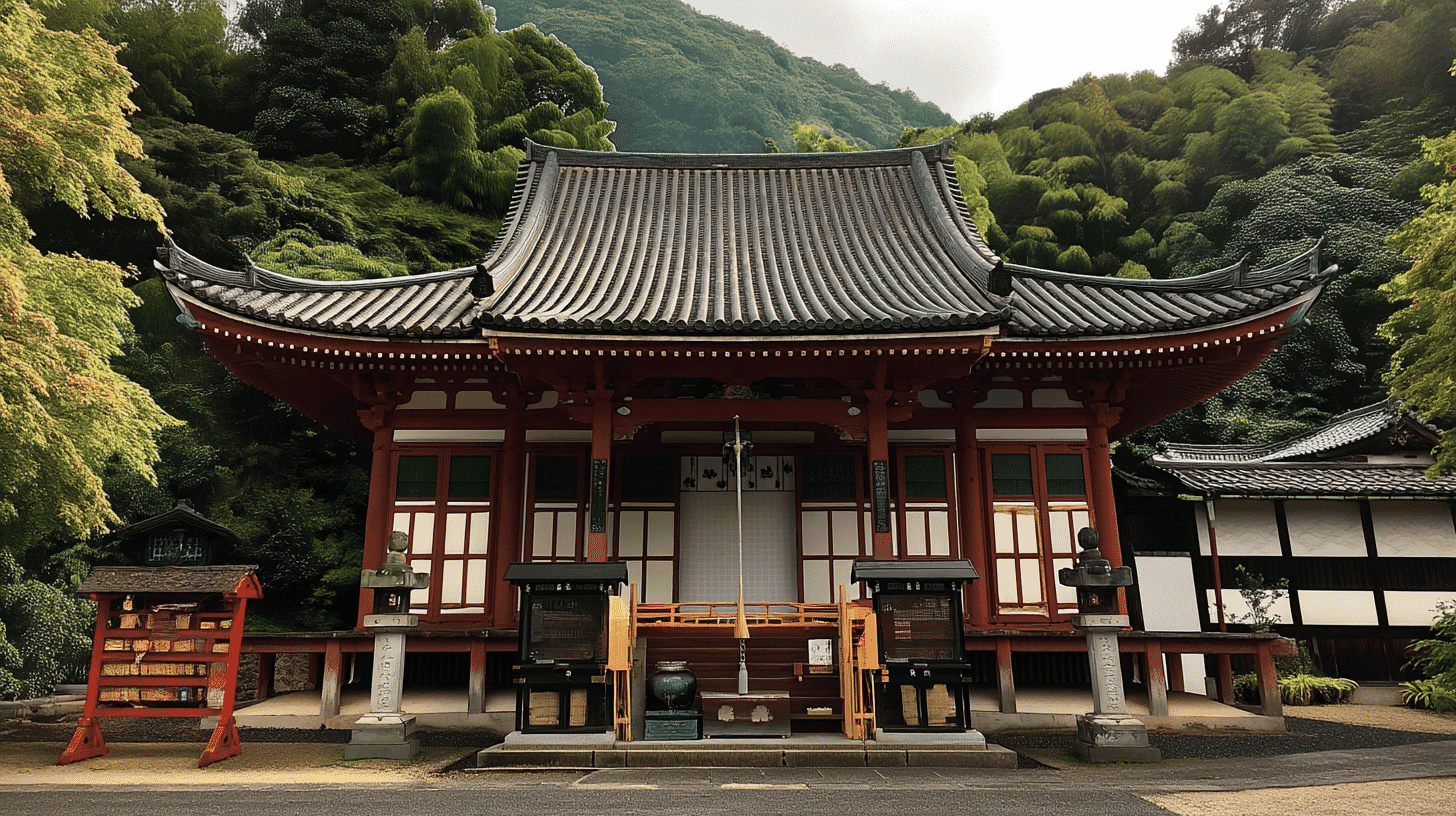
Myōōin Hondō: Japan's Oldest Eclectic-Style Buddhist Hall
Nestled at the foot of Mount Atago along the banks of the Ashida River in Fukuyama, Hiroshima Prefecture, the main hall (Hondō) of Myōōin Temple stands as one of Japan's most significant architectural achievements. Built in 1321 during the late Kamakura period, this National Treasure is the oldest surviving example of Setchūyō — an eclectic architectural style that harmoniously blends Japan's traditional building methods with newly arrived techniques from continental Asia. For visitors seeking encounters with authentic medieval Japanese architecture far from the tourist crowds, Myōōin Hondō offers a rare and deeply rewarding experience.
A Temple Founded by Kūkai — Over 1,200 Years of Sacred History
Myōōin Temple traces its origins to the year 807 (Daidō 2), when the legendary monk Kūkai — known posthumously as Kōbō Daishi, the founder of Shingon Buddhism — is said to have enshrined an image of Kannon (Avalokiteśvara) on the slopes of Mount Atago. The temple was originally called Jōfukuji and belonged to the Ritsu sect of Buddhism. During the Edo period, the third lord of the Fukuyama domain, Mizuno Katsusada, merged the temple with another institution called Myōōin, giving the temple the name it carries today. As a Shingon-shū Daikakuji-ha temple, Myōōin became the official prayer temple for successive Fukuyama domain lords, securing its place at the heart of local spiritual and cultural life.
Why Was Myōōin Hondō Designated a National Treasure?
The main hall was designated a National Treasure on May 26, 1964, and the reasons for this distinction are compelling. During a meticulous dismantling restoration carried out between 1962 and 1964, researchers discovered an ink inscription on an interior structural element called a kaerumata (frog-leg strut) within the inner sanctum. This inscription confirmed that the hall was constructed in 1321 (Genō 3), during the Kamakura period — making it one of the oldest medieval temple halls along the Seto Inland Sea coast, comparable to the National Treasure main hall of Jōdoji Temple in Onomichi.
What makes this building truly extraordinary is its architectural style. The Hondō represents the earliest known surviving example of Setchūyō (eclectic style) architecture in Japan. While the overall appearance follows the traditional Japanese Wayō style, its structural details incorporate significant elements from Daibutsuyō (the Indian or Great Buddha style) and Zenshūyō (the Zen or Chinese style) — two continental building traditions that had only recently arrived in Japan during the Kamakura period. This blending of three distinct architectural vocabularies into a single, coherent structure makes the Hondō an indispensable reference point for understanding the evolution of Japanese Buddhist architecture.
Architectural Highlights and Unique Features
The Hondō is a single-story building with an elegant irimoya-zukuri (hipped-gable roof) and a projecting worship porch (kōhai) at the front, covered in traditional hongawara tiles. The hall measures five bays by five bays (approximately 11.8 meters square), creating a dignified yet intimate space for worship.
The Setchūyō Synthesis
The eclectic fusion visible in this hall is both subtle and remarkable. The latticed doors (san-karado) on the exterior and the rounded cross-section rainbow beams (kōryō) spanning the interior pillars are characteristic elements of the Daibutsuyō tradition. Meanwhile, the chimaki (tapering of column tops), daiwā (horizontal board atop pillars), and scroll-patterned kibana (decorative carvings at the ends of horizontal members) reflect Zenshūyō influence. The way rainbow beams are elevated above column tops through an intricate assembly of bearing blocks (masu) and decorative bracket arms (esama hijiki) is a structural solution found nowhere else in Japanese architecture.
The Unique Wadatuki Ceiling
Perhaps the most visually striking interior feature is the arched ceiling of the outer sanctum (gejin), constructed with wadatuki — circular rafters arranged in a radiating fan pattern. While this technique became relatively common in Ōbaku Zen temple architecture during the Edo period, its use here in 1321 is the earliest known application in any Japanese temple. This unprecedented ceiling design creates a dramatic sense of upward movement and spatial grandeur within the worship space.
The Sacred Inner Sanctum
The interior is divided in the manner typical of esoteric Buddhist halls, with the front two bays forming the gejin (outer sanctum for worshippers) and the rear area forming the naijin (inner sanctum for the Buddha). These spaces are separated by lattice screens, creating a sense of mystery and sacred division. Within the inner sanctum, a beautiful Kasuga-style zushi (miniature shrine cabinet) with lotus paintings on the inner doors houses the principal deity: a wooden standing statue of the Eleven-Faced Kannon (Jūichimen Kannon), designated as an Important Cultural Property. This sacred image is a hibutsu (hidden Buddha) revealed to the public only once every 33 years — the most recent unveiling took place in autumn 2024.
Beyond the Main Hall — More Treasures Across the Temple Grounds
While the Hondō alone justifies a visit, Myōōin's compact grounds hold an extraordinary concentration of cultural properties. Standing beside the main hall is the Five-Story Pagoda — also a National Treasure — built in 1348 during the Northern and Southern Courts period. Rising 29.14 meters, it is the fifth oldest National Treasure pagoda in Japan and the only one from this turbulent historical period. Uniquely, it was funded not by aristocrats or the imperial court but by countless small donations from ordinary local residents, a testament to the deep faith of the medieval community.
Other buildings on the grounds include the Shoin (study), Kuri (kitchen quarters), and Goma-dō (fire ritual hall), all designated Important Cultural Properties by Hiroshima Prefecture. Along the path to the Atago Shrine behind the temple, visitors can see a collection of medieval stone grave markers excavated from the nearby Kusado Sengen-chō archaeological site, offering a tangible link to the people who once thrived in this area.
Kusado Sengen and the Medieval Port Town That Vanished
The story of Myōōin is inseparable from Kusado Sengen-chō, a medieval settlement that once flourished on a sandbar in the Ashida River directly in front of the temple. Functioning as both a port town and a temple market town from the Kamakura to the Muromachi period, Kusado Sengen was a vibrant commercial center with connections across the Seto Inland Sea and even to continental Asia. Repeated flooding eventually buried the town beneath layers of river sediment, earning it the nickname "Japan's Pompeii." The acclaimed author Itsuki Hiroyuki described the area as having once pulsed with an energy comparable to medieval Florence. The excavated artifacts are now preserved and displayed — including a life-size reconstruction of the medieval streetscape — at the Hiroshima Prefectural Museum of History (Fukuyama Kusado Sengen Museum), located near JR Fukuyama Station.
Nearby Attractions and Exploring the Area
Myōōin sits within a rich cultural landscape that can easily fill a half-day or more of exploration.
- Kusado Inari Shrine: Immediately adjacent to Myōōin, this striking vermilion-painted shrine was founded the same year as the temple (807). Climb the stairs to its elevated main hall for panoramic views across Fukuyama city and the Ashida River. The shrine draws approximately 400,000 visitors for hatsumode (New Year's visit) and is famous for its rare "dai-dai-kichi" (super-great-fortune) fortune slip.
- Hiroshima Prefectural Museum of History (Fukuyama Kusado Sengen Museum): Located near JR Fukuyama Station, this museum brings the vanished medieval port town to life with full-scale reconstructions and extensive displays of excavated artifacts.
- Fukuyama Castle: About 1.8 km from the temple, this Edo-period castle sits directly beside JR Fukuyama Station — one of the few castles in Japan viewable from a bullet train platform.
- Tomo-no-Ura: A historic port town about 30 minutes south by bus, renowned for its preserved Edo-period streetscapes and stunning Seto Inland Sea scenery. This picturesque harbor is said to have inspired Studio Ghibli's film Ponyo.
- San'yō Flower Temple Pilgrimage: Myōōin is the 18th temple on the San'yō Hana no Tera circuit — a 24-temple pilgrimage route across Hiroshima, Yamaguchi, and Okayama Prefectures. The temple's seasonal flowers include azaleas, camellias, and hydrangeas, with the sala tree (Stewartia) as the pilgrimage's symbolic flower.
Practical Tips for Visitors
The temple grounds are open and free to enter at any time, allowing visitors to admire the exteriors of the Hondō and the Five-Story Pagoda year-round. Interior viewings of the Shoin, Kuri, and Goma-dō are available on the third Saturday of each month (10:00–16:00) for an admission fee of ¥500 (¥300 for middle and high school students). The Hondō outer sanctum is occasionally opened for special public viewings on an irregular schedule — contact the temple by fax in advance for information. Photography may be restricted in certain interior areas, so please follow posted guidelines.
Spring and autumn are particularly beautiful seasons to visit, when cherry blossoms or vivid autumn foliage frame the vermilion buildings against the green mountainside. The compact grounds make it easy to combine a visit with the adjacent Kusado Inari Shrine and a stroll along the Ashida River banks.
- 📍 Plan Your Visit to Hiroshima
- Find tours, activities & transport passes near Myooin Main Hall
- [ Itsukushima Shrine & Hiroshima Peace Memorial ]
Q&A
- How do I get to Myōōin Temple from JR Fukuyama Station?
- From JR Fukuyama Station, take a Tomotetsu Bus bound for Tomo-no-Ura (Myōōin route) and alight at the Myōōin-mae bus stop — the ride takes about 10 minutes, followed by a short walk. Alternatively, buses toward Onomichi or Numakuma from platform 6 stop at Kamishima-bashi Nishizume, which is about a 10-minute walk from the temple. By taxi, the journey takes approximately 10 minutes. By car, the temple is about 30 minutes from either Fukuyama-higashi IC or Fukuyama-nishi IC on the San'yō Expressway. Free parking is available (shared with Kusado Inari Shrine).
- Can I go inside the main hall (Hondō)?
- The interior of the Hondō is generally not open to the public. However, the outer sanctum (gejin) is occasionally opened for special public viewings, typically on the third Saturday of the month. To confirm schedules and make arrangements, please contact Myōōin Temple directly by fax. The inner sanctum's principal image, the Eleven-Faced Kannon statue, is a hidden Buddha revealed only once every 33 years — the most recent unveiling was in autumn 2024.
- Is there an admission fee?
- Entering the temple grounds and viewing the exteriors of the Hondō and Five-Story Pagoda is completely free. If you wish to view the interior of designated buildings (Shoin, Kuri, Goma-dō) during special opening days, the admission fee is ¥500 for adults and ¥300 for middle and high school students.
- What is Setchūyō architecture, and why is it significant?
- Setchūyō (eclectic style) refers to a blended architectural approach that emerged in the Kamakura period, combining the traditional Japanese Wayō style with elements from two newly introduced continental styles: Daibutsuyō (Great Buddha style, influenced by Song Dynasty Chinese and Indian architecture) and Zenshūyō (Zen style, derived from Chinese Zen temple design). The Myōōin Hondō is the oldest verified surviving example of this fusion, making it a landmark in the history of Japanese architecture.
- What is the best season to visit?
- Myōōin is beautiful year-round, but spring (cherry blossoms in late March to April) and autumn (vivid foliage in November) are especially scenic, with colorful trees framing the vermilion buildings. As a stop on the San'yō Flower Temple pilgrimage, the temple grounds feature seasonal blooms including azaleas, camellias, hydrangeas, and the sala tree throughout the year.
Basic Information
| Name | Myōōin Hondō (明王院本堂) — Main Hall of Myōōin Temple |
|---|---|
| Formal Temple Name | Chūdōzan Enkōji Myōōin (中道山円光寺明王院) |
| Buddhist Sect | Shingon-shū Daikakuji-ha (真言宗大覚寺派) |
| Temple Founding | 807 (Daidō 2), attributed to Kūkai (Kōbō Daishi) |
| Hondō Construction | 1321 (Genō 3), Kamakura period |
| National Treasure Designation | May 26, 1964 (Shōwa 39) |
| Structure | Irimoya-zukuri (hipped-gable roof), single story with kōhai (porch), hongawara tile roofing; 5 bays × 5 bays (approx. 11.8 m square) |
| Architectural Style | Setchūyō (eclectic) — the oldest verified surviving example in Japan |
| Principal Image | Wooden standing Jūichimen Kannon (Eleven-Faced Kannon), Important Cultural Property |
| Appended Designations | 1 Kasuga-style zushi (shrine cabinet), 3 ridge-pole inscriptions (munafuda) |
| Location | 1473 Kusado-chō, Fukuyama, Hiroshima 720-0831, Japan |
| Grounds Admission | Free (interior building viewings: ¥500 adults / ¥300 students, 3rd Saturday of month) |
| Access | Approx. 10 min by bus or taxi from JR Fukuyama Station; 30 min from San'yō Expressway Fukuyama-higashi or Fukuyama-nishi IC |
| Parking | Free (shared with Kusado Inari Shrine) |
References
- 明王院本堂(みょうおういんほんどう) — 福山市ホームページ
- https://www.city.fukuyama.hiroshima.jp/soshiki/bunka/64279.html
- 明王院 — Myōōin Temple Official Website
- http://www.chisan.net/myooin/
- 明王院 (福山市) — Wikipedia
- https://ja.wikipedia.org/wiki/明王院_(福山市)
- 【国宝】明王院 — 福山観光コンベンション協会
- https://www.fukuyama-kanko.com/travel/tourist/detail.php?id=19
- 国宝 本堂 — 明王院を愛する会
- https://myouo-in.jimdofree.com/明王院の文化財/本堂-国宝/
- 国宝-建築|明王院 本堂[広島] — WANDER 国宝
- https://wanderkokuho.com/102-03142/
- 明王院(みょうおういん) — 福山市ホームページ 観光・魅力情報
- https://www.city.fukuyama.hiroshima.jp/site/miryoku2023/288940.html
- 明王院 — 備後とことこ
- https://bintoco.com/myooin/
- Myooin Temple — Fukuyama Cultural Properties Information Site
- https://fukuyama.hiddenheritage.jp/en/3
- 明王院の観光ガイド — NAVITIME Travel
- https://travel.navitime.com/ja/area/jp/spot/02301-12100224
Last verified: 2026.02.17