Kinosaki Onsen Ropeway Onsenji Station: A Registered Cultural Property Connecting History and Skyline
Introduction: Where Modern Engineering Meets Ancient Spirituality
Perched on the mountainside at an elevation of 98 meters above Kinosaki Onsen, the Onsenji Station of the Kinosaki Onsen Ropeway stands as a remarkable testament to Japan's mid-century modernist architecture. Designated as a Registered Tangible Cultural Property in 2017, this intermediate station serves as a gateway to one of Japan's most historically significant temples while showcasing engineering techniques perfected during the legendary Kurobe Dam construction.
For international visitors seeking an authentic Japanese experience that combines natural beauty, architectural heritage, and spiritual history, the Onsenji Station offers a unique journey that begins the moment you step aboard the gondola. This is not merely a transit point—it is a cultural landmark where the story of post-war Japanese innovation intersects with 1,300 years of hot spring tradition.
The Story Behind the Station: Born from Kurobe Dam Technology
The Kinosaki Onsen Ropeway, including the Onsenji Station, was conceived by Shiro Otagaki, the first president of Kansai Electric Power Company. Born in Kinosaki in 1894, Otagaki rose to become one of Japan's most influential business leaders, famously directing the construction of the Kurobe Dam—often called "the Pyramid of the 20th Century."
In 1962, Otagaki channeled his expertise and hometown pride into creating a ropeway system that would elevate Kinosaki's tourism appeal. The concrete construction techniques developed for the demanding alpine conditions of Kurobe were adapted for these station buildings. When engineers conducted seismic assessments over five decades later, they found the structures still meeting earthquake safety standards with minimal deterioration—a living proof of the exceptional quality inherited from Japan's greatest dam project.
The ropeway opened on May 26, 1963, and the Onsenji Station holds a unique distinction: it is the only intermediate station on a traverse-type ropeway in Japan. This engineering choice was made specifically to serve pilgrims visiting Onsenji Temple, allowing them to bypass the arduous 500-step stone staircase while still honoring the temple's sacred significance.
Architectural Features: Modernist Design with Purpose
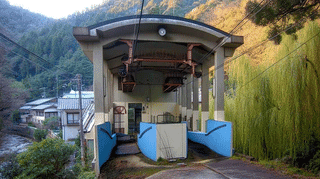
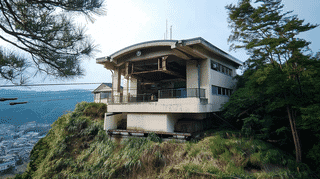
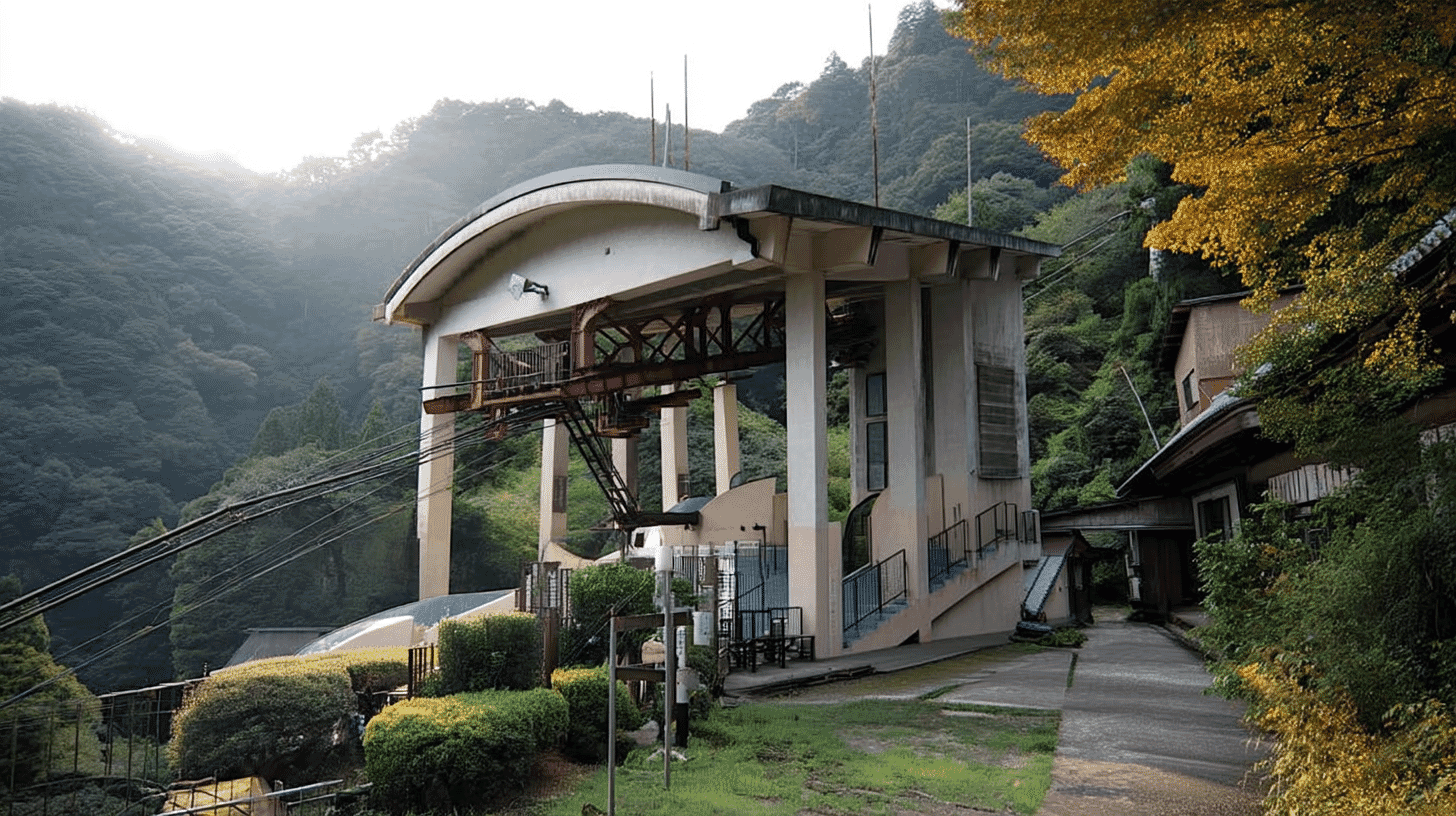
The Onsenji Station exemplifies the clean, functional aesthetics of early 1960s Japanese architecture. Built with reinforced concrete, the two-story structure covers a building area of 141 square meters. Its most distinctive feature is the vault-shaped roof, which creates graceful curves that echo the surrounding mountain contours while providing practical shelter from the elements.
The station's design philosophy embraces simplicity and transparency. The boarding platforms are open-air, with columns extending according to the mountain's slope to support the curved roof overhead. This creates an seamless visual connection between the station interior and the forested landscape beyond. The first floor houses a spacious hall and station office, while the second floor accommodates platforms on both the central line and a separate entrance facing Onsenji Temple.
What makes this station architecturally significant is how it balances industrial purpose with contextual sensitivity. Rather than imposing a stark modern structure onto a sacred mountainside, the designers created a building that seems to emerge naturally from its setting—a philosophy that would later become central to contemporary Japanese architecture.
Why It Became a Registered Cultural Property
In October 2017, all three stations of the Kinosaki Onsen Ropeway—including Onsenji Station—were officially registered as Tangible Cultural Properties by the Japanese government. This recognition was granted based on several criteria that highlight the stations' cultural and historical significance.
First, the stations represent an important chapter in Japan's post-war transportation infrastructure development. The technology transfer from major civil engineering projects like Kurobe Dam to local tourism facilities demonstrates how industrial advancement benefited regional communities.
Second, the architectural design and construction quality have proven exceptional. Unlike many structures from this era that have required extensive renovation or replacement, these stations have maintained their original integrity for over six decades.
Third, the stations preserve a specific moment in Japanese architectural history—the early 1960s transition period when modernist principles were being adapted for Japanese contexts. The vault-shaped roofs and open platform designs represent a distinctive regional interpretation of international architectural movements.
Onsenji Temple: The Sacred Destination
Stepping off at Onsenji Station brings visitors immediately to one of the Tajima region's most important religious sites. Onsenji Temple was founded in 738 CE by the monk Dochi Shonin, the same priest credited with discovering Kinosaki's hot springs. Emperor Shomu granted the temple its official name, "Matsudai-zan Onsenji," designating it as the guardian temple of Kinosaki Onsen.
The temple's main hall, constructed around 1387 during the early Muromachi period, is designated as an Important Cultural Property of Japan. It represents Tajima's oldest wooden structure and showcases a rare architectural fusion of three styles: Wayo (Japanese), Zenshuyo (Zen), and Daibutsuyo (Great Buddha style).
Within the main hall resides the principal image of worship: an Eleven-Faced Kannon (Juichimen Kannon) standing over two meters tall. This magnificent cypress sculpture, also designated as an Important Cultural Property, was carved from the same tree as the famous Kannon statues at Hase-dera temples in Nara and Kamakura. According to legend, the Kinosaki statue was made from the very top of the sacred tree, which may explain the town's name—"Kinosaki" can be interpreted as "tip of the tree."
The Kannon is a secret Buddha (hibutsu), fully revealed only once every 33 years. The next complete unveiling is scheduled for 2051, though visitors can glimpse portions of the statue during the annual temple festival on April 23-24.
The Ancient Bathing Ritual
Onsenji Temple preserves an ancient bathing ritual (koshiki nyuto saho) that dates back to when Kinosaki was a serious therapeutic destination. Historically, visitors to Kinosaki were expected to first visit Onsenji, receive a wooden ladle (yushaku) as a blessing from Dochi Shonin's spirit, recite specific prayers, and only then proceed to the public baths.
This ritual connected spiritual purification with physical healing, treating the hot spring waters as sacred gifts requiring respectful reception. Today, visitors can still learn and experience this traditional practice, adding a contemplative dimension to their Kinosaki Onsen experience that most tourists never discover.
Highlights and Must-See Attractions
The Onsenji Station area offers several compelling reasons to disembark and explore. The Kinosaki Art Museum (Onsenji Treasure Hall), located adjacent to the temple's main hall, houses an impressive collection of Buddhist sculptures, ancient documents, and artifacts related to Kinosaki's history. Admission is 300 yen, or 400 yen for a combined ticket with the main hall.
The temple grounds feature a multi-story pagoda (tahoto), the only one of its kind in the Tajima region, rebuilt in 1768 and housing a Dainichi Nyorai statue. Seasonal visitors will find the mountainside particularly stunning during autumn foliage season, when the maple trees surrounding the temple create spectacular color contrasts against the historic wooden structures.
For those seeking a physical challenge, a hiking trail connects the Onsenji Station area to the summit station, passing through forests that are home to deer and various bird species. The trail takes approximately 20-30 minutes and offers a different perspective on the mountain landscape.
Surrounding Area: Kinosaki Onsen Town
Kinosaki Onsen itself is consistently ranked among Japan's finest hot spring towns. The Michelin Green Guide Japan awarded the town two stars and the ropeway summit view one star, bringing international recognition to this historic spa destination.
The town is famous for its seven public bathhouses (sotoyu), each with distinct architectural character and therapeutic properties. Visitors typically stay at traditional ryokan inns and spend their evenings strolling between bathhouses in yukata robes and wooden geta sandals—a scene that has remained essentially unchanged for centuries.
Notable nearby attractions include the Kinosaki Straw Craft Museum, the literary monument to author Naoya Shiga (whose novel "At Kinosaki" made the town famous), and the Maruyama River, where cormorant fishing demonstrations take place during summer months.
Practical Information for Visitors
The Kinosaki Onsen Ropeway operates year-round except for the second and fourth Thursday of each month (unless those days fall on national holidays). First departure is at 9:10 AM, with the last upward trip at 4:50 PM. The journey from the base station to Onsenji Station takes approximately 3 minutes, with the full trip to the summit requiring about 7 minutes total.
Round-trip tickets to Onsenji Station cost 570 yen for adults and 280 yen for children. For those continuing to the summit, round-trip fares are 910 yen for adults and 460 yen for children. The summit station features a terrace café with specialty coffee and panoramic views extending to the Sea of Japan.
From JR Kinosaki Onsen Station, the ropeway base station is approximately a 15-20 minute walk through the atmospheric hot spring town. Note that there are about 97 steps between the parking area and the station entrance, so visitors with mobility concerns should plan accordingly.
- 📍 Plan Your Visit to Hyogo
- Find tours, activities & transport passes near Kinosaki Onsen Ropeway Onsenji Station
- [ Himeji Castle & Kobe Night View Cruise ]
Q&A
- What makes Onsenji Station a Registered Cultural Property?
- The station was designated in 2017 for its exceptional architectural design featuring vault-shaped roofs, its historical significance as infrastructure built using Kurobe Dam construction technology, and its remarkably preserved original condition after more than 60 years. It represents an important example of early 1960s Japanese modernist architecture adapted for a mountain setting.
- Can I visit Onsenji Temple without riding the ropeway?
- Yes, the temple can be reached by climbing approximately 500 stone steps from the base of the mountain. However, the ropeway provides convenient access and allows you to experience the registered cultural property stations. Many visitors ride up and walk down, or vice versa.
- Is the Onsenji Station accessible for wheelchair users?
- The facility has limited accessibility. There are approximately 97 steps between the parking area and the base station entrance, and the historic station buildings were not designed with barrier-free access. Visitors with mobility concerns should contact the ropeway office in advance at 0796-32-2530 to discuss available assistance.
- What is the connection between this ropeway and the famous Kurobe Dam?
- The ropeway was conceived by Shiro Otagaki, who directed the Kurobe Dam construction as president of Kansai Electric Power Company. He was born in Kinosaki and wanted to contribute to his hometown's development using the engineering expertise gained from the dam project. The concrete construction techniques developed for Kurobe were applied to the ropeway stations, which is why they have remained structurally sound for over six decades.
- What is the best season to visit?
- Each season offers unique appeal. Autumn (November) provides spectacular foliage views from both the ropeway and temple grounds. Winter brings snow-covered landscapes and the famous Matsuba crab season. Spring features cherry blossoms, and summer offers lush greenery and escape from lowland heat. The temple festival on April 23-24 allows partial viewing of the secret Kannon statue.
Basic Information
| Official Name | Kinosaki Onsen Ropeway Onsenji Station (城崎温泉ロープウェイ温泉寺駅) |
|---|---|
| Cultural Property Status | Registered Tangible Cultural Property (Building) - Registered October 27, 2017 |
| Year Built | 1962 (Showa 37) |
| Construction | Reinforced concrete, 2 stories, Building area: 141㎡ |
| Elevation | 98 meters above sea level |
| Location | 806-1 Tera-no-tani, Yushima, Kinosakicho, Toyooka City, Hyogo Prefecture |
| Owner/Operator | Kinosaki Kanko Co., Ltd. |
| Operating Hours | First departure 9:10 AM, Last upward trip 4:50 PM (varies seasonally) |
| Closed | 2nd and 4th Thursday of each month (open if national holiday) |
| Fares (Round Trip) | To Onsenji: Adults ¥570, Children ¥280 / To Summit: Adults ¥910, Children ¥460 |
| Contact | TEL: 0796-32-2530 |
| Access | 15-20 minute walk from JR Kinosaki Onsen Station |
References
- Cultural Heritage Online - Kinosaki Onsen Ropeway Onsenji Station
- https://bunka.nii.ac.jp/heritages/detail/294880
- Kinosaki Onsen Ropeway Official Website
- https://www.kinosaki-ropeway.jp/
- Kinosaki Onsen Ropeway Construction Story
- https://kinosaki-ropeway.jp/story/
- Toyooka City Tourism Official Site - Onsenji Temple
- https://toyooka-tourism.com/recommend/culture/onsenji/
- Kinosaki Onsen Tourism Association - Otagaki Shiro Museum
- https://kinosaki-spa.gr.jp/facility/ootagaki/
- Wikipedia - Kinosaki Ropeway
- https://ja.wikipedia.org/wiki/城崎ロープウェイ
- Wikipedia - Onsenji Temple (Toyooka)
- https://ja.wikipedia.org/wiki/温泉寺_(豊岡市)