Kinosaki Onsen Ropeway Summit Station: Where Kurobe Dam Engineering Meets Mountain Splendor
Perched atop Mt. Daishi at an elevation of 231 meters, the Kinosaki Onsen Ropeway Summit Station stands as a remarkable testament to Japan's post-war industrial ingenuity and architectural ambition. This reinforced concrete building, completed in 1962, was designated as a Registered Tangible Cultural Property of Japan in October 2017, recognized for its exceptional design that harmonizes with the mountain landscape and its unique construction heritage tied to one of Japan's greatest engineering achievements—the Kurobe Dam.
Unlike typical tourist facilities, the summit station represents a fascinating intersection of industrial history, mid-century modern architecture, and natural beauty. The panoramic views from its rooftop observation deck have earned a prestigious star in the Michelin Green Guide Japan, making this cultural property an essential destination for travelers seeking authentic encounters with Japan's architectural heritage.
The Story Behind a Cultural Property: Born from the Kurobe Dam Legacy
The Kinosaki Onsen Ropeway owes its existence to Shiro Otagaki, a native son of Kinosaki who rose to become the first president of Kansai Electric Power Company. Otagaki commanded the legendary construction of the Kurobe Dam—often called the "Pyramid of the 20th Century"—a monumental project that pushed the boundaries of Japanese engineering and was later immortalized in the classic film "The Sun Above, The Death Below" starring Yujiro Ishihara and Toshiro Mifune.
Wishing to contribute to his hometown's prosperity, Otagaki conceived the ropeway project in 1962, bringing together Kansai Electric Power, Hankyu Railway, the town of Kinosaki, and local supporters. The construction team applied the advanced concrete techniques perfected during the Kurobe Dam project to build the three station buildings along the route.
Remarkably, when seismic evaluations were conducted over fifty years after construction, the stations passed modern earthquake resistance standards with minimal modifications required—a testament to the exceptional quality of the Kurobe Dam-era concrete craftsmanship that continues to protect visitors today.
Architectural Significance: Mid-Century Modern Design in the Mountains
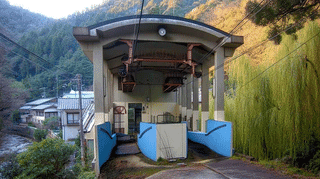
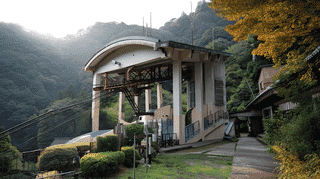
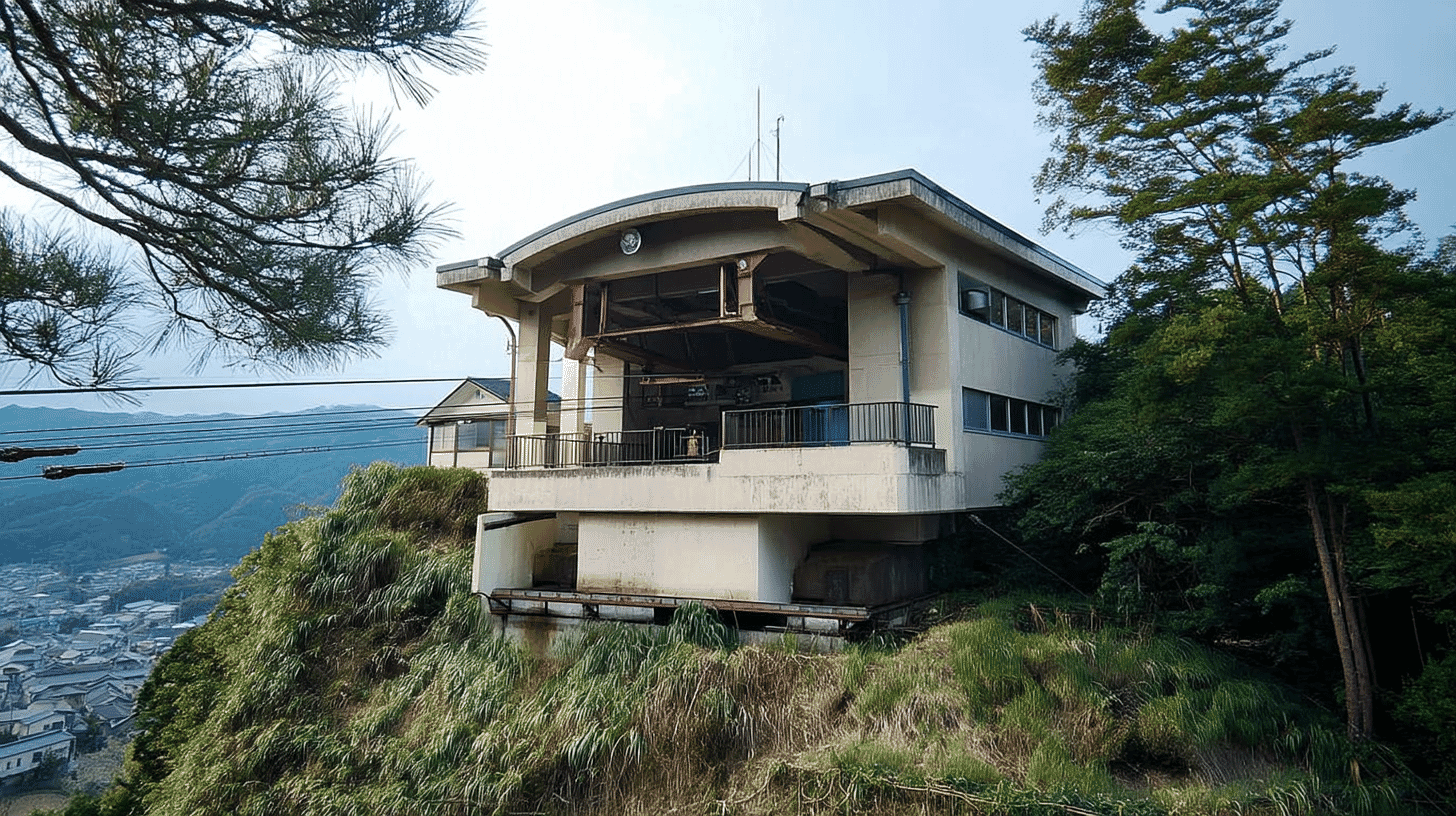
The summit station exemplifies the restrained elegance of Japanese mid-century modern architecture. The two-story reinforced concrete structure, with a building area of 187 square meters, features a flat roof with a gracefully curved profile on its western section. This rooftop functions as an observation deck, ingeniously integrating utility with visitor experience.
The building houses operational facilities including the control room and electrical equipment on the western side, while the boarding platform employs a structural design consistent with the other stations along the route. The architects demonstrated particular sensitivity to the natural environment, designing the exterior to complement rather than dominate the mountaintop landscape.
This thoughtful approach to landscape integration was specifically cited by the Agency for Cultural Affairs when designating the station as a cultural property. The building successfully shapes a favorable mountain summit scenery while maintaining the functional requirements of a working transportation facility.
Michelin-Starred Panoramas: The View from the Summit
The observation deck atop the summit station offers what the Michelin Green Guide Japan recognized as a one-star panoramic view—a vista "worth a detour." From this vantage point, visitors can survey the entire Kinosaki Onsen townscape (itself awarded two Michelin stars), trace the meandering course of the Maruyama River through the valley, and gaze out to the Sea of Japan glittering on the horizon.
The view transforms dramatically with the seasons: spring brings cascading cherry blossoms down the mountainside, summer reveals lush green canopies, autumn paints the slopes in brilliant reds and golds, and winter occasionally dusts the landscape in pristine white. The station's location on Mt. Daishi—where young Shiro Otagaki once played as a child—connects visitors to both natural beauty and personal history.
Summit Attractions and Experiences
Beyond the architectural heritage, the summit area offers several engaging experiences. The Miharashi Terrace Café, housed within the station complex, serves specialty single-origin coffee roasted on-site, along with hot dogs made with local ingredients and original sweets. Guests can savor these treats while drinking in the expansive mountain views through floor-to-ceiling windows or from the outdoor terrace.
Near the station stands Okunoin Daishido, a rare earthen-floored hall enshrining Kobo Daishi, Senju Kannon, and Myoken Bosatsu. This spiritual site connects to the Onsenji Temple complex lower on the mountain—the 1,300-year-old guardian temple of Kinosaki Onsen.
Visitors can also participate in "kawarake-nage," a traditional Japanese custom of throwing unglazed clay discs from the mountaintop. According to local belief, if your disc passes through the circular target set against the backdrop of the Maruyama River, your wish will be granted—a wonderfully tactile way to engage with Japanese folk traditions.
The Ropeway Experience: Japan's Only Mid-Station on a Funitel
The Kinosaki Onsen Ropeway holds a unique distinction in Japanese transportation history: it is the only funitel-type (to-and-fro) ropeway in Japan featuring an intermediate station. This middle stop at Onsenji Temple Station allows visitors to break their journey and explore the historic temple grounds, creating a multi-layered cultural experience rather than a simple point-to-point ride.
The seven-minute aerial journey from the base station to the summit carries passengers over forested slopes, offering ever-expanding views as the gondola climbs. Departures occur every twenty minutes throughout the day, with the first ascent at 9:10 AM and the last descent at 5:10 PM.
Planning Your Visit
The ropeway base station is located at the western end of Kinosaki Onsen town, approximately a twenty-minute walk from JR Kinosaki Onsen Station. The route passes through the charming hot spring town with its willow-lined canals and traditional ryokan inns, making the approach itself a delightful prelude to the mountain experience.
Be aware that approximately 100 steps lead from street level to the ropeway entrance at the base station—an important consideration for visitors with mobility concerns. The facility does not currently offer barrier-free access.
For the best experience, combine the ropeway visit with Kinosaki Onsen's famous "sotoyu meguri" (public bathhouse hopping). Seven public baths, each with distinct characteristics and legendary origins, dot the town—perfect for relaxing tired legs after mountain exploration.
Nearby Attractions
The summit station serves as a gateway to several worthwhile destinations. Onsenji Temple, accessible from the middle station, is the oldest temple in the Tajima region with 1,300 years of history. Its main hall enshrines an eleven-headed Kannon statue said to be carved from the same sacred tree as the famous Kannon at Hasedera in Nara.
At the base station, the Shiro Otagaki Memorial Museum offers free admission to exhibits chronicling the life of the ropeway's visionary founder and includes video presentations about the Kurobe Dam construction.
The surrounding Tajima region offers further exploration: the columnar basalt formations of Genbudo Caves, the pristine beaches along the Sea of Japan, and the famous Matsuba snow crab—a winter delicacy that draws gourmands from across the country.
- 📍 Plan Your Visit to Hyogo
- Find tours, activities & transport passes near Kinosaki Onsen Ropeway Summit Station
- [ Himeji Castle & Kobe Night View Cruise ]
Q&A
- Why was the Kinosaki Onsen Ropeway Summit Station designated as a Registered Tangible Cultural Property?
- The station was designated in October 2017 for its exceptional architectural design that harmonizes with the mountain landscape, its historical significance as a structure built using Kurobe Dam construction techniques, and its role in shaping a favorable summit scenery. The gently curved roofline and thoughtful landscape integration exemplify quality mid-century modern architecture.
- What is the connection between the ropeway and the Kurobe Dam?
- The ropeway was conceived by Shiro Otagaki, the first president of Kansai Electric Power Company who directed the Kurobe Dam construction. He brought the advanced concrete techniques developed for that monumental project to his hometown of Kinosaki, resulting in station buildings that still exceed modern seismic standards over sixty years later.
- What makes the view from the summit station special?
- The panoramic view has earned one star in the Michelin Green Guide Japan. From the rooftop observation deck, visitors can see the entire Kinosaki Onsen townscape (itself a two-star Michelin site), the Maruyama River valley, and the Sea of Japan—all in a single sweeping vista that changes dramatically with the seasons.
- How do I get to the ropeway from Kinosaki Onsen Station?
- The base station is approximately a 20-minute walk from JR Kinosaki Onsen Station, located at the western end of the hot spring town. There is no direct bus service, but the walk through the atmospheric onsen district is enjoyable. Note that about 100 steps lead up to the ropeway entrance.
- What facilities are available at the summit?
- The summit offers Miharashi Terrace Café serving specialty coffee and local food, an observation deck with Michelin-starred views, Okunoin Daishido temple, a "kawarake-nage" throwing area for traditional good luck rituals, and a playground. Visitors can also start hiking trails to nearby Mt. Kurubi from here.
Basic Information
| Name | Kinosaki Onsen Ropeway Summit Station (城崎温泉ロープウェイ山頂駅) |
|---|---|
| Cultural Property Designation | Registered Tangible Cultural Property (Building) - Designated October 27, 2017 |
| Construction | 1962 (Showa 37) |
| Structure | Reinforced concrete, 2 stories, Building area: 187㎡ |
| Elevation | 231 meters above sea level |
| Location | 806-1 Yushima Teranodani, Kinosaki-cho, Toyooka City, Hyogo Prefecture 669-6101 |
| Owner | Kinosaki Kanko Co., Ltd. |
| Operating Hours | First departure 9:10 AM / Last ascent 4:30 PM / Last descent 5:10 PM |
| Regular Holidays | 2nd and 4th Thursdays (open if national holiday) |
| Round-trip Fare (to Summit) | Adults ¥1,200 / Children ¥600 |
| Telephone | 0796-32-2530 |
| Access | Approximately 20 minutes on foot from JR Kinosaki Onsen Station |
References
- 城崎温泉ロープウェイ山頂駅 - 文化遺産オンライン
- https://bunka.nii.ac.jp/heritages/detail/290043
- 城崎温泉ロープウェイ 公式サイト
- https://kinosaki-ropeway.jp/
- ロープウェイ建設ストーリー - 城崎温泉ロープウェイ
- https://kinosaki-ropeway.jp/story/
- 城崎ロープウェイ - Wikipedia
- https://ja.wikipedia.org/wiki/城崎ロープウェイ
- 太田垣士郎資料館 - 城崎温泉観光協会
- https://kinosaki-spa.gr.jp/facility/ootagaki/
- Ropeway - Visit Kinosaki
- https://visitkinosaki.com/things-to-do/ropeway/
- 城崎ロープウェイ - まるごと北近畿
- https://kitakinki.gr.jp/members/372884