
Important Cultural Property of Ibaraki
茨 城 県 の 重 要 文 化 財Ibaraki’s Important Cultural Properties — designated for their value to the nation’s cultural history.
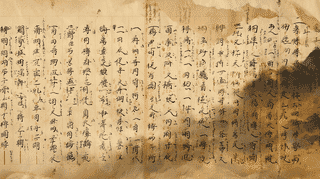
A manuscript owned by the Tokugawa Museum in Mito, Ibaraki Prefecture, which comes down to us here in its own two volumes, the upper and the lower one.

A run-of-river hydro plant of 1911 in Takahagi and Kitaibaraki, Ibaraki. Its 9 structures, built throughout in reinforced concrete, were designated in 2008.
A timber assembly hall of 1904 in Hitachiota, Ibaraki, the only survivor of three built to one set of prefectural drawings. Carved capitals, plasterwork, access.
A timber schoolhouse of 1904 in Tsuchiura, Ibaraki, the first old-system middle school building in Japan made an Important Cultural Property. Spire, arches, access.
A mid-Edo farmhouse in Tsukuba, Ibaraki, designated an Important Cultural Property in 1976. Its 18.5-metre thatched hip roof covers an early four-room grid plan.
Erected in 1465 on Mount Tomiya in Ibaraki, this three-bay pagoda carries a finial inscription naming both its patron and its master carpenter. Designated in 1906.
Built in 1860 in Kasama, Ibaraki, this unpainted zelkova shrine hall carries seven relief panels of the Orchid Pavilion gathering on its inner chamber walls.
Four linked halls at Hitachi's first-ranked shrine in Ibaraki, raised in 1618 and 1619 by the shogun Hidetada and built by his master carpenter Suzuki Nagatsugu.
Built in 1619 to house Kashima's deity while the main hall was rebuilt, this temporary sanctuary was never taken down. Moved three times, it stands today.
Tokugawa Ieyasu paid for this hall in 1605 as Kashima's main sanctuary. Hauled to the rear of the precinct in 1619, it survives unlacquered and plain.
Tokugawa Yorifusa gave this two-storey gate to Kashima in 1634, its timbers cut in Edo and rafted downriver. Repainted in 2026, its vermilion is only months old.
A 1920 shoin wing and an early Meiji storehouse at the Former Sakano Family Residence in Joso City, Ibaraki, became an Important Cultural Property in 2023.
The Former Yanaka Family Residence in Tsukuba, built in 1942 and 1949 by materials researcher Yanaka Ryujiro, became an Important Cultural Property in 2023.
A pagoda finial planted in the ground as a monument in itself: 9.16 metres of hammered copper on a wooden core, raised at Sairenji in 1287 and incised with donors.
Built in 1543 and shorn of its upper storey in the Kansei era, Sairenji Niomon still carries three-stepped brackets designed to hold a balcony that is long gone.
Designated in 1968, the Sakano Family Residence in Joso City keeps a thatched main house, a samurai-style gate and a one-hectare walled compound, open as a museum.
The Main Hall of Satake-ji Temple in Hitachiota, Ibaraki Prefecture, is a National Important Cultural Property rebuilt in 1546. This magnificent thatched-roof structure showcases transitional architectural elements that foreshadow the Momoyama period, including flame-shaped windows and ornate bracket complexes. As the 22nd temple on the historic Bandō 33 Kannon Pilgrimage, it carries over a millennium of spiritual devotion.
Discover the Shiina Family Residence in Kasumigaura, Ibaraki — a nationally designated Important Cultural Property and the oldest precisely dated farmhouse in eastern Japan, built in 1674. Explore its thatched roof, traditional hiroba-style layout, and timeless craftsmanship near the shores of Lake Kasumigaura.
Located in Ushiku, Ibaraki, the former brewery of Château Kamiya was completed in 1903 as Japan's first authentic wine château, founded by entrepreneur Kamiya Denbei. The Storage Cellar and Fermentation Room — brick structures designed around Bordeaux techniques and a gravity-fed vertical workflow — form the production heart of the complex, with twenty-six massive fermentation barrels still in place. Designated an Important Cultural Property in 2008, the buildings now welcome visitors as the Kamiya Denbei Memorial Hall, free of charge.
Discover the Zenkoji Romon Gate, an Important Cultural Property in Ishioka, Ibaraki Prefecture. This thatched-roof gate from the Muromachi period remains uniquely unfinished, offering a rare glimpse into medieval Japanese temple architecture and the turbulent history of the Oda clan.
More from Ibaraki
Ibaraki’s registered properties across designations, with featured heritage and travel notes.
The complete kokuhō catalogue — browse by prefecture, period, and category.
Nationwide jūyō bunkazai — architecture, sculpture, painting, crafts, and documents.